Pupil sheet · Homeostasis
A warm room and a cold porch — questions
Name ______________________ Date ____________
Try every question before you use a nudge. Write in full sentences where you are asked to explain.
1. define
Which statement describes homeostasis?
Circle one answer.
- Changing the internal environment to match the surroundings.
- Keeping the skin at the same temperature as the air.
- Keeping every condition in the body exactly the same at all times.
- The maintenance of a constant internal environment.
Nudge (only if you are stuck): Think of the core temperature in the cold porch: did it stay exactly the same, or close to one value?
2. identify
In the experiment the model person stood in a cold porch for 10 minutes. Which temperature stayed close to 37 °C?
Circle one answer.
- All three.
- The temperature of the air in the porch.
- The core temperature.
- The skin temperature of the forearm.
Nudge (only if you are stuck): One temperature fell by 8.5 °C, the other by a tenth of a degree.
3. calculate
In the porch the skin temperature fell from 34.5 °C to 26.0 °C. By how much did it fall?
Fall in skin temperature: ______________ unit ________
Nudge (only if you are stuck): Subtract the final value from the starting value.
4. identify
Supplement: match each response to cold with how it helps to keep the core warm.
Write the number of the matching option.
- insulates: slows the loss of heat from the body
- less blood flows near the skin surface, so less heat is lost
- respiration in the muscles releases heat
- vasoconstriction: ______
- shivering: ______
- a layer of fatty tissue: ______
Nudge (only if you are stuck): Two of them reduce the heat lost; one releases heat.
5. explain
Supplement: why does sweating cool the skin?
Circle one answer.
- Sweat reflects the heat of the sun.
- Sweat stops blood reaching the skin.
- Sweat is colder than the skin.
- The water in sweat evaporates, taking heat from the skin.
Nudge (only if you are stuck): Watch what happened to the drops of sweat in the magnifier.
6. define
Supplement: what happens in vasoconstriction?
Circle one answer.
- The heart pumps less blood to every organ.
- The arterioles supplying the skin surface capillaries become narrower.
- The capillaries move away from the skin surface.
- The arterioles supplying the skin surface capillaries become wider.
Nudge (only if you are stuck): In the cold porch the magnifier showed one blood vessel change. Did it get wider or narrower?
7. explain
In the porch the skin temperature fell by 8.5 °C but the core temperature fell by only 0.1 °C. Explain how this shows homeostasis.
Nudge (only if you are stuck): Which of the two temperatures is part of the internal environment?
8. interpret
The graphs show a swimmer in a cool lake for 20 minutes. Read the fall in (a) the core temperature and (b) the skin temperature over the 20 minutes.
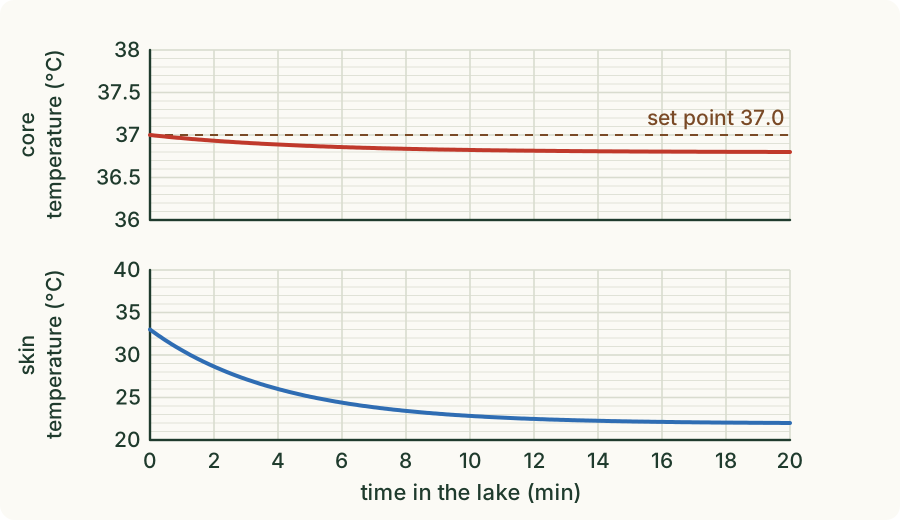
(a) Fall in core temperature: ______________ unit ________
(b) Fall in skin temperature: ______________ unit ________
Nudge (only if you are stuck): Read each graph on its own scale (a thin line is 0.1 °C on the core graph, 1 °C on the skin graph): the start at 0 minutes and the value at 20 minutes.
9. describe
Supplement: describe three ways in which the body keeps its core temperature near 37 °C in a cold porch.
First way
Second way
Third way
Nudge (only if you are stuck): One change in the blood vessels of the skin, one in the muscles, one in the hairs or the fatty tissue.
10. explain
Supplement: explain how vasodilation helps to cool the body in a warm room.
Nudge (only if you are stuck): What gets wider, and what does more blood near the surface do?
11. classify
Supplement: which of these happen when the body is too warm? Choose all that apply.
Tick every correct statement.
- Muscles shiver.
- Sweat glands release sweat.
- Hair erector muscles raise the hairs.
- The arterioles supplying the skin surface capillaries widen.
Nudge (only if you are stuck): Think of the warm room in the experiment: what did the magnifier show?
12. interpret
The table shows a runner in a race on a sunny morning. Use it to explain whether the runner's body showed homeostasis.
| Time in the race (min) | 0 | 20 | 40 | 60 |
|---|---|---|---|---|
| Air temperature (°C) | 24 | 26 | 28 | 30 |
| Skin temperature (°C) | 33.0 | 31.5 | 31.0 | 30.5 |
| Core temperature (°C) | 37.0 | 37.6 | 37.8 | 37.8 |
Nudge (only if you are stuck): Compare how much the core temperature changed with how much the air changed. Where did it settle?
13. explain
Supplement: an arctic fox has thick fur and a thick layer of fatty tissue under its skin. When it is cold, its hair erector muscles raise its fur. Explain why raised fur keeps the fox much warmer than raised hairs keep a human.
Nudge (only if you are stuck): What do raised hairs trap, and how much of it can short hairs trap?
14. explain
Supplement: on a hot, humid day (the air already holds a lot of water vapour) sweat drips off a person's skin instead of drying, and the person feels much hotter than on a hot, dry day. Explain why.
Nudge (only if you are stuck): What must happen to sweat for it to cool the skin?