Pupil sheet · Homeostasis
Skin and negative feedback — questions
Name ______________________ Date ____________
Try every question before you use a nudge. Write in full sentences where you are asked to explain.
1. identify
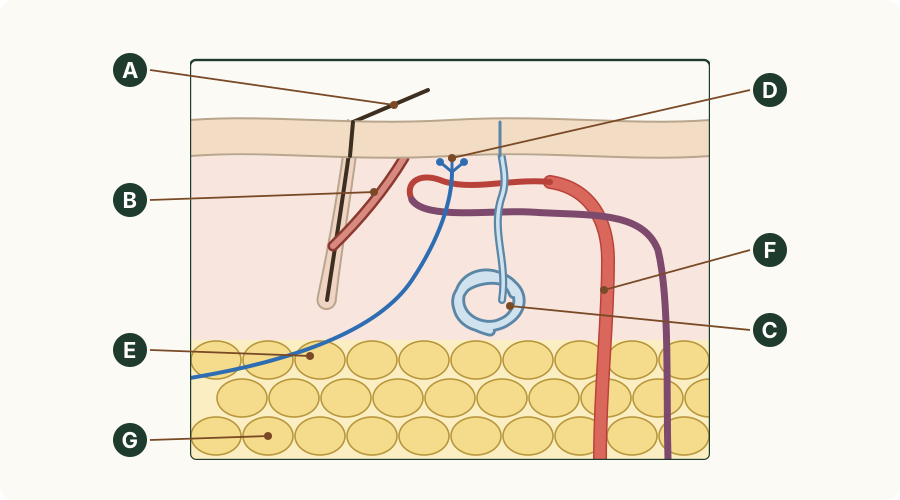
Supplement: the diagram shows a section through the skin. Identify the parts labelled B and C.
B
C
Nudge (only if you are stuck): B is joined to the side of a hair; C is a coiled tube with a duct up to the surface.
2. identify
Supplement: match each part of the skin with what it does.
Write the number of the matching option.
- insulates: slows the loss of heat
- releases sweat onto the surface
- carries impulses towards the brain
- detects a change in temperature
- receptor: ______
- sensory neurone: ______
- fatty tissue: ______
- sweat gland: ______
Nudge (only if you are stuck): Which part detects, which carries impulses, which insulates?
3. sequence
Supplement: put the steps of negative feedback in order, for a person whose core temperature has fallen.
Write the number of each step in order.
- The core temperature rises back towards the set point.
- The brain sends impulses to the effectors.
- Muscles shiver and the arterioles supplying the skin surface narrow.
- The core temperature falls below the set point.
- Receptors detect the fall.
- Step 1: ______
- Step 2: ______
- Step 3: ______
- Step 4: ______
- Step 5: ______
Nudge (only if you are stuck): Start with the change, and end with the change reversed.
4. explain
Supplement: why is this control called negative feedback?
Circle one answer.
- The response makes the change bigger.
- The change is always a fall, never a rise.
- The body does something harmful.
- The response reverses the change.
Nudge (only if you are stuck): What does the response do to the change that started it?
5. state
Supplement: where are the receptors that detect a change in body temperature?
Circle one answer.
- In the fatty tissue.
- Only in the muscles.
- In the skin and in the brain.
- Only in the sweat glands.
Nudge (only if you are stuck): The reading names two places.
6. identify
Supplement: name the parts labelled D, E, F and G in the diagram of the skin.
D
E
F
G
Nudge (only if you are stuck): D is just under the surface and E leads away from it; F carries blood; G is made of rounded cells.
7. identify
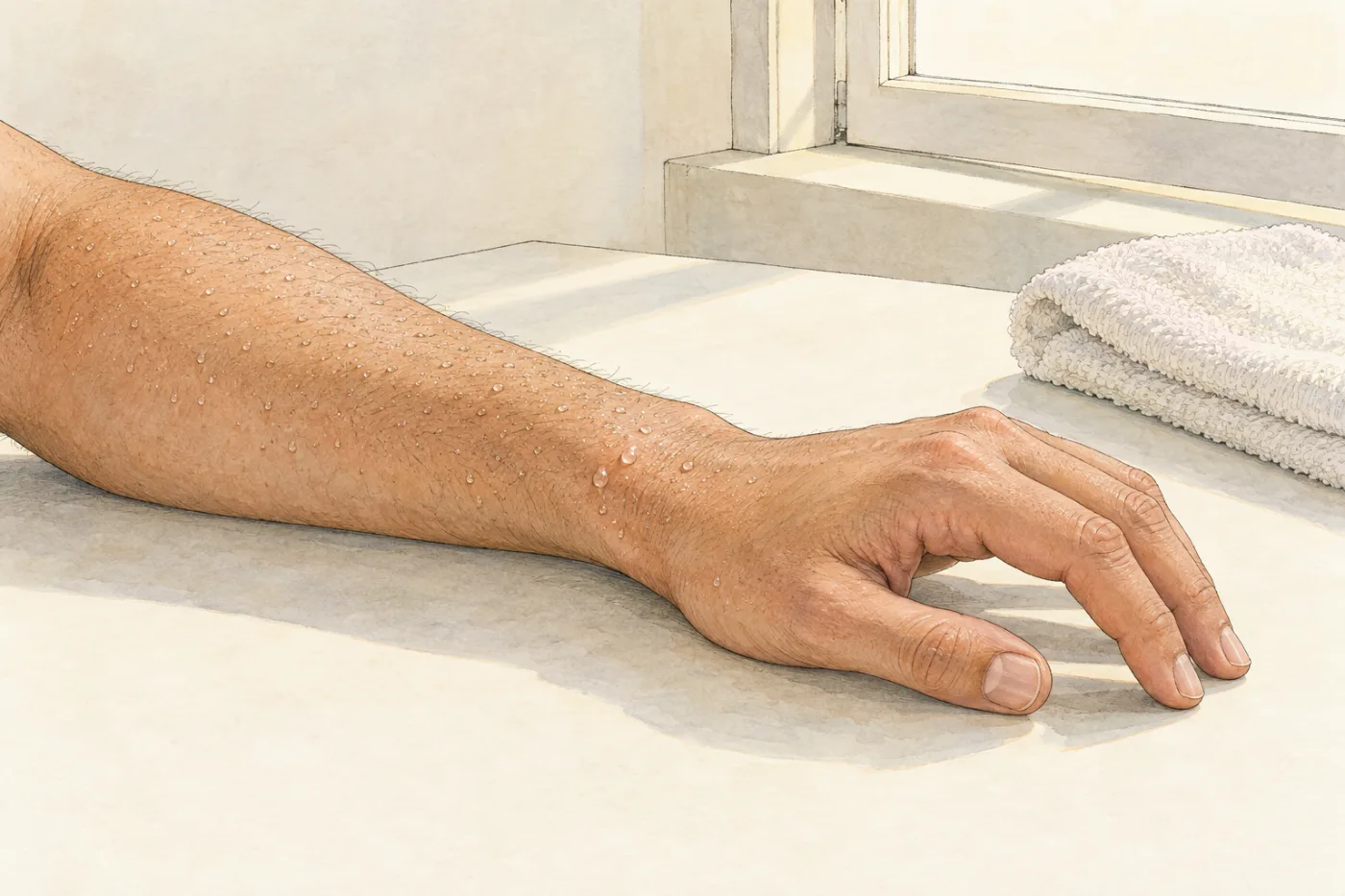
Supplement: the picture shows a forearm on a warm day. Identify the part of the skin that made the drops on the surface, and say where in the skin it is.
Part of the skin
Where it is
Nudge (only if you are stuck): The drops are sweat. Is the part that makes them on the surface?
8. describe
Supplement: describe how negative feedback returns the core temperature to its set point after it rises in a warm room.
Nudge (only if you are stuck): Change, receptors, brain, effectors, result.
9. interpret
Supplement: the table shows the model person's core temperature after 10 minutes with one response switched off. (a) By how much was the core temperature above the set point of 37.0 °C with sweating off? (b) By how much was it below the set point with shivering off?
| Room | Responses | Core temperature after 10 minutes (°C) |
|---|---|---|
| warm room (30 °C) | all on | 37.0 |
| warm room (30 °C) | sweating off | 37.4 |
| cold porch (5 °C) | all on | 36.9 |
| cold porch (5 °C) | shivering off | 36.6 |
(a) Above the set point with sweating off: ______________ unit ________
(b) Below the set point with shivering off: ______________ unit ________
Nudge (only if you are stuck): Find each row and compare with 37.0 °C.
10. explain
Supplement: in the model, switching sweating off in the cold porch left the core temperature at 36.9 °C, the same as with every response on. Explain why.
Nudge (only if you are stuck): Does the body sweat when it is cold?
11. apply
Supplement: a fish tank has a heater with a thermostat set at 25 °C. A sensor in the water measures the temperature; below 25 °C the heater switches on, and above 25 °C it switches off. Identify (a) the set point, (b) the part that acts like a receptor and (c) the part that acts like an effector, and explain why this is negative feedback.
(a) Set point
(b) Like a receptor
(c) Like an effector
Why it is negative feedback
Nudge (only if you are stuck): Which part detects, which part responds, and what does the response do to the change?
12. identify
Supplement: a person is waiting at a cold bus stop. The hairs on their arm are standing up and the skin is covered in small bumps (goose bumps). Identify the part of the skin that raised the hairs, and the part that detected the cold.
Raised the hairs
Detected the cold
Nudge (only if you are stuck): One part is a small muscle; the other is a nerve ending.
13. choose
Supplement: a student wants to use the model to show that shivering helps to control body temperature. Which run is the fair test?
Circle one answer.
- Shivering and sweating both off in the cold porch.
- Shivering off in the warm room, compared with all on in the warm room.
- Shivering off in the warm room, compared with all on in the porch.
- Shivering off in the cold porch, compared with all responses on in the porch.
Nudge (only if you are stuck): Shivering releases heat. Where does the body need extra heat?