Pupil sheet · Homeostasis
Homeostasis — final check
Name ______________________ Date ____________
Work alone, with the lesson closed. Answer every question; there are no hints.
1. describe
A person walks from a warm room into a cold porch. After 10 minutes the skin temperature has fallen by 8.5 °C and the core temperature by 0.1 °C. Describe homeostasis, and use these results to explain what it means.
2. compare
Supplement: compare what the arterioles supplying the skin surface capillaries do in a cold porch and in a warm room, and the effect on heat loss.
In the cold porch
In the warm room
3. identify
Supplement: in the diagram of the skin, name the parts labelled Q, T, U and V.
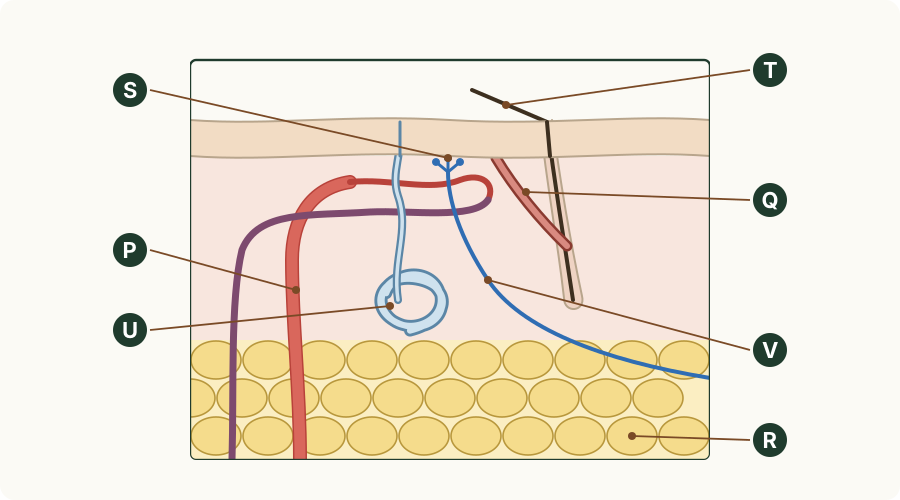
Q
T
U
V
4. explain
Supplement: explain how negative feedback keeps the core temperature close to 37 °C when a person walks into a cold porch. Include the role of the brain.
5. describe
After a meal the blood glucose concentration rises, then returns to normal. (a) Identify the hormone that brings it back down, and the organ that secretes it. (b) Supplement: describe what the liver does to return the concentration to normal.
(a) Hormone and organ
(b) What the liver does
6. explain
Supplement: (a) Explain how the blood glucose concentration is raised when it falls during exercise. (b) Outline how Type 1 diabetes is treated.
(a) Raising blood glucose
(b) Treating Type 1 diabetes