Pupil sheet · Excretion and the kidneys
Inside a nephron — questions
Name ______________________ Date ____________
Try every question before you use a nudge. Write in full sentences where you are asked to explain.
1. identify
Supplement. The diagram shows one nephron and its blood vessels. Match each letter to the name of the part.
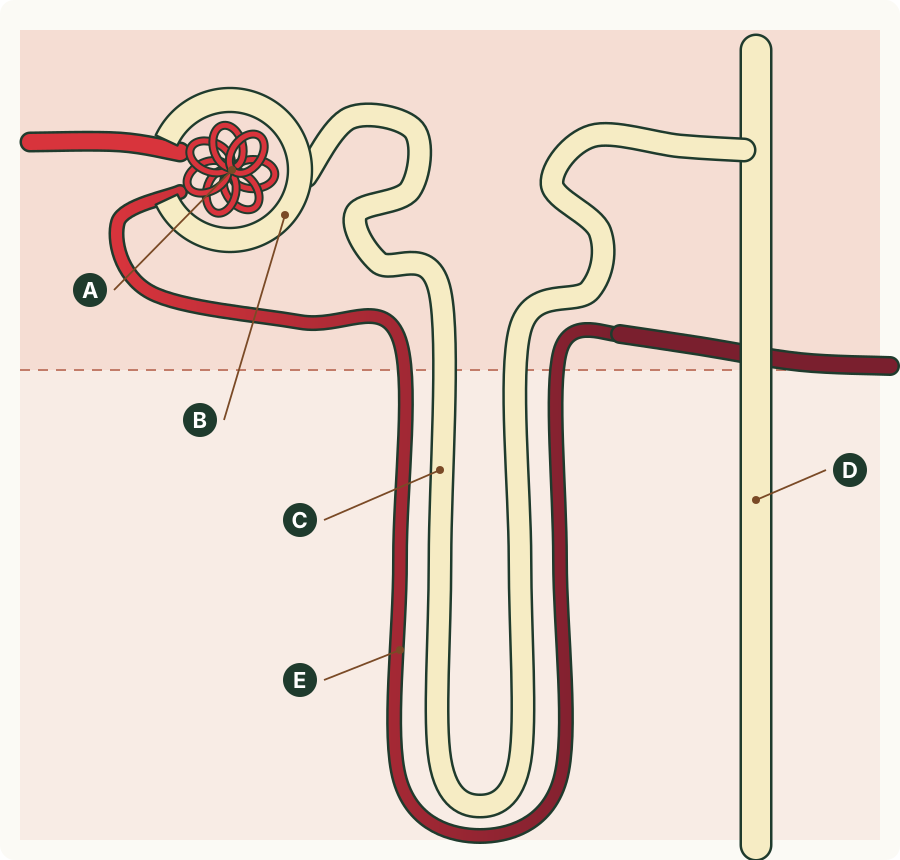
Write the number of the matching option.
- capsule
- collecting duct
- capillary
- glomerulus
- tubule
- A: ______
- B: ______
- C: ______
- D: ______
- E: ______
Nudge (only if you are stuck): Start with the knot of capillaries and the cup round it.
2. identify
Supplement. Which substances are filtered out of the blood in the glomerulus, into the capsule? Choose all that apply.
Tick every correct statement.
- Red blood cells.
- Ions.
- Water.
- Protein.
- Urea.
- Glucose.
Nudge (only if you are stuck): Which molecules are small enough to pass through the filter?
3. predict
Supplement. After heavy bleeding, a person's blood pressure falls, so the blood in their glomeruli is at a much lower pressure than usual. The gaps in the filter do not change. Which prediction about the filtrate is correct?
Circle one answer.
- Filtrate with no glucose is made, because glucose needs more push.
- More filtrate is made, because the blood flows through more slowly.
- Less filtrate is made, because less liquid is pushed through.
- The same filtrate is made, because the gaps are the same size.
Nudge (only if you are stuck): What makes liquid move out of the glomerulus through the filter at all?
4. identify
Supplement. Which statements about reabsorption along the tubule are normally correct? Choose all that apply.
Tick every correct statement.
- None of the water is reabsorbed.
- All of the glucose is reabsorbed.
- All of the urea is reabsorbed.
- Most of the water is reabsorbed.
- Some of the ions are reabsorbed.
Nudge (only if you are stuck): What does the body need to keep?
5. state
Supplement. Where do the substances reabsorbed from the tubule go?
Circle one answer.
- Into the urine that flows down the collecting duct.
- Into the blood in the capillaries round the tubule.
- Into the bladder, where they are stored for later.
- Back into the capsule, to be filtered once again.
Nudge (only if you are stuck): Which vessels wrap round the tubule?
6. describe
Supplement. A urea molecule is filtered out of the blood. Put the places it passes through in order, until it reaches the ureter.
Write the number of each step in order.
- It flows along the tubule.
- It flows down the collecting duct.
- It drains into the ureter.
- It passes into the capsule.
- It is in the blood in the glomerulus.
- First: ______
- Second: ______
- Third: ______
- Fourth: ______
- Last: ______
Nudge (only if you are stuck): Where does the filtrate collect first?
7. calculate
Supplement. A patient's urine contains 26 g of urea per dm³. The urea in this urine is 65 times as concentrated as the urea in the patient's blood plasma. Calculate the concentration of urea in the plasma. Give your answer to 2 significant figures.
Concentration of urea in the plasma: ______________ unit ________
Nudge (only if you are stuck): Is the plasma more or less concentrated than the urine? So do you multiply or divide?
8. calculate
Supplement. A person's kidneys make 160 dm³ of filtrate in a day, and their tubules reabsorb 99.2% of the water in it. Treat the filtrate and the urine as water. Calculate the volume of urine they make in the day. Give your answer to 1 decimal place.
Volume of urine: ______________ unit ________
Nudge (only if you are stuck): What percentage of the water is not reabsorbed?
9. identify / calculate
Supplement. The table shows the mass of three substances filtered into the capsules of one person's kidneys in a day, and the mass of each in that day's urine. (a) Identify the substance that is only partly reabsorbed, and give the evidence from the table. (b) Calculate the mass of that substance reabsorbed in the day.
| Substance | Mass filtered in a day (g) | Mass in the urine in a day (g) |
|---|---|---|
| protein | 0 | 0 |
| glucose | 150 | 0 |
| ions | 1150 | 14 |
(a) Substance and evidence
(b) Mass reabsorbed
Nudge (only if you are stuck): For each row, compare the two columns: none left, some left, or nothing filtered?
10. predict / explain
Supplement. A doctor puts two harmless dyes into a person's blood. The blue dye has molecules smaller than glucose molecules. The red dye has molecules larger than protein molecules. The tubules do not reabsorb either dye. Predict which dye appears in the urine, and explain.
Nudge (only if you are stuck): What decides whether a molecule can pass the filter in the glomerulus?
11. predict / explain
Supplement. In a healthy person, the tubules reabsorb all of the glucose that is filtered. The most glucose they can reabsorb is about twice the amount filtered at a normal blood glucose concentration. A person with untreated diabetes has a blood glucose concentration three times the normal value. Predict whether glucose is found in their urine, and explain.
Nudge (only if you are stuck): If the blood has three times as much glucose, how much glucose is filtered?
12. suggest
Supplement. In some kidney diseases, protein appears in the urine. Suggest what has gone wrong in the nephrons.
Nudge (only if you are stuck): How does protein normally stay out of the filtrate?
13. identify / explain
Supplement. Three liquids, X, Y and Z, were taken from one person: one is plasma, one is filtrate and one is urine. Identify each liquid, and explain each choice using the table.
| Liquid | Protein (g per dm³) | Glucose (g per dm³) | Urea (g per dm³) |
|---|---|---|---|
| X | 0 | 0 | 16 |
| Y | 75 | 0.9 | 0.25 |
| Z | 0 | 0.9 | 0.25 |
X
Y
Z
Nudge (only if you are stuck): Which has protein? Which has no glucose?