Pupil sheet · Excretion and the kidneys
Excretion and the kidneys — return questions
Name ______________________ Date ____________
Use one to two weeks after the lessons. Keep the notes and the lesson closed.
1. identify
Match each substance to what normally happens to it.
Write the number of the matching option.
- excreted by the kidneys in urine
- excreted through the lungs
- egested in faeces, not excreted
- kept by the body: none in urine
- carbon dioxide: ______
- urea: ______
- glucose: ______
- undigested fibre from food: ______
2. identify
The diagram shows the urinary system. A stone blocks the tube labelled K. Which row is correct?
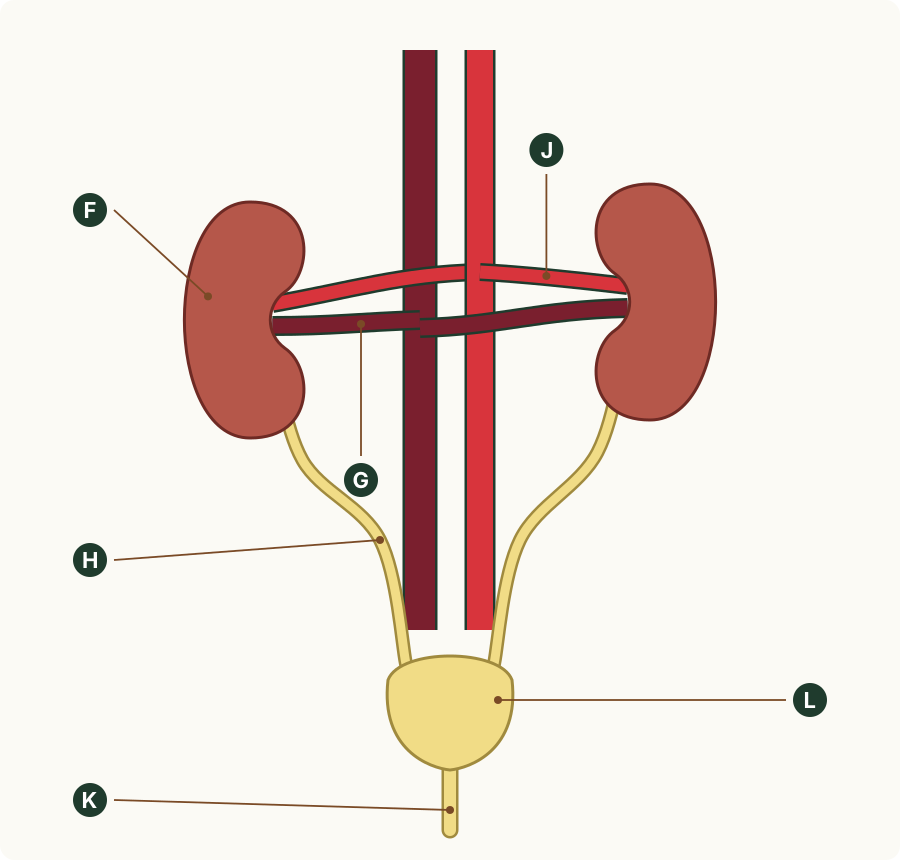
| Row | Can urine from F still reach L? | Where does urine build up? | Can urine leave the body? |
|---|---|---|---|
| A | yes | in L | no |
| B | no | in H | no |
| C | yes | in L | yes |
| D | no | in F | no |
Circle one answer.
- A
- B
- C
- D
3. predict / explain
A swimmer holds her breath under water for 40 seconds. Predict what happens to the concentration of carbon dioxide in her blood during these 40 seconds, and explain.
4. identify
Supplement. The picture shows a kidney cut in half lengthways. The fine lines in its pink, fan-shaped areas are thousands of tiny tubes lying side by side, and urine flows along them. Look at the way the fans point. Where do these tubes carry the urine?
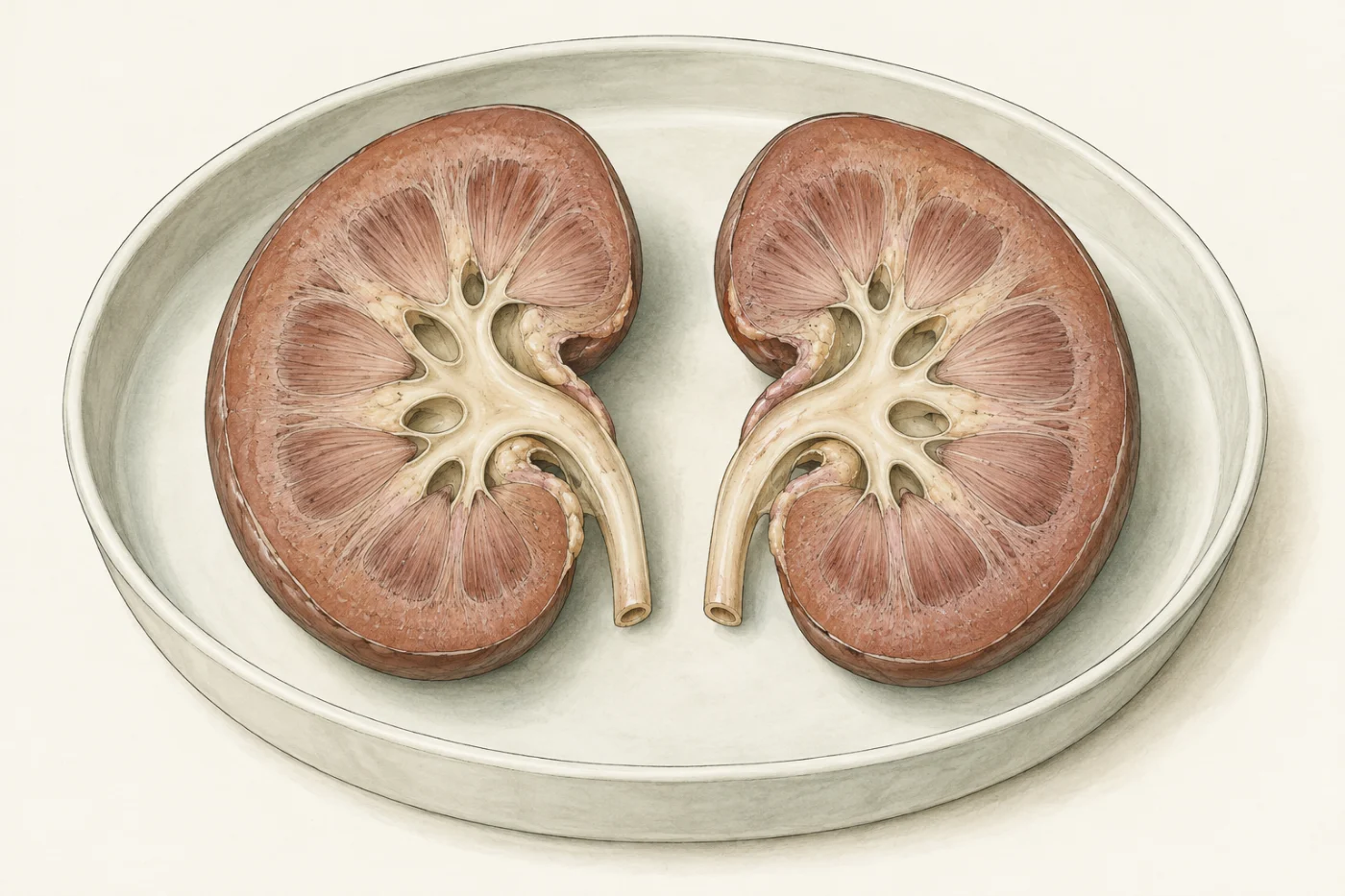
Circle one answer.
- Into the cream space in the middle, which leads into the ureter.
- Into the blood of the renal vein, which carries it away.
- Out to the curved outer surface, where the urine leaves.
- Out into the reddish-brown band, which leads into the ureter.
5. state
Supplement. (a) State the part of a nephron where the blood is filtered. (b) State two useful substances that pass from the blood into the capsule.
(a) Where
(b) Two useful substances
6. predict
Supplement. A healthy pupil drinks 1.4 dm³ of water in half an hour, with no food. Over the next two hours her kidneys filter about the same volume as usual. Which row is correct for those two hours, compared with a usual two hours?
| Row | Filtered water that is reabsorbed | Filtered glucose that is reabsorbed | Volume of urine |
|---|---|---|---|
| A | a smaller percentage | all of it | rises |
| B | a larger percentage | all of it | falls |
| C | a smaller percentage | less of it | rises |
| D | the same percentage | all of it | stays the same |
Circle one answer.
- A
- B
- C
- D
7. calculate
Supplement. In a model, 120 cm³ of filtrate passes along a person's tubules each minute, and 1.6 cm³ of urine is made. The filtrate contains 0.24 g of urea per dm³. Assume none of the urea is reabsorbed. Calculate the concentration of urea in the urine.
Concentration of urea in the urine: ______________ unit ________
8. predict / explain
Supplement. A healthy woman gives blood at a blood bank. For the next week her liver makes plasma proteins faster than usual, to replace the ones in the blood she gave. She eats the same food as in a normal week. Predict whether she excretes more, less or the same mass of urea in this week, and explain your prediction using assimilation.
9. describe
Supplement. Put these steps in order, to follow one urea molecule from where it is made until it enters a kidney.
Write the number of each step in order.
- It enters a kidney in the renal artery.
- It leaves the heart in the aorta.
- It leaves the liver in the hepatic vein.
- It is made in a liver cell from an excess amino acid.
- It passes through the heart and the lungs.
- First: ______
- Second: ______
- Third: ______
- Fourth: ______
- Last: ______
10. identify
Supplement. Before birth, a baby already makes some urea. In the placenta, the baby's blood flows very close to its mother's blood, and the urea passes across into her blood. Which row is correct?
| Row | Organ that made the urea | Organs that excrete it from the mother's body | Why it must be excreted |
|---|---|---|---|
| A | the baby's liver | the mother's kidneys | it is toxic |
| B | the baby's kidneys | the mother's kidneys | it is toxic |
| C | the baby's liver | the mother's lungs | it is toxic |
| D | the baby's liver | the mother's kidneys | her cells need it |
Circle one answer.
- A
- B
- C
- D