Pupil sheet · Excretion and the kidneys
Excretion and the kidneys — final check
Name ______________________ Date ____________
Work alone, with the lesson closed. Answer every question; there are no hints.
1. identify
The picture shows the urinary system from the front. A nurse passes a thin, soft tube into the body from the outside to drain the urine that is being stored. Which row is correct?
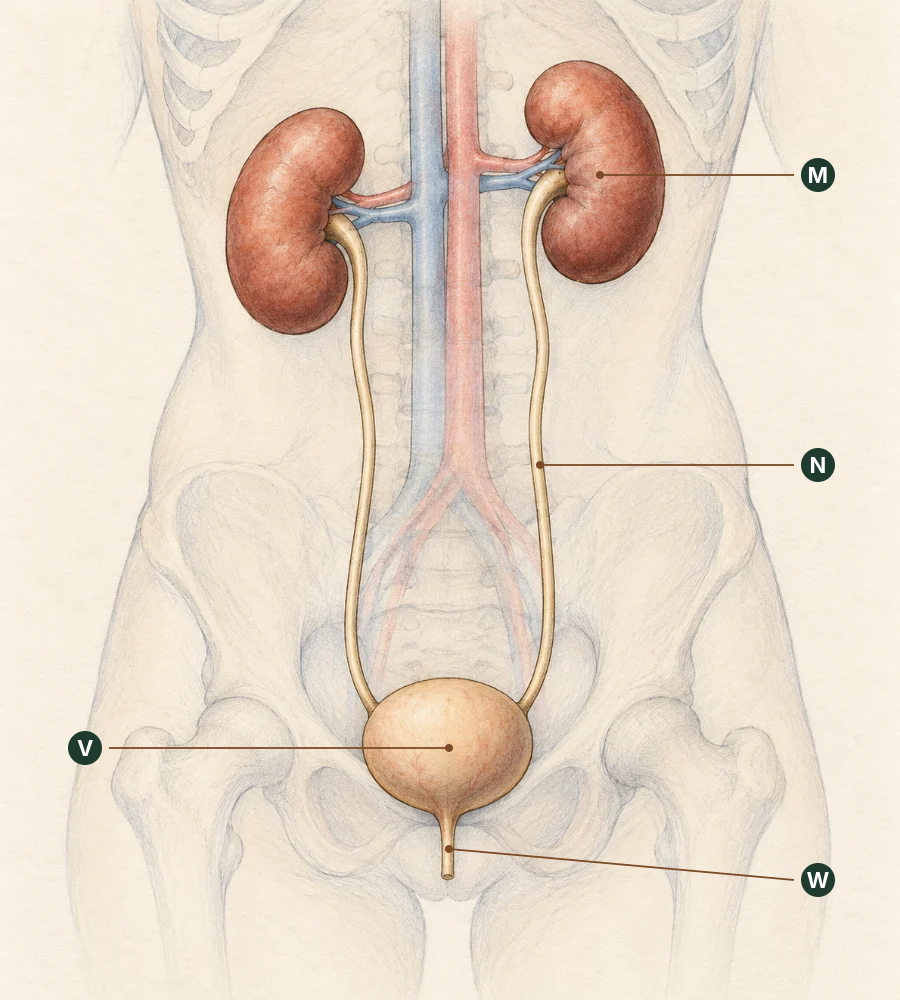
| Row | Tube that the nurse's tube passes along | Organ that stores the urine | Tube for urine that a person has two of |
|---|---|---|---|
| A | W | V | N |
| B | N | V | W |
| C | W | M | N |
| D | N | M | W |
Circle one answer.
- A
- B
- C
- D
2. identify
On Monday a pupil sits at a desk all day. On Tuesday the pupil eats the same meals with much more salt added, drinks the same volume of water, and spends two hours cycling. The day is cool, so the pupil hardly sweats. Which row shows how Tuesday compares with Monday?
| Row | Mass of ions in the urine | Volume of carbon dioxide breathed out | Organ that excretes the extra ions |
|---|---|---|---|
| A | more | more | kidneys |
| B | more | the same | kidneys |
| C | the same | more | kidneys |
| D | more | more | lungs |
Circle one answer.
- A
- B
- C
- D
3. identify
Supplement. The picture shows two teaching models on stands. Look at the kidney model on the left, which is cut lengthways. Its maker painted a row of small dark dots on the cut face, and some fan shapes. Which row is correct?
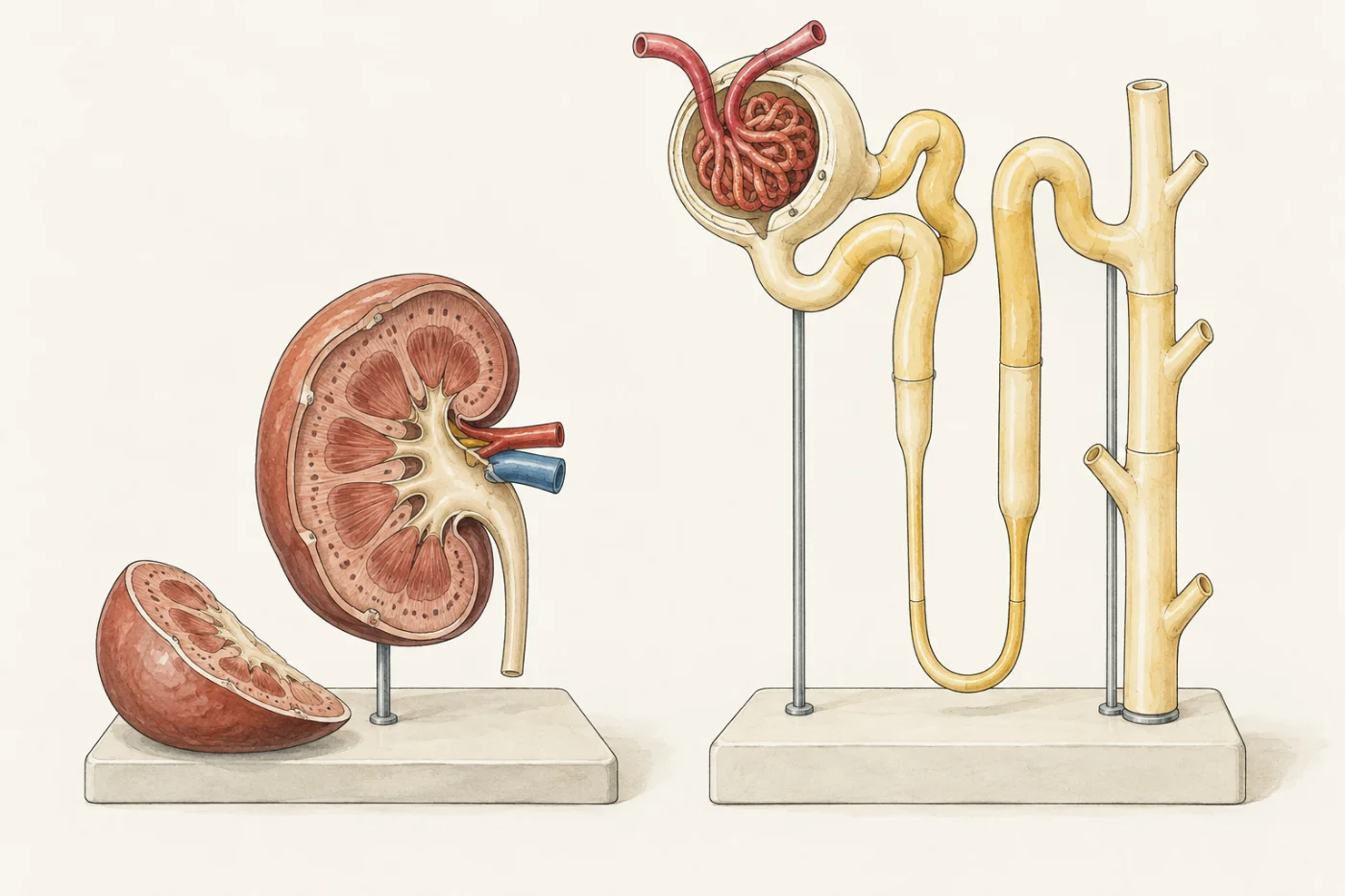
| Row | Region with the row of dark dots | Region with the fan shapes | Cream tube leaving the bottom of the kidney |
|---|---|---|---|
| A | cortex | medulla | ureter |
| B | medulla | cortex | ureter |
| C | cortex | medulla | urethra |
| D | medulla | space where urine collects | ureter |
Circle one answer.
- A
- B
- C
- D
4. identify
Supplement. Blood flows into a glomerulus in one small vessel and out of it in another. Compare the blood flowing out with the blood flowing in, over one minute. Which row is correct?
| Row | Volume of plasma | Mass of protein | Mass of glucose |
|---|---|---|---|
| A | less | the same | less |
| B | less | less | less |
| C | the same | the same | less |
| D | less | the same | the same |
Circle one answer.
- A
- B
- C
- D
5. identify
Supplement. A computer model of a nephron is run with four settings. Each time, 300 water particles, 30 glucose particles and 60 ion particles are filtered into the capsule. The table shows how many of each are left in the urine at the end of the tubule. Which setting reabsorbs as a healthy nephron does?
| Row | Water particles left in the urine | Glucose particles left in the urine | Ion particles left in the urine |
|---|---|---|---|
| A | 3 | 0 | 30 |
| B | 3 | 0 | 0 |
| C | 3 | 12 | 30 |
| D | 150 | 0 | 30 |
Circle one answer.
- A
- B
- C
- D
6. explain
Supplement. The table shows the concentrations of ions and of urea in one person's filtrate and urine. From filtrate to urine, the urea becomes about 60 times as concentrated, but the ions less than 2 times. Explain why the two change by such different amounts.
| Substance | Filtrate (g per dm³) | Urine (g per dm³) |
|---|---|---|
| ions | 7.2 | 13 |
| urea | 0.28 | 17 |
7. explain
Supplement. A growing 12-year-old and an adult eat the same mass of protein each day. The child excretes less urea. Explain why, using assimilation.
8. identify
Supplement. A man's liver is badly damaged, and its cells can no longer deaminate amino acids. He eats the same meals as before, and his kidneys still work normally. Which row shows how his blood and urine compare with before the damage?
| Row | Amino acids in the blood | Urea in the blood | Urea in the urine |
|---|---|---|---|
| A | higher | lower | less |
| B | higher | higher | less |
| C | higher | the same | the same |
| D | the same | lower | less |
Circle one answer.
- A
- B
- C
- D
9. describe / explain
Supplement. Stones block both of a man's ureters, and he is not yet treated. The table shows the concentration of urea in his blood over five days. (a) Describe the change. (b) Explain why the concentration changes in this way. (c) Explain why this is dangerous.
| Day | Urea in the blood (g per dm³) |
|---|---|
| 1 | 0.26 |
| 2 | 0.48 |
| 3 | 0.70 |
| 4 | 0.91 |
| 5 | 1.13 |
(a) Change
(b) Why
(c) Danger