Pupil sheet · Excretion and the kidneys
Getting rid of waste — questions
Name ______________________ Date ____________
Try every question before you use a nudge. Write in full sentences where you are asked to explain.
1. identify
The diagram shows the urinary system from the front. Match each letter to the name of the part.
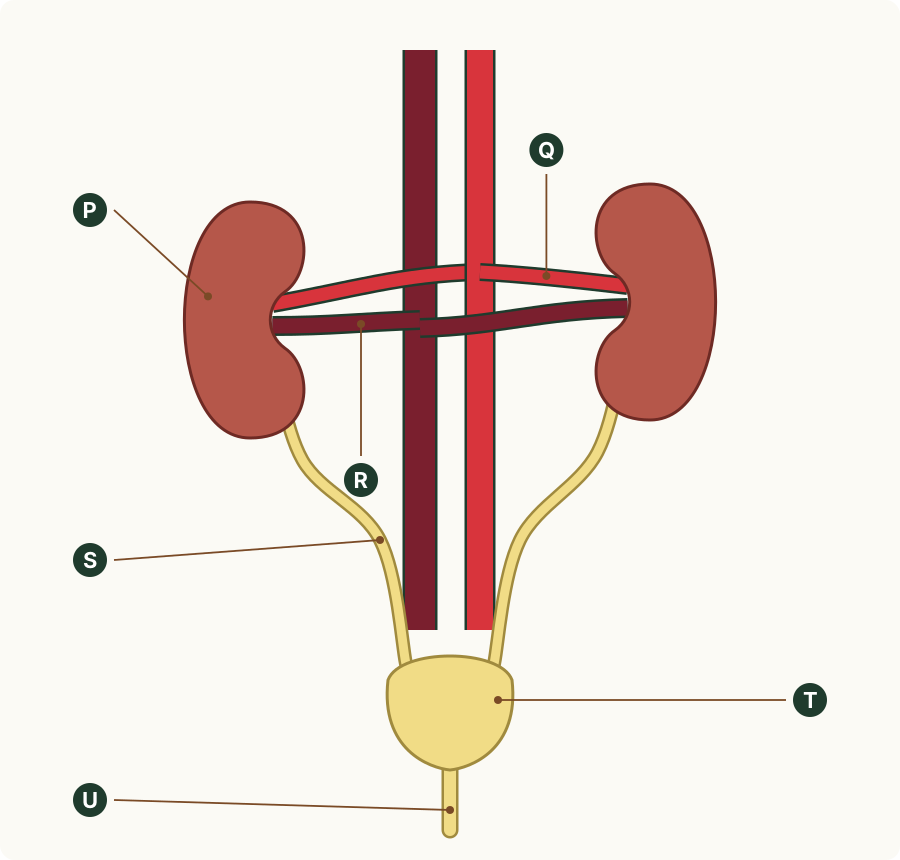
Write the number of the matching option.
- bladder
- urethra
- kidney
- renal artery
- ureter
- renal vein
- P: ______
- Q: ______
- R: ______
- S: ______
- T: ______
- U: ______
Nudge (only if you are stuck): Follow the urine: where is it made, where is it stored, and how does it leave?
2. state
Which organ excretes carbon dioxide?
Circle one answer.
- The kidneys.
- The liver.
- The bladder.
- The lungs.
Nudge (only if you are stuck): Where does carbon dioxide leave the body?
3. identify
Which substances do the kidneys excrete in urine? Choose all that apply.
Tick every correct statement.
- Glucose.
- Carbon dioxide.
- Urea.
- Protein.
- Excess water.
- Excess ions.
Nudge (only if you are stuck): Urine is a solution: what is dissolved in it, and what is it dissolved in?
4. identify
Excretion is the removal of the waste products of metabolism and of substances in excess. Which of these is NOT excretion?
Circle one answer.
- Breathing out carbon dioxide made by muscle cells.
- Burping out air that was swallowed with a meal.
- Passing urine that carries urea made by the body.
- Passing urine after drinking more water than needed.
Nudge (only if you are stuck): For each one, ask: was this made by the body's cells, or is it more than the body needs?
5. describe
Some people pass pink urine after eating a lot of beetroot. The red colour is absorbed from the gut into the blood, and the kidneys remove it from the blood into the urine. Put the places the red colour passes through in order, from the blood vessel that brings it to a kidney until it leaves the body.
Write the number of each step in order.
- It flows down a ureter.
- It leaves the body through the urethra.
- It is stored in the bladder.
- It arrives in the renal artery.
- It is removed into the urine in a kidney.
- First: ______
- Second: ______
- Third: ______
- Fourth: ______
- Last: ______
Nudge (only if you are stuck): Which vessel brings blood to a kidney? After that, follow the urine.
6. identify
Supplement. The diagram shows a kidney cut in half from top to bottom. Match each letter to its name.
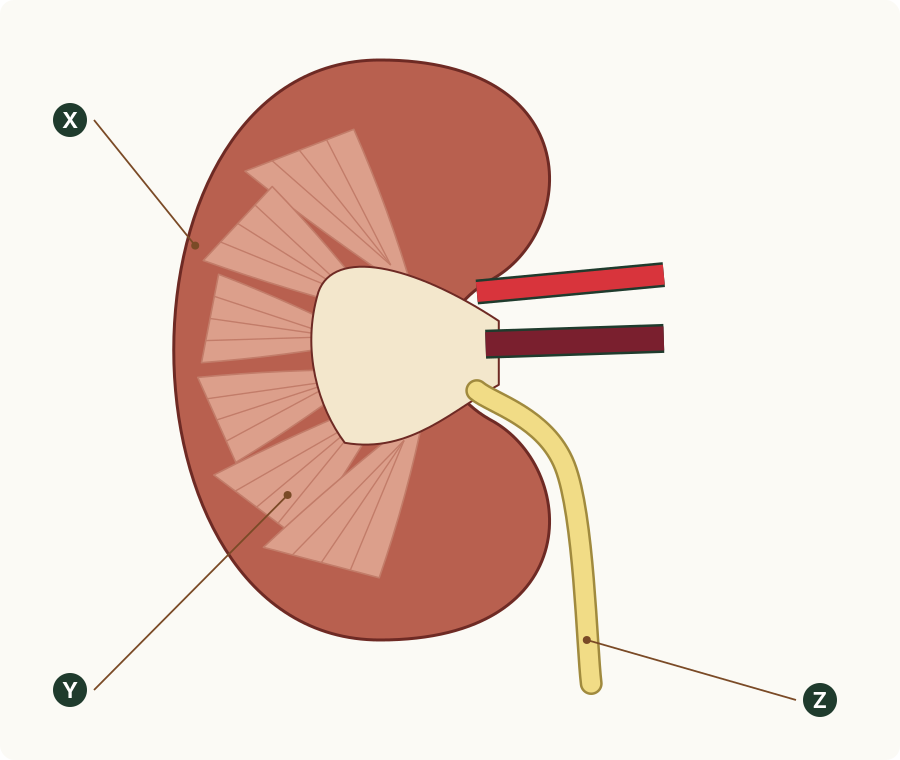
Write the number of the matching option.
- medulla
- ureter
- cortex
- X: ______
- Y: ______
- Z: ______
Nudge (only if you are stuck): Which region is just under the surface?
7. identify
A surgeon gives a patient a new kidney. It is placed low in the front of the abdomen, just above the bladder, and the patient's own kidneys are left where they are. Which join must the surgeon make so that urine from the new kidney can be stored and then leave the body?
Circle one answer.
- The new kidney's ureter is joined to the bladder.
- The new kidney's urethra is joined to the bladder.
- The new kidney's ureter is joined to the urethra.
- The new kidney's renal vein is joined to the bladder.
Nudge (only if you are stuck): Follow the urine from a normal kidney: which tube does it enter, and where does that tube end?
8. calculate
A resting person breathes out 6.0 dm³ of air each minute. 3.5% of this air is carbon dioxide made in respiration. Calculate the volume of carbon dioxide, in cm³, that their lungs excrete in one minute. (1 dm³ = 1000 cm³)
Volume of carbon dioxide: ______________ unit ________
Nudge (only if you are stuck): A percentage is a number out of 100. Work in dm³ first, then change the unit.
9. describe
Supplement. A thin needle is pushed straight into a kidney, from the middle of its curved outer surface towards the ureter. Put the parts it passes through in order, until it enters the ureter.
Write the number of each step in order.
- The space where urine collects.
- The ureter.
- The cortex.
- The medulla.
- First: ______
- Second: ______
- Third: ______
- Last: ______
Nudge (only if you are stuck): Start at the surface and work inwards. Which region has the stripes?
10. explain
A pupil says: "The kidneys only excrete substances that the body's cells have made, so extra water from a drink is not excreted." Explain why the pupil is wrong.
Nudge (only if you are stuck): Excretion removes two kinds of substance. What is the second kind?
11. predict / explain
A person eats food with very little salt for a week, but drinks the same volume of water as usual. Predict how the mass of ions in their urine changes, and explain.
Nudge (only if you are stuck): Do the kidneys excrete all the ions in the blood, or only some?
12. predict / explain
A doctor compares the blood flowing into the lungs with the blood flowing out of them. Predict which has more carbon dioxide in it, and explain.
Nudge (only if you are stuck): What happens to carbon dioxide in the lungs?
13. predict / explain
Something blocks a person's left ureter. Explain what happens to the urine made by the left kidney, and whether the person can still pass urine.
Nudge (only if you are stuck): Which tubes join the kidneys to the bladder?
14. predict
Supplement. Two pupils each cut a pig's kidney from a butcher. Pupil 1 cuts it lengthways, from top to bottom, through the inner dent where the ureter leaves. Pupil 2 cuts straight across it, a quarter of the way down from the top end, above the inner dent. Which row is correct?
| Row | Cortex seen by | Medulla seen by | Ureter seen by |
|---|---|---|---|
| A | both pupils | both pupils | pupil 1 only |
| B | pupil 1 only | both pupils | pupil 1 only |
| C | both pupils | pupil 1 only | both pupils |
| D | both pupils | both pupils | both pupils |
Circle one answer.
- A
- B
- C
- D
Nudge (only if you are stuck): Picture the whole kidney, not just one cut face. Where is the outer layer, and where does the ureter leave?