Pupil sheet · Antibiotics
Viruses and resistant bacteria — questions
Name ______________________ Date ____________
Try every question before you use a nudge. Write in full sentences where you are asked to explain.
1. identify
Which of these illnesses could be treated with an antibiotic?
Circle one answer.
- Mumps, a swelling of the glands caused by a virus
- Cold sores on the lip, caused by a virus
- Tuberculosis, a lung infection caused by a bacterium
- Chickenpox, an itchy rash caused by a virus
Nudge (only if you are stuck): Antibiotics act on one kind of cause only. Which illness here has that cause?
2. explain
Which statement explains why antibiotics do not affect viruses?
Circle one answer.
- A virus is far too small for the molecules of an antibiotic to reach it.
- An antibiotic is broken down in the blood before it reaches any virus.
- A virus quickly becomes resistant to every antibiotic it meets in the body.
- A virus has none of the cell parts, such as a cell wall, that antibiotics act on.
Nudge (only if you are stuck): Think about what an antibiotic acts on in a bacterium. Does a virus have it?
3. state
Which statement says what it means for bacteria to be resistant to an antibiotic?
Circle one answer.
- The bacteria can now be killed only by heating them to a high temperature.
- The patient's body has got used to the antibiotic after taking it.
- The antibiotic has passed its use-by date and stopped working.
- The antibiotic no longer kills the bacteria or stops them growing.
Nudge (only if you are stuck): Resistance is a property of something. Of what: the patient, the antibiotic or the bacteria?
4. identify
Bacteria from an infected wound are grown as a lawn with discs of antibiotics J, K, L and M and a disc W soaked in sterile water. The figure shows the plate after two days. Which antibiotics are these bacteria resistant to?
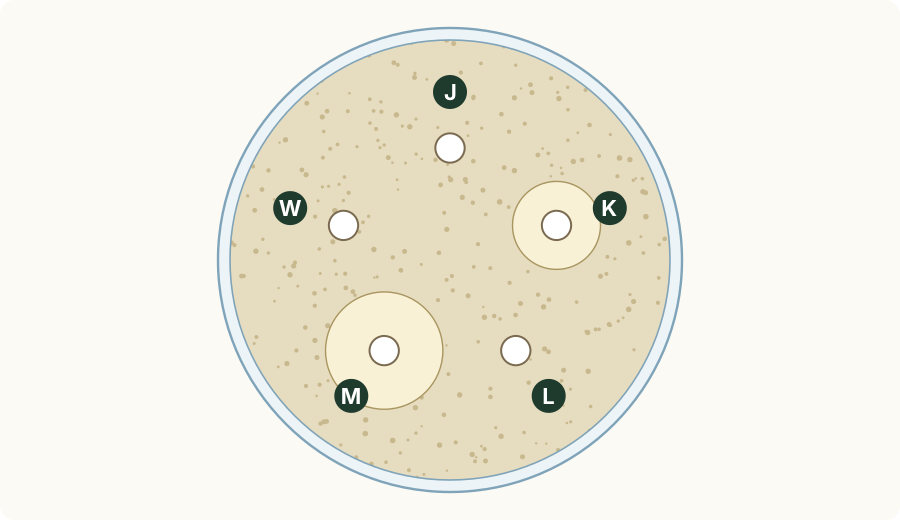
Tick every correct statement.
- M
- W
- L
- J
- K
Nudge (only if you are stuck): Compare each antibiotic disc with the water disc. What does growth right up to a disc mean?
5. identify
Bacteria from a patient's infection are tested with antibiotic T on a plate, as in this module: bacteria are either stopped by T, with a clear zone, or resistant to it, growing right up to the disc. The disc is 6 mm across. Which row is correct?
| Row | Zone round T (mm) | Bacteria resistant to T? | Would T treat this infection? |
|---|---|---|---|
| A | 6 | no | yes |
| B | 6 | yes | no |
| C | 20 | yes | no |
| D | 20 | no | no |
Circle one answer.
- A
- B
- C
- D
Nudge (only if you are stuck): What does a zone of only 6 mm tell you? Then: can an antibiotic that does not stop these bacteria treat the infection?
6. identify
Supplement. Which of these limits the development of resistant bacteria?
Circle one answer.
- Adding antibiotics to the feed of healthy farm animals each day.
- Using antibiotics only for bacterial infections that need them.
- Using a new antibiotic for each cold, so the virus cannot resist it.
- Giving antibiotics early for every sore throat, before it spreads.
Nudge (only if you are stuck): Each use of an antibiotic gives resistant bacteria a chance. Which choice gives them the fewest chances?
7. explain
A man has flu. A week later he develops a chest infection caused by bacteria. Explain why an antibiotic is useful for the chest infection but was no use for the flu.
Nudge (only if you are stuck): Compare the causes of the two illnesses and what an antibiotic acts on.
8. calculate
A hospital lab tested 60 samples of one kind of bacterium in 2015 and found 3 resistant to an antibiotic. In 2025, 21 of 60 samples were resistant to it. Calculate the percentage of samples that were resistant in each year.
2015: ______________ unit ________
2025: ______________ unit ________
Nudge (only if you are stuck): Percentage = number resistant ÷ number tested × 100.
9. explain
Supplement. Put these steps in order to explain how resistant bacteria become common in a population.
Write the number of each step in order.
- The resistant bacteria survive and multiply.
- A random mutation makes a few bacteria resistant.
- The next population has a larger share of resistant bacteria.
- It kills the bacteria that are not resistant.
- The antibiotic is used.
- Step 1: ______
- Step 2: ______
- Step 3: ______
- Step 4: ______
- Step 5: ______
Nudge (only if you are stuck): Ask two things: does the resistance exist before the antibiotic is used, and which bacteria can multiply after it is used?
10. calculate
Supplement. A population of 1000 bacteria contains 10 resistant ones. An antibiotic kills 90 % of the bacteria that are not resistant and none of the resistant ones. Calculate the percentage of the surviving bacteria that are resistant. Give your answer to 2 significant figures.
Resistant share of the survivors: ______________ unit ________
Nudge (only if you are stuck): Work out how many of the bacteria that are not resistant survive, then add the resistant ones.
11. explain
Supplement. On some farms, healthy chickens are given antibiotics in their feed to make them grow faster. Explain how this could make some human infections harder to treat.
Nudge (only if you are stuck): What happens to the bacteria living in the chickens each time the antibiotic is given?
12. predict / explain
Supplement. In town P, doctors give antibiotics for most sore throats. In town Q, they give them only when a test shows that bacteria are the cause. Predict in which town resistant bacteria will become common more quickly, and explain your prediction.
Nudge (only if you are stuck): Most sore throats are caused by viruses. In which town are antibiotics used more often?
13. predict / explain
In 1892 a scientist passed the juice of diseased tobacco leaves through a filter with holes too small for any bacterium. The juice that came through still caused the disease in healthy plants, and the cause multiplied only inside living leaf cells. Predict whether an antibiotic would cure the disease, and explain your prediction.
Nudge (only if you are stuck): What kind of cause gets through a filter that stops every bacterium, and multiplies only inside living cells?
14. suggest / explain
A lab tests the bacteria that cause urine infections in one town. Of the samples, 38 % are resistant to antibiotic E and 3 % are resistant to antibiotic F. Suggest which antibiotic is more likely to work against a new urine infection in the town, and explain why.
Nudge (only if you are stuck): What happens when an antibiotic meets bacteria that are resistant to it?