Pupil sheet · Antibiotics
Antibiotics against bacteria — questions
Name ______________________ Date ____________
Try every question before you use a nudge. Write in full sentences where you are asked to explain.
1. describe
Which statement describes a drug?
Circle one answer.
- Any substance taken into the body that modifies or affects chemical reactions in the body.
- Any substance that kills microorganisms, whether inside the body or on a surface outside it.
- Any illegal substance that people can become addicted to if they take it often.
- Any medicine that a doctor prescribes to a patient to treat an illness they have.
Nudge (only if you are stuck): A drug has to get somewhere and then change something. Where, and what?
2. identify
Which of these are drugs?
Tick every correct statement.
- Bleach poured into a sink to kill bacteria
- A plaster stuck over a cut on a knee
- The alcohol in a glass of wine
- An antihistamine tablet swallowed for hay fever
Nudge (only if you are stuck): For each one, ask two questions: is it taken into the body, and does it change the body's chemical reactions?
3. describe
A patient has a sore throat caused by bacteria and is given an antibiotic. Which statement describes how the antibiotic helps?
Circle one answer.
- It numbs the throat, so that the pain stops while the body clears the infection.
- It makes the patient's white blood cells stronger, so that they can fight any germ.
- It kills the throat cells that the bacteria have infected, so the bacteria die out.
- It kills the bacteria or stops them growing, so the body's defences can clear the rest.
Nudge (only if you are stuck): What does an antibiotic act on: the patient, or the cause of the infection?
4. determine
The figure shows a ruler laid across a clear zone, through the centre of the paper disc. Determine the diameter of the clear zone.
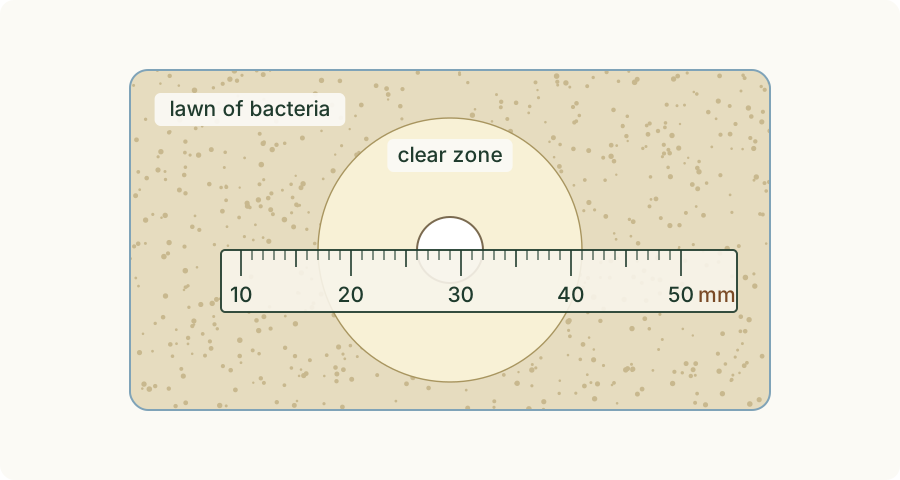
Diameter of the clear zone: ______________ unit ________
Nudge (only if you are stuck): Find where each edge of the zone meets the ruler. Count the small marks past the nearest numbered one.
5. identify
A student makes extracts of three plants by soaking them in ethanol. Discs soaked in each extract are pressed onto a lawn of bacteria. Which disc should be the control?
Circle one answer.
- A disc soaked in the ethanol only.
- A disc soaked in sterile water only.
- No disc at all in the fourth place.
- A disc soaked in a known antibiotic.
Nudge (only if you are stuck): The control has everything the other discs have except the one thing being tested.
6. identify
A plate of bacteria has discs of antibiotics X and Y and a disc soaked in sterile water, all 6 mm across. Which row of results shows that both antibiotics stopped the bacteria growing?
| Row | Water disc (mm) | Antibiotic X (mm) | Antibiotic Y (mm) |
|---|---|---|---|
| A | 14 | 16 | 22 |
| B | 6 | 16 | 22 |
| C | 6 | 16 | 6 |
| D | 6 | 6 | 22 |
Circle one answer.
- A
- B
- C
- D
Nudge (only if you are stuck): Check the water disc first: what should it show if nothing but the antibiotics stops growth?
7. identify / calculate
Five plates test the same antibiotic disc. The zone diameters are 26 mm, 25 mm, 11 mm, 27 mm and 24 mm. (a) Identify the anomalous result. (b) Calculate the mean zone diameter without it. Give your answer to 3 significant figures.
(a) Anomalous result: ______________ unit ________
(b) Mean without the anomaly: ______________ unit ________
Nudge (only if you are stuck): Look for the result that does not fit the pattern of the other four, then divide by the number of results you add.
8. explain
On one plate, antibiotic P gives a clear zone of 30 mm and antibiotic Q a zone of 12 mm. A student concludes that P will always treat an infection better than Q. Explain why this conclusion is not justified.
Nudge (only if you are stuck): What, apart from how well an antibiotic works against bacteria, could make one zone wider than another?
9. explain
A person with diabetes injects insulin before a meal. The insulin makes liver and muscle cells take up glucose and turn it into glycogen. Explain whether the insulin is acting as a drug.
Nudge (only if you are stuck): Check both parts of the definition of a drug.
10. describe
Put the steps of a disc test of antibiotics in order.
Write the number of each step in order.
- Tape the lid on with two short strips.
- Spread a safe bacterium evenly over the agar.
- Incubate the plate upside down at 25 °C for two days.
- Measure each zone through the centre of its disc.
- Press the discs onto the agar with forceps.
- Step 1: ______
- Step 2: ______
- Step 3: ______
- Step 4: ______
- Step 5: ______
Nudge (only if you are stuck): The discs go onto the agar before the bacteria have had time to grow.
11. predict / explain
A student tests one antibiotic at two strengths: disc S is soaked in a solution twice as concentrated as disc T. Both discs are on the same lawn. Predict which disc will have the wider clear zone, and explain your prediction.
Nudge (only if you are stuck): The antibiotic spreads out of the disc into the agar and becomes weaker the further it goes.
12. suggest
Two students measure the same clear zone. One records 9 mm and the other 18 mm. The second student is right. Suggest what the first student did wrong.
Nudge (only if you are stuck): Compare the two values: how is one related to the other?
13. explain
A nicotine patch and a sunscreen cream are both put on the skin. The nicotine passes through the skin into the blood and reaches the brain. The sunscreen stays on the surface and blocks some of the ultraviolet light. Explain which of the two acts as a drug.
Nudge (only if you are stuck): For each one, ask: does it get into the body, and does it change a reaction there?