Pupil sheet · Stretching springs
Spring constant and the limit of proportionality — questions
Name ______________________ Date ____________
Try every question before you use a nudge. Write in full sentences where you are asked to explain.
1. define
Supplement. Which statement defines the spring constant of a spring?
Circle one answer.
- The extension of the spring for each newton of load
- The force on the spring for each unit of its extension
- The largest load that the spring can safely hold up
- The load at which the graph stops being a straight line
What is its unit?
Nudge (only if you are stuck): Would your answer get bigger or smaller for a stiffer spring?
2. calculate
Supplement. A load of 4.2 N stretches a spring by 3.5 cm. Calculate its spring constant in N/m.
Spring constant: ______________ unit ________
Why must the extension be in metres?
Nudge (only if you are stuck): Which unit must the extension be in to give the spring constant in N/m?
3. calculate
Supplement. A spring has a spring constant of 28 N/m. A load of 1.82 N hangs on it, and its extension is proportional to the load. Calculate its extension in cm.
Extension: ______________ unit ________
How did you rearrange k = F / x?
Nudge (only if you are stuck): Which form of k = F / x has the extension on its own? Which unit does it give the extension in?
4. identify
Supplement. Match each term to its meaning.
Write the number of the matching option.
- the force per unit extension of a spring
- the point beyond which the extension is no longer proportional to the load
- the increase in length of the spring
- equal to the spring constant, on the straight part
- equal to 1 ÷ the spring constant, on the straight part
- the biggest load a spring can hold
- the length of the spring with no load on it
- spring constant: ______
- limit of proportionality: ______
- extension: ______
- gradient of a load–extension graph, with the load up the side: ______
- gradient of a load–extension graph, with the extension up the side: ______
Nudge (only if you are stuck): Two of the meanings do not match any term.
5. complete
Supplement. Complete the sentences. An engineer stretches a steel wire in a test machine. She plots force up the side against extension along the bottom. On the straight part of her graph, she divides the force by the extension to find the ____ (1) of the wire, in ____ (2). A second wire of the same steel and the same thickness, but twice as long, stretches twice as far for the same force. Its value of (1) is ____ (3), and its line is ____ (4) steep. For the first wire, the line is straight up to 900 N; beyond 900 N, each extra 100 N stretches the wire more than the 100 N before. So 900 N is the ____ (5) of the wire. Beyond 900 N, her line ____ (6). She can use (1) to calculate the extension for 600 N but not for 1200 N, because 1200 N is ____ (7) 900 N.
Gap 1
Gap 2
Gap 3
Gap 4
Gap 5
Gap 6
Gap 7
Nudge (only if you are stuck): Which quantity is divided by which? And what happens to the graph where the extension stops being proportional to the force?
6. determine / calculate
Supplement. The graph shows a pupil’s results for a spring, with a ruled best-fit line. Determine the spring constant of the spring, in N/m, from the gradient of the line.
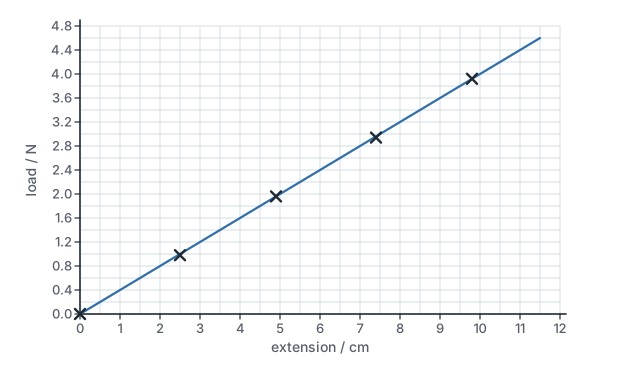
Spring constant: ______________ unit ________
Which two points did you use for your triangle?
Nudge (only if you are stuck): How big should your triangle be? Which unit must its run be in?
7. identify
Supplement. A pupil plots load–extension graphs for two springs, X and Y, on the same axes, with the load up the side. X’s line is straight from the origin to the point (3.0 cm, 2.7 N), and beyond that point it flattens. Y’s line is straight from the origin to the point (16.0 cm, 7.2 N), and beyond that point it flattens. Which row is correct?
| Row | Stiffer spring | Spring with the larger load at its limit of proportionality |
|---|---|---|
| A | X | X |
| B | X | Y |
| C | Y | X |
| D | Y | Y |
Circle one answer.
- A
- B
- C
- D
Nudge (only if you are stuck): Compare the two springs’ force per unit extension on the straight parts. Then, separately, compare where each straight part ends.
8. identify
Supplement. The graph shows the results for a spring. Which point is the limit of proportionality?
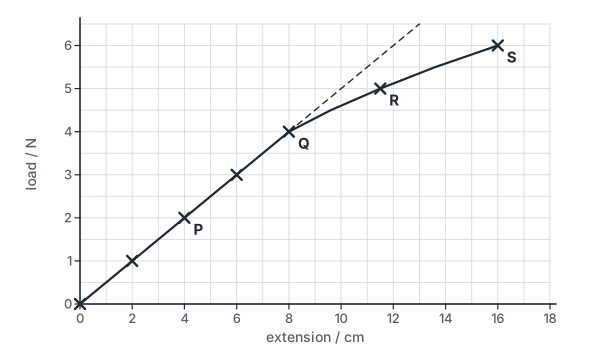
Circle one answer.
- P
- Q
- R
- S
How did you decide?
Nudge (only if you are stuck): Lay a ruler along the straight part. Where do the points leave it?
9. calculate
Supplement. The spring in a luggage scale has a spring constant of 1200 N/m, and it stays below its limit of proportionality. When a bag hangs from the scale, the spring stretches by 25 mm. Take g = 9.8 N/kg. Calculate (a) the weight of the bag, and (b) its mass, to 2 significant figures.
(a) Weight of the bag: ______________ unit ________
(b) Mass of the bag, to 2 significant figures: ______________ unit ________
Why must the extension be in metres?
Nudge (only if you are stuck): Which unit must the extension be in before you use a spring constant in N/m? How are weight and mass linked?
10. state / suggest
Supplement. A pupil loads a spring in 1.0 N steps. Her points at 1.0 N, 2.0 N and 3.0 N lie on a straight line through the origin, but her point at 4.0 N lies below the line. She then adds loads of 3.25 N, 3.5 N and 3.75 N. The 3.25 N and 3.5 N points lie on the line; the 3.75 N point lies below it. (a) State the range of loads in which the limit of proportionality could lie, from her 1.0 N steps alone. (b) State the range after she adds the smaller steps. (c) Suggest two loads she should add next to find the limit more closely.
(a) Range from the 1.0 N steps
(b) Range with the smaller steps
(c) The next loads
Nudge (only if you are stuck): With only the 1.0 N steps, which is the last point on the line, and which is the first point off it?
11. state / describe / explain / determine / calculate
Supplement. A pupil plots her results with the axes the other way round: extension up the side, load along the bottom. (a) State, from the graph, the limit of proportionality. (b) Describe how the line changes beyond the limit. (c) She says: “The line gets steeper beyond the limit, so the spring is getting stiffer.” Explain why she is wrong. (d) Determine the gradient of the straight part of her line, with its unit. (e) Use your gradient to calculate the spring constant, in N/m.
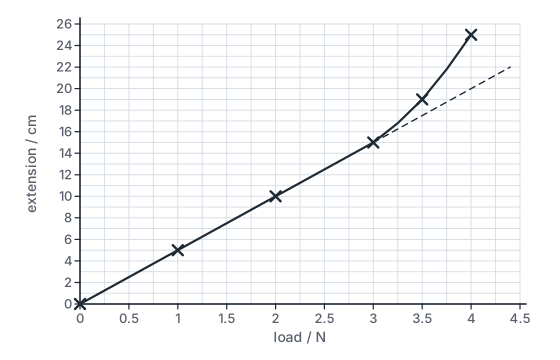
(a) The limit of proportionality
(b) Beyond the limit
(c) Stiffer?
(d) The gradient
(e) The spring constant
Nudge (only if you are stuck): Read the axis labels first. Which quantity is up the side?
12. calculate / explain
Supplement. A spring has a spring constant of 16 N/m, and its limit of proportionality is at a load of 2.0 N. (a) Calculate its extension, in cm, at the limit of proportionality. (b) A pupil uses x = F / k to predict its extension for a load of 2.4 N. Calculate her prediction, in cm.
(a) Extension at the limit of proportionality: ______________ unit ________
(b) Her prediction for 2.4 N: ______________ unit ________
Will the real extension at 2.4 N be bigger or smaller than her prediction? Explain why.
Nudge (only if you are stuck): Which form of k = F / x gives the extension? Is 2.4 N on the straight part of the graph?
13. identify
Supplement. An engineer tests a steel spring from an up-and-over garage door. She pulls it with known forces and measures its extension. Her results are: 0 N, 0 cm; 90 N, 4.5 cm; 180 N, 9.0 cm; 270 N, 15.1 cm; 360 N, 18.0 cm; 450 N, 22.5 cm. Which row is correct about the 270 N reading and the spring constant?
| Row | The 270 N reading is | Spring constant |
|---|---|---|
| A | an anomalous reading, left out | 2000 N/m |
| B | an anomalous reading, left out | 20 N/m |
| C | the limit of proportionality | 2000 N/m |
| D | the limit of proportionality | 1800 N/m |
Circle one answer.
- A
- B
- C
- D
Nudge (only if you are stuck): Look at the readings after 270 N. Do they stay off the line, or come back to it?