Pupil sheet · Stretching springs
Loading a spring — questions
Name ______________________ Date ____________
Try every question before you use a nudge. Write in full sentences where you are asked to explain.
1. identify
A force can change the size and the shape of an object. Match each example to the change that the force causes.
Write the number of the matching option.
- stretch: it gets longer
- squash: it gets shorter
- bend: it curves
- twist: it turns round on itself
- no change: it is too hard to change
- The rubber of a catapult as it is pulled back: ______
- A tennis ball at the moment it hits the racket: ______
- A fishing rod when a big fish pulls on the line: ______
- The rubber motor of a toy plane as its propeller is wound up: ______
- A steel shelf with a row of heavy books on it: ______
Nudge (only if you are stuck): Picture each object before and after the force acts. Does it get longer, get shorter, curve, or turn round on itself?
2. calculate
A spring hangs from a clamp with an empty hanger of mass 50 g on it, and a pupil takes the zero reading. Then she adds six 100 g masses to the hanger and reads the pointer again, to find the extension. Take g = 9.8 N/kg. Calculate the load that goes in her results table next to this extension.
Load: ______________ unit ________
Why is the hanger not part of the load?
Nudge (only if you are stuck): Which masses went on after the zero reading was taken? And is a load a mass or a force?
3. calculate
With the empty hanger on, the pointer of a spring reads 9.5 cm on the metre rule. After a load is added, it reads 14.3 cm. Calculate the extension of the spring.
Extension: ______________ unit ________
Why is the extension not 14.3 cm?
Nudge (only if you are stuck): Where was the pointer before the load went on?
4. describe
Put the steps in order to measure the extension of a spring for a series of loads and plot a load–extension graph.
Write the number of each step in order.
- Add a 100 g mass; when the spring is still, read the pointer at eye level and subtract the zero reading
- Plot load against extension, including (0, 0), and draw a ruled best-fit line
- Clamp the stand to the bench, hang the spring from the clamp and fix a metre rule upright beside it
- Repeat with one more 100 g mass each time, recording the load and the extension in a table
- Hang the empty hanger on the spring and read the pointer at eye level: the zero reading
- Step 1: ______
- Step 2: ______
- Step 3: ______
- Step 4: ______
- Step 5: ______
Nudge (only if you are stuck): What must be read before any mass goes on? And what must you have for every load before you can plot it?
5. complete
Complete the sentences. Mia hangs a small bag from a strip of rubber and puts marbles in the bag. The pull of the marbles ____ (1) the strip: it gets longer. When she takes the bag off, the strip goes back to its original length, so the rubber is ____ (2). The weight of the marbles is the ____ (3) on the strip, so it is measured in ____ (4). Before any marbles go in, she reads where the bottom of the strip is with the empty bag on: this is her ____ (5). Each time she adds marbles, the increase in the length of the strip is its ____ (6). If twice as many marbles always gave twice this increase, it would be ____ (7) to the load.
Gap 1
Gap 2
Gap 3
Gap 4
Gap 5
Gap 6
Gap 7
Nudge (only if you are stuck): Does a pull make the strip longer or shorter? What happens to it when the load is taken away? And is a weight a mass or a force?
6. identify
A pupil hangs loads on a spring and records the pointer reading each time, as in the table. She plots load against reading, not against extension. Her points lie on a straight line, and she says: “This shows that the reading is proportional to the load.” Which statement is correct?
| load / N | pointer reading / cm |
|---|---|
| 0 | 5.0 |
| 1.0 | 7.2 |
| 2.0 | 9.4 |
| 3.0 | 11.6 |
| 4.0 | 13.8 |
Circle one answer.
- She is right: any straight-line graph shows proportion
- She is wrong: her line does not go through the origin
- She is right: the line has a constant gradient
- She is wrong: she should join the points dot to dot
What should she plot instead?
Nudge (only if you are stuck): Where does her line meet the reading axis when the load is zero?
7. determine
The graph shows a pupil’s results for a spring, with a ruled best-fit line. Determine from the graph (a) the load that gives an extension of 6.5 cm, and (b) the extension for a load of 3.0 N.
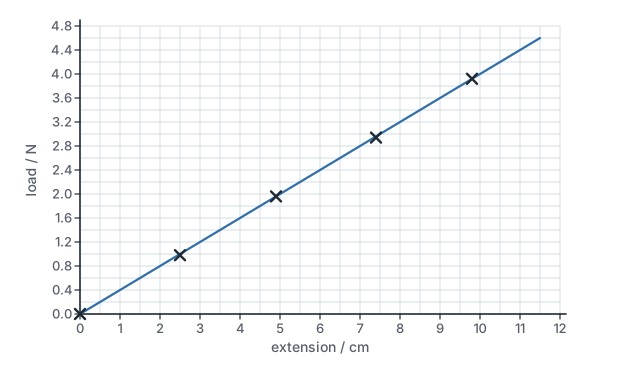
(a) Load for an extension of 6.5 cm: ______________ unit ________
(b) Extension for a load of 3.0 N: ______________ unit ________
Why read from the line rather than the nearest point?
Nudge (only if you are stuck): Which axis does each part start on? And do you read from a plotted point or from the line?
8. explain
Ravi says: “The steel cable that holds up a lift is far too hard to change. When eight people get into the lift, nothing about the cable changes.” Explain what is wrong with Ravi’s idea.
Nudge (only if you are stuck): What does the weight of the people do to the cable? Does an object have to be soft for a force to change it?
9. describe / suggest / explain / state
Sam is about to load a spring with 100 g masses, up to 800 g, to plot a load–extension graph. His clamp stand stands loose on the bench, there is nothing under the hanger, he stands up and looks down at the pointer, and he reads the pointer as soon as each mass goes on. (a) Describe what could happen to the stand, and how he can stop it. (b) Suggest what he should put under the hanger, and why. (c) Explain why looking down at the pointer gives a wrong reading, and state how he should look at it. (d) State what he should do before he reads the pointer each time, and why.
(a) The stand
(b) Under the hanger
(c) Reading the pointer
(d) Before each reading
Nudge (only if you are stuck): Think about what could tip over, what could fall, and where his eye is compared with the pointer.
10. identify
The sketch graphs A to D show load against extension. Which one shows that the extension of a spring is proportional to the load?
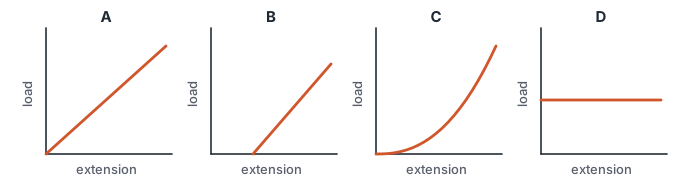
Circle one answer.
- Graph A
- Graph B
- Graph C
- Graph D
Why is each of the other graphs wrong?
Nudge (only if you are stuck): Proportion needs two things at once. Which graph has both?
11. calculate
A spring has a zero reading of 5.5 cm. With 100 g added, the pointer reads 8.7 cm. Its extension is proportional to the load. Calculate (a) the extension with 250 g added, and (b) the pointer reading then.
(a) Extension with 250 g: ______________ unit ________
(b) Pointer reading with 250 g: ______________ unit ________
How did you use the fact that the extension is proportional to the load?
Nudge (only if you are stuck): How many times bigger than 100 g is 250 g? Which quantity grows in that ratio?
12. calculate / explain
A spring is 6.0 cm long with nothing on it. A pupil hangs a 50 g hanger on it, and the spring is then 6.5 cm long. She adds 500 g of masses, and it is 11.5 cm long. Take g = 9.8 N/kg. (a) She measures the extension from the spring’s original length, 6.0 cm. Calculate the extension and the load that goes with it. (b) Her partner measures from the length with the empty hanger on, 6.5 cm. Calculate his extension and his load.
(a) Extension from 6.0 cm: ______________ unit ________
(a) Load for that extension: ______________ unit ________
(b) Extension from 6.5 cm: ______________ unit ________
(b) Load for that extension: ______________ unit ________
Explain why both ways give the same load for each centimetre of extension.
Nudge (only if you are stuck): Does each extension include the stretch made by the hanger? Then should its load include the hanger?
13. identify
Which of these would make a pupil’s extensions wrong? Choose all that would.
Tick every correct statement.
- Reading the pointer from above, not at eye level
- Measuring each extension from the 0 cm mark
- Reading the pointer while the spring still bounces
- Measuring from the bare spring, hanger in the load
- Taking the zero reading with the empty hanger on
- Reading the rule to the nearest millimetre
What does each wrong method do to the extension?
Nudge (only if you are stuck): For each one, ask: would the extension she writes down really belong with the load she writes down?
14. describe / determine / calculate
A market stall weighs bags of fruit on a hanging spring scale. To check it, a trader hangs known loads on its hook and records where its pointer is, as in the table. (a) Describe what the loads do to the spring. (b) The trader wants to mark a newton scale beside the pointer, with a mark for every 5 N. Determine how far apart the marks should be. (c) A bag of apples moves the pointer to 6.0 cm. Calculate the weight of the bag. (d) The trader fits a heavier hook. With no load on it, the pointer now reads 2.6 cm. Calculate where the pointer will be with the same bag of apples.
| load / N | pointer reading / cm |
|---|---|
| 0 | 2.0 |
| 10 | 3.6 |
| 20 | 5.2 |
| 30 | 6.8 |
| 40 | 8.4 |
(a) What the loads do
(b) The newton scale
(c) The bag of apples
(d) The heavier hook
Nudge (only if you are stuck): How far does the pointer move for each 10 N? And what does it read with no load on the hook?