Pupil sheet · Resultant force
F = ma and circular motion — questions
Name ______________________ Date ____________
Try every question before you use a nudge. Write in full sentences where you are asked to explain.
1. calculate
Supplement. A go-kart and its driver have a total mass of 150 kg. The resultant force on them is 330 N forwards. Calculate their acceleration.
Acceleration of the go-kart: ______________ unit ________
Its direction
Nudge (only if you are stuck): Start from F = ma. Which quantity do you need on its own?
2. identify / explain
Supplement. A skateboarder is rolling east and drags one foot on the ground. The resultant force on her is 40 N towards the west. In which direction is her acceleration? Then explain your choice.
Circle one answer.
- Towards the east, like her motion
- Towards the west, like the force
- None, because she is slowing down
- Towards the east until she stops
Why?
Nudge (only if you are stuck): Which quantities in F = ma are vectors, and which one is a scalar?
3. calculate
Supplement. A toy car of mass 800 g accelerates along a straight track at 4.5 m/s². Calculate the resultant force on the car.
Resultant force on the car: ______________ unit ________
Its direction
Nudge (only if you are stuck): Use F = ma. Which unit must the mass be in?
4. identify
Supplement. A trolley is pulled along a smooth, level track. Match each change to what happens to its acceleration.
Write the number of the matching option.
- the acceleration doubles
- the acceleration halves
- the acceleration stays the same
- the acceleration becomes four times as big
- The resultant force is doubled, the mass stays the same: ______
- The mass is doubled, the resultant force stays the same: ______
- The resultant force and the mass are both doubled: ______
- The resultant force is halved, the mass stays the same: ______
- The mass is halved, the resultant force stays the same: ______
Nudge (only if you are stuck): Use a = F ÷ m. What happens to a fraction if the top doubles? If the bottom doubles? If both double?
5. identify / explain
Supplement. The diagram shows a puck going round a pin on a string, seen from above. At point X the string is cut. Which path, A, B, C or D, does the puck follow? Then explain your choice.
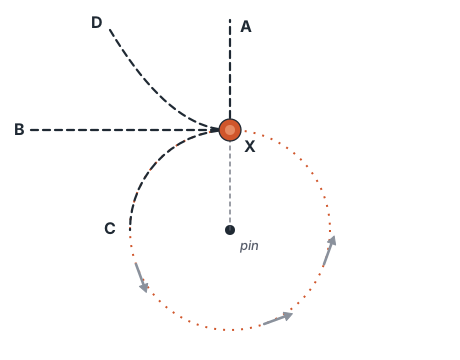
Circle one answer.
- Path A
- Path B
- Path C
- Path D
Why?
Nudge (only if you are stuck): Once the string is cut, is there any force on the puck in the plane of the table? What does an object do with no resultant force?
6. state
Supplement. State the word or words that complete each sentence. A model aeroplane flies round in a horizontal circle at a steady speed, held by a wire from a post. The wire pulls the aeroplane towards the ____ (1) of the circle. This pull is always at ____ (2) to the aeroplane’s velocity. It changes the aeroplane’s ____ (3) of motion. Even at a steady speed, the aeroplane has an ____ (4) towards the post. If the wire breaks, the aeroplane flies off in a straight line along the ____ (5) to the circle.
Gap 1
Gap 2
Gap 3
Gap 4
Gap 5
Nudge (only if you are stuck): Where does the wire pull, what changes as the aeroplane goes round, and which way does it go when nothing pulls it any more?
7. calculate
Supplement. While a bowler’s hand pushes a bowling ball along the lane, the resultant force on the ball is 7.0 N and its acceleration is 1.2 m/s². Calculate the mass of the ball. Give your answer to 2 significant figures.
Mass of the ball: ______________ unit ________
Show the check: does your mass give 7.0 N?
Nudge (only if you are stuck): Rearrange F = ma so that m is on its own.
8. calculate
Supplement. On the air table, a second puck sits on top of the first, so the mass is 0.40 kg. Meter E pulls the pucks east with 0.35 N, and meter W pulls them west with 0.05 N. Calculate the acceleration of the pucks. Then give its direction.
Acceleration of the pucks: ______________ unit ________
Its direction
Nudge (only if you are stuck): F in F = ma is the resultant force. Find it first, as in part 1.
9. identify
Supplement. A robot cart runs round a circular track at a steady speed. A cable joins it to a post at the centre, and a force meter in the cable reads the pull. The table shows four tests. Match each statement to the two tests that show it.
| Test | Mass of cart / kg | Speed / m/s | Radius of circle / m | Pull of cable / N |
|---|---|---|---|---|
| 1 | 2.0 | 3.0 | 1.5 | 12 |
| 2 | 2.0 | 4.5 | 1.5 | 27 |
| 3 | 2.0 | 3.0 | 2.0 | 9.0 |
| 4 | 4.0 | 3.0 | 1.5 | 24 |
Write the number of the matching option.
- Tests 1 and 2
- Tests 1 and 3
- Tests 1 and 4
- Tests 2 and 3
- A bigger force goes with a bigger speed, mass and radius the same: ______
- A bigger force goes with a smaller radius, mass and speed the same: ______
- A bigger mass needs a bigger force, speed and radius the same: ______
Nudge (only if you are stuck): For each statement, look for two tests in which only that one quantity changes. Then check that the pull changes the way the statement says.
10. identify / explain
Supplement. A puck goes round a pin on a string at a constant speed. Which of these statements are correct? Choose all that are correct, then explain one of the wrong ones.
Tick every correct statement.
- The force on the puck points towards the centre of the circle
- The force on the puck is at right angles to its velocity
- The speed of the puck stays the same, but its velocity keeps changing
- An outward force balances the pull of the string
- The resultant force on the puck is zero, because its speed is constant
- The pull of the string makes the puck go faster and faster
Explain why one of the wrong statements is wrong
Nudge (only if you are stuck): Think about which way the string pulls, and what the velocity does as the puck goes round.
11. compare / explain
Supplement. Ravi rides his bicycle round two bends of a cycle track at the same steady 14 m/s. The first bend is part of a large circle. The second bend is tighter: it is part of a much smaller circle. Compare the resultant force on Ravi on the tighter bend with the force on the first bend. Then explain your choice.
Circle one answer.
- Bigger on the tighter bend
- Smaller on the tighter bend
- The same on both bends
Explain your choice
Nudge (only if you are stuck): Imagine the bend getting tighter and tighter. Does Ravi’s direction change faster or more slowly?
12. state / explain / describe / calculate / predict
Supplement. In the hammer throw, an athlete swings a steel ball of mass 7.26 kg on a wire, round and round in a circle, and then lets go. Take g = 9.8 N/kg. (a) While the ball goes round at a steady speed, state the direction of the force of the wire on the ball. (b) On one circle, a coach measures the pull of the wire on the ball: about 1400 N when the ball moves at 15 m/s, and about 2400 N at 20 m/s. Predict whether the pull needed at 25 m/s, on the same circle, is bigger or smaller than 2400 N. Explain your prediction. (c) Seen from above, describe the path of the ball just after the athlete lets go. (d) A younger athlete throws a 4.0 kg hammer, at the same speed and on the same radius. Does she need a bigger or a smaller pull? Explain. (e) Once it is let go, the only force on the ball is its weight. Calculate its weight, then its acceleration, and give the direction of the acceleration.
(a) Force of the wire
(b) Faster on the same circle
(c) Path after release
(d) The lighter hammer
(e) Weight and acceleration after release
Nudge (only if you are stuck): For (a) to (d), think of the puck on the string. For (e), find the weight first, then use F = ma with the mass of the ball.