Pupil sheet · Resultant force
Balanced and unbalanced forces — questions
Name ______________________ Date ____________
Try every question before you use a nudge. Write in full sentences where you are asked to explain.
1. calculate / identify
On the air table, meter E pulls the puck east with 0.35 N, and meter W pulls it west with 0.15 N. Meter N is slack. Which is the resultant force on the puck?
Circle one answer.
- 0.50 N east
- 0.20 N east
- 0.20 N west
- 0.25 N east
How did you work it out?
Nudge (only if you are stuck): The two pulls act along the same straight line, in opposite directions. Do you add them or take one away from the other?
2. calculate / state
Three forces act on the puck along the same straight line: 0.25 N east, 0.10 N east and 0.40 N west. Calculate the size of the resultant force. Then state its direction.
Size of the resultant force: ______________ unit ________
Which way does the resultant force point, and why?
Nudge (only if you are stuck): Which of the three forces point the same way? Deal with those first.
3. identify
Match each situation on the air table to what the puck does next. Each pull keeps the same size and direction.
Write the number of the matching option.
- stays at rest
- keeps moving east at a steady speed
- speeds up
- slows down
- changes direction, curving towards the north
- stops at once
- At rest, and the resultant force is zero: ______
- Moving east, and the resultant force is zero: ______
- Moving east, and the resultant force is towards the east: ______
- Moving east, and the resultant force is towards the west: ______
- Moving east, and the resultant force is towards the north: ______
Nudge (only if you are stuck): First ask: is there a resultant force at all? If there is, compare its direction with the way the puck is moving.
4. identify / explain
A puck is nudged west. It then glides across the air table at a steady 0.40 m/s, while meters W and E both pull on it with 0.10 N. What keeps it moving? Then explain your choice.
Circle one answer.
- The force of the nudge, which stays in the puck
- No force: the resultant force on it is zero
- Meter W, because the puck moves towards it
- The air that blows up through the holes in the table
Why?
Nudge (only if you are stuck): Once the hand has let go, which forces act on the puck along its path, and how do they compare?
5. state
State the word that completes each sentence. A canoe is paddled across a still lake. The paddles push it forwards with 60 N, and the water drags it backwards with 60 N. The forces on the canoe are ____ (1), so the resultant force is ____ (2) N, and the canoe moves at a steady speed in a ____ (3) line. Then the paddling stops. The resultant force now acts against the motion, so the canoe’s speed ____ (4). Later, a wind blows on the side of the canoe, at right angles to its motion, and the canoe’s ____ (5) of motion changes. In both of these changes, the canoe’s ____ (6) changes.
Gap 1
Gap 2
Gap 3
Gap 4
Gap 5
Gap 6
Nudge (only if you are stuck): Gaps 1 to 3 are about the steady paddling. For gap 6, find the one quantity that changes both when the canoe slows down and when it turns.
6. identify / calculate
The diagram shows five free-body diagrams, A to E. In which of them are the forces balanced? Choose all that are balanced. Then give the resultant force for one diagram that is not balanced.
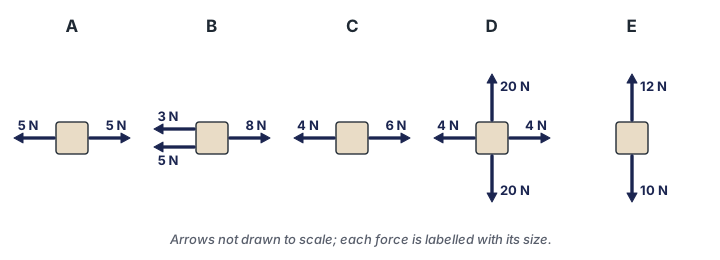
Tick every correct statement.
- Diagram A
- Diagram B
- Diagram C
- Diagram D
- Diagram E
The resultant force for one diagram that is not balanced
Nudge (only if you are stuck): For each diagram, add the forces that point the same way, then compare opposite directions. Up and down are a separate line from left and right.
7. calculate / state / describe
A crane lifts a steel beam of mass 450 kg. Its cable pulls the beam up with a force of 5000 N. Take g = 9.8 N/kg. Calculate the size of the resultant force on the beam. Then state its direction, and describe what it does to the beam if the beam starts at rest.
Size of the resultant force on the beam: ______________ unit ________
Its direction, and what it does to the beam
Nudge (only if you are stuck): Which other force acts on the beam along the cable’s line, and how big is it?
8. explain
A curling stone is pushed across the ice and let go. It slides a long way, slowing down very gradually. Jamal says: “The push from the hand is still inside the stone, keeping it moving. It slows down because the push gets used up.” Explain what is wrong with Jamal’s idea, and what really happens to the stone.
Nudge (only if you are stuck): When does a push act: only while the hand touches the stone, or afterwards too? And what would a moving object do if no resultant force acted on it at all?
9. identify
A resultant force may change an object’s speed, its direction of motion, or both. For each case, identify what changes: the speed only, the direction only, both, or neither. An answer may be used more than once.
Write the number of the matching option.
- the speed only
- the direction only
- both of them
- neither of them
- A runner goes round the bend of a track at a steady 7.0 m/s: ______
- A dropped ball falls straight down, faster and faster: ______
- A train runs along a straight track at a constant 30 m/s: ______
- A car brakes on a straight road: ______
- A stone thrown sideways off a cliff curves down, faster and faster: ______
Nudge (only if you are stuck): For each one, ask two questions: does it go faster or slower? Does it turn?
10. identify / explain
A drone carries a parcel. Its rotors push it up, and its weight pulls it down; ignore air resistance. Each row of the table compares the upward force from the rotors with the weight in three cases. Which row is correct? Then explain the middle column.
| Row | Hovering still | Rising at a steady speed | Rising faster and faster |
|---|---|---|---|
| A | equal to the weight | bigger than the weight | bigger than the weight |
| B | equal to the weight | equal to the weight | bigger than the weight |
| C | bigger than the weight | bigger than the weight | bigger than the weight |
| D | equal to the weight | equal to the weight | equal to the weight |
Circle one answer.
- A
- B
- C
- D
Explain the middle column
Nudge (only if you are stuck): For each column, ask: is the drone’s velocity changing? If it is not, what must the resultant force be?
11. calculate
On the air table, meter E pulls the puck with 0.10 N and meter N is slack. The resultant force on the puck is 0.15 N towards the west. Calculate the pull of meter W.
Pull of meter W: ______________ unit ________
How did you work it out?
Nudge (only if you are stuck): Which meter must pull harder for the resultant to point west?
12. describe / state / calculate
An overhead camera marks a puck every 0.1 s as it moves east along a straight line. The gaps between neighbouring dots, in cm, are: run 1: 3, 3, 3, 3; run 2: 1, 2, 3, 4; run 3: 6, 5, 4, 3. (a) For run 1, describe the motion. (b) For run 2, describe the motion and give the direction of the resultant force. (c) For run 3, describe the motion and give the direction of the resultant force. (d) Calculate the speed of the puck in run 1, in m/s.
(a) Run 1
(b) Run 2
(c) Run 3
(d) Speed in run 1
Nudge (only if you are stuck): Equal gaps, growing gaps or shrinking gaps: each tells you what the speed is doing. For (d), change centimetres to metres first.
13. state / explain / calculate / describe / compare
A rocket stands on its launch pad. Its weight is 2.0 × 10⁶ N. When its engines fire, they push it up with a force, the thrust, of 3.0 × 10⁶ N. (a) Before the engines start, the rocket stands still. State the resultant force on it, and explain why, in terms of the forces on it. (b) Calculate the resultant force on the rocket just after lift-off, and give its direction. (c) Describe how the rocket moves just after lift-off. (d) Higher up, air resistance also pushes down on the rocket, and the engines are turned down until the rocket rises at a steady speed. Compare the thrust with the weight and the air resistance together, and explain your answer.
(a) On the pad
(b) Resultant after lift-off
(c) Just after lift-off
(d) Rising at a steady speed
Nudge (only if you are stuck): Draw a free-body diagram for (a), (b) and (d). For (d), ask whether the velocity is changing.