Pupil sheet · Resultant force
Resultant force — final check
Name ______________________ Date ____________
Work alone, with the lesson closed. Answer every question; there are no hints.
1. deduce / give / state / calculate / explain
A hovercraft moves over flat, wet sand. A tracker on it records its velocity every 2.0 s in four runs, P to S. The table shows the results. (a) Deduce the resultant force on the hovercraft in run P. (b) Give the direction of the resultant force in run Q and in run R. (c) In run S, state what the resultant force changes, and give its direction at the start of the run. (d) In run Q, three horizontal forces act on the hovercraft: the push of its fan, 900 N towards the east; air resistance, 150 N towards the west; and the pull of a rope towing a small boat, towards the west. The resultant force is 400 N towards the east. Calculate the pull of the rope. (e) A pupil says: “In run R, at 4.0 s the hovercraft is not moving, so the resultant force on it at that moment is zero.” Explain why this is wrong.
| Run | Velocity at 0 s | at 2.0 s | at 4.0 s | at 6.0 s |
|---|---|---|---|---|
| P | 5.0 m/s east | 5.0 m/s east | 5.0 m/s east | 5.0 m/s east |
| Q | 2.0 m/s east | 4.0 m/s east | 6.0 m/s east | 8.0 m/s east |
| R | 6.0 m/s east | 3.0 m/s east | 0 | 3.0 m/s west |
| S | 5.0 m/s east | 5.0 m/s north-east | 5.0 m/s north | 5.0 m/s north-west |
(a) Run P
(b) Runs Q and R
(c) Run S
(d) The pull of the rope in run Q
(e) The pupil’s claim
2. calculate / state / explain / identify
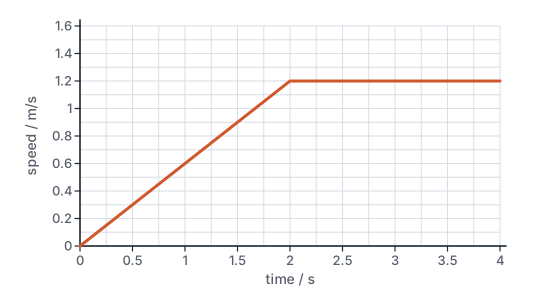
Supplement. The graph shows the speed of a trolley of mass 0.50 kg on a smooth, level track. A constant resultant force pulls it from 0 to 2.0 s. (a) Calculate the acceleration of the trolley from 0 to 2.0 s. (b) Calculate the resultant force on the trolley from 0 to 2.0 s, and state its direction compared with the direction of the acceleration. (c) At 4.0 s a brake starts to act, and the resultant force on the trolley becomes 0.10 N backwards. Calculate its acceleration, and state its direction. (d) The same resultant force as in (b) gives a second trolley an acceleration of 0.40 m/s². Calculate the mass of the second trolley. (e) A toy train goes round a circular track at a steady speed. State whether the force needed towards the centre is bigger or smaller (i) on a larger track at the same speed; (ii) when the train pulls heavier wagons at the same speed on the same track. (f) On a ferry moving north at 0.30 m/s, a boy walks across the deck towards the east at 0.50 m/s. Calculate the size of his resultant velocity. (g) Identify which of these are vectors: the trolley’s mass, its velocity, the distance it travels, the time on the graph, the resultant force on it.
(a) Acceleration, 0 to 2.0 s
(b) Resultant force and its direction, 0 to 2.0 s
(c) Braking after 4.0 s
(d) The second trolley’s mass
(e) The toy train: (i) larger track, (ii) heavier wagons
(f) The boy on the ferry
(g) The vectors