Pupil sheet · The particle model
Temperature and absolute zero — questions
Name ______________________ Date ____________
Try every question before you use a nudge. Write in full sentences where you are asked to explain.
1. identify / explain
Two identical sealed flasks each hold the same mass of nitrogen. Flask P is at 30 °C, and flask Q is at 70 °C. Which statement about the nitrogen molecules is correct? Then explain your choice.
Circle one answer.
- Every single molecule in Q is moving faster than every one in P
- On average Q’s are faster, though some in P are faster than some in Q
- The molecules in Q have grown bigger, so they carry more kinetic energy
- Q has more molecules in it, so each one has more kinetic energy
Why?
Nudge (only if you are stuck): In any gas, the molecules do not all move at the same speed. What does the temperature tell you about them?
2. identify
A block of copper is heated from 20 °C to 80 °C. It stays solid. Which row describes the particles of the copper at 80 °C, compared with 20 °C?
| Row | Motion of the particles | Average kinetic energy | Size of each particle |
|---|---|---|---|
| A | vibrate faster about fixed positions | greater | the same |
| B | vibrate faster about fixed positions | greater | larger |
| C | move about, sliding past each other | greater | the same |
| D | vibrate at the same speed as before | the same | the same |
Circle one answer.
- A
- B
- C
- D
Nudge (only if you are stuck): The copper is still a solid. What changes about its particles when it is hotter, and what stays the same?
3. determine / explain
The graph shows the average kinetic energy of an air molecule in the model at four temperatures. The straight line through the points has been drawn only from −150 °C to 150 °C. Imagine the line carried on, with a ruler, to colder temperatures. Determine the temperature at which it reaches zero kinetic energy.
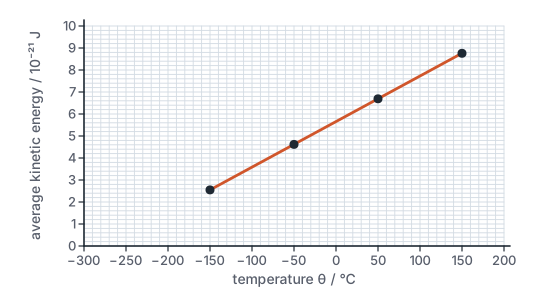
Temperature where the line reaches zero kinetic energy: ______________ unit ________
Explain why the line cannot be carried on below this temperature.
Nudge (only if you are stuck): Lay a ruler along the points and follow the line down to where the kinetic energy is zero.
4. identify
In the model, the typical speed of an air molecule depends on the temperature. Match each temperature to the typical speed of an air molecule at that temperature. One speed is not used.
Write the number of the matching option.
- 0 m/s
- 438 m/s
- 485 m/s
- 515 m/s
- 582 m/s
- −50 °C: ______
- 0 °C: ______
- 35 °C: ______
- 120 °C: ______
Nudge (only if you are stuck): As the temperature of a gas rises, does the typical speed of its molecules go up or down?
5. explain
Tiny specks of clay in a sealed drop of water are watched through a microscope. The drop is warmed from 10 °C to 40 °C, and the specks jiggle more. Put the steps of the explanation in order.
Write the number of each step in order.
- They hit each speck harder
- The speck’s jumps are bigger: it jiggles more
- The water is warmed
- The uneven push on a speck at each moment is bigger
- Its molecules move faster, with more kinetic energy on average
- Step 1: ______
- Step 2: ______
- Step 3: ______
- Step 4: ______
- Step 5: ______
Nudge (only if you are stuck): Start with the warming, and end with what you see happen to the specks.
6. calculate / determine
The table shows the average kinetic energy of an air molecule in the model at four temperatures. (a) Calculate the fall in average kinetic energy for every 60 °C colder, in joules. Give your answer to 3 significant figures. Type a number such as 3.5 × 10⁻²¹ as 3.5x10⁻²¹ or 3.5e-21. (b) Use your answer to (a) to determine the temperature at which the average kinetic energy reaches zero.
| θ / °C | 90 | 30 | −30 | −90 |
|---|---|---|---|---|
| average kinetic energy of a molecule / 10−21 J | 7.521 | 6.278 | 5.036 | 3.793 |
(a) Fall in average kinetic energy for every 60 °C colder: ______________ unit ________
(b) Temperature where the average kinetic energy reaches zero: ______________ unit ________
Nudge (only if you are stuck): For (a), check how far apart the temperatures in the table are. For (b), start from the coldest temperature in the table.
7. identify / explain
Hydrogen gas is kept in a laboratory cooler at −250 °C. Which of these statements about the hydrogen are correct? Choose all that are correct, then explain one of your choices.
Tick every correct statement.
- Its molecules are still moving, so they have kinetic energy
- On average, its molecules move more slowly than at −200 °C
- It is about 23 °C above the lowest possible temperature
- Its molecules have stopped moving completely, as it is so cold
- A better cooler could take the hydrogen down to −280 °C
- It is colder than absolute zero, so it has no kinetic energy
Explain one of your choices.
Nudge (only if you are stuck): Three are correct. Compare −250 °C with the lowest possible temperature before you read the statements.
8. explain
In the model, air is cooled to −180 °C. The model shows that an air molecule now has an average kinetic energy of 1.93 × 10⁻²¹ J and a typical speed of 283 m/s. A pupil says: “At −180 °C the air molecules have stopped, because it is so cold.” Explain why the pupil is incorrect.
Nudge (only if you are stuck): Use the two values the model shows. What would they be if the molecules had stopped?
9. identify / explain
A pupil wants to test the model’s straight line by measuring the average kinetic energy of the molecules of a real gas, while it is still a gas, all the way down to −260 °C. The table gives the boiling points of four gases. Which gas could she use? Then explain why the other three would not work.
| Gas | Boiling point / °C |
|---|---|
| argon | −186 |
| neon | −246 |
| hydrogen | −253 |
| helium | −269 |
Circle one answer.
- argon
- neon
- hydrogen
- helium
Why would the other three not work?
Nudge (only if you are stuck): A substance is a gas only above its boiling point. Which gases are still gases at −260 °C?
10. explain / suggest / predict
(a) A sealed steel can of air is moved from a room at 20 °C into a cold store at −20 °C. A pupil says: “Now every molecule in the can is slower than every molecule was at 20 °C.” Explain why the pupil is incorrect. (b) Scientists cool a tiny crystal of solid xenon to within 0.01 °C of absolute zero. A newspaper headline says: “Xenon atoms stop dead”. Suggest a better headline, and explain why it is better. (c) Two sealed drops of water contain tiny specks of iron oxide. One drop is kept at 50 °C and the other at 10 °C. Predict in which drop the specks jiggle more, and explain your prediction.
(a) Every molecule slower?
(b) A better headline
(c) Specks at 50 °C and at 10 °C
Nudge (only if you are stuck): For each part, link temperature to how fast the particles move, and to their average kinetic energy.