Pupil sheet · The particle model
The particle model — final check
Name ______________________ Date ____________
Work alone, with the lesson closed. Answer every question; there are no hints.
1. identify / state / describe / explain
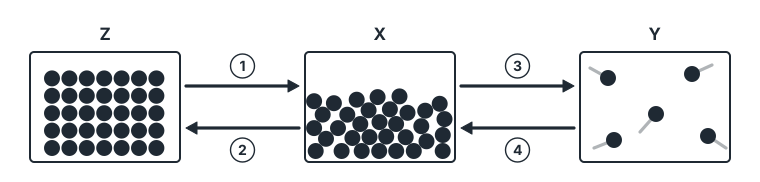
The diagram shows the particles of one substance in three states, Z, X and Y, and four changes of state between them, numbered 1 to 4. (a) Identify the state shown by Z, by X and by Y. (b) Identify changes 1, 2 and 4. (c) Change 3 can happen in two different ways. Identify both, and state one difference between them. (d) Describe the motion of the particles in Z and in Y. (e) Supplement. State which of Z, X and Y can be compressed easily, and explain why, in terms of the particles. (f) Supplement. A pupil says: “The forces between the particles are strongest in Y, because its particles move fastest.” Explain why the pupil is incorrect. (g) A pupil says that in change 1 the particles get bigger. Explain why this is incorrect.
(a) States Z, X and Y
(b) Changes 1, 2 and 4
(c) Two ways for change 3
(d) Motion in Z and in Y
(e) Easily compressed
(f) Strongest forces?
(g) Bigger particles?
2. state / describe / explain / give / calculate / suggest / predict
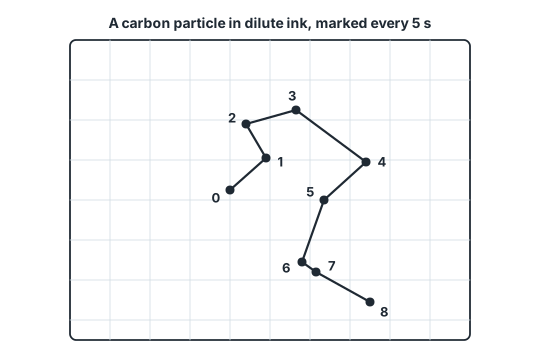
A drop of dilute ink contains tiny particles of carbon. One carbon particle is watched through a microscope, and its position is marked every 5 s. The diagram shows the result. (a) State the name of this kind of motion, and what it is evidence for. (b) Describe two features of the path that show that the motion is random. (c) Explain, in terms of collisions, why the carbon particle moves like this. (d) Supplement. A pupil writes: “Each carbon atom in the ink is pushed about by the water.” Explain what is incorrect in the pupil’s sentence, and give a correct version. (e) Supplement. The carbon particle has a mass of about 1 × 10⁻¹⁶ kg, and a water molecule about 3 × 10⁻²⁶ kg. Calculate how many times heavier the carbon particle is, and use your answer to explain why the effect of one hit cannot be seen. (f) A pupil thinks that the particle is carried by a slow current in the drop. Suggest one observation that would show that it is moved by collisions, not by a current. (g) The drop is cooled from 20 °C to 5 °C; it is still a liquid. Predict how the motion of the carbon particle changes, and explain. (h) Explain, in terms of the kinetic energy of its particles, why the ink can never be cooled below about −273 °C.
(a) The name of the motion, and what it shows
(b) Two signs that it is random
(c) Why it moves
(d) Correct the sentence
(e) The mass ratio, and why one hit cannot be seen
(f) Collisions, not a current
(g) Cooling the drop
(h) Why not below −273 °C