Pupil sheet · The particle model
Solids, liquids and gases — questions
Name ______________________ Date ____________
Try every question before you use a nudge. Write in full sentences where you are asked to explain.
1. identify / explain
A sealed 1000 cm³ plastic bottle holds 300 cm³ of water, and air fills the rest of it. The bottle is laid on its side. Which statement is correct? Then explain your choice.
Circle one answer.
- The water spreads along the bottle, so it now takes up more than 300 cm³
- The water keeps its upright shape, so it still takes up exactly 300 cm³
- The water takes a new shape but still takes up 300 cm³; air fills the rest
- The air is squashed into one bubble, so the water now takes up 700 cm³
Why?
Nudge (only if you are stuck): Shape and volume are two different properties. Which one does a liquid keep when its container is tipped, and what does a gas always do in its container?
2. identify
Match each property to the state or states of matter that have it.
Write the number of the matching option.
- solid only
- liquid only
- gas only
- liquid and gas
- solid and liquid
- solid, liquid and gas
- Has a fixed shape: ______
- Takes the shape of its container but keeps its volume: ______
- Spreads out to fill its whole container: ______
- Is easily compressed: ______
- Flows: ______
- Has a fixed volume: ______
Nudge (only if you are stuck): Picture a stone, a glass of lemonade and the air in a bicycle pump. Which of them keep their shape, which keep their volume, which flow, and which can be squashed?
3. identify
Match each event to the change of state it shows. One of them is not a change of state at all.
Write the number of the matching option.
- melting
- freezing (solidification)
- boiling
- evaporation
- condensation
- not a change of state
- Butter in a warm pan goes soft and runny: ______
- Molten candle wax drips onto a table and sets hard: ______
- Drops of dew form on grass on a cold, clear night: ______
- The water level in a fish tank slowly falls, with no leak: ______
- A pan of water for pasta bubbles hard at 100 °C: ______
- Instant coffee granules disappear when hot water is added: ______
Nudge (only if you are stuck): For each event ask: what state was the substance in before, and what state is it in after? If it has only spread out among the particles of another substance, it has not changed state.
4. identify
Supplement. Match each substance to the particles it is made of.
Write the number of the matching option.
- separate single atoms
- molecules of joined atoms
- positive ions and free electrons
- positive and negative ions
- Helium gas in a party balloon: ______
- Water in a glass: ______
- A copper wire: ______
- A crystal of salt (sodium chloride): ______
Nudge (only if you are stuck): First decide what kind of substance each one is: a noble gas, a compound of non-metals, a metal, or a compound of a metal with a non-metal.
5. identify / explain
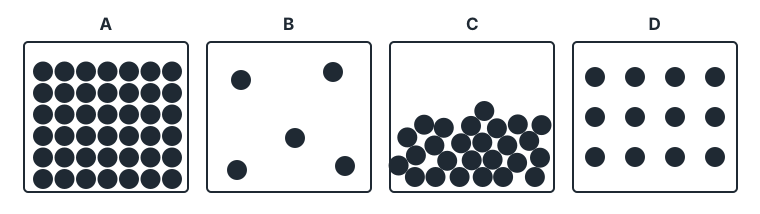
The diagram shows four boxes of particles, A to D. Which box shows the particles of a liquid? Then explain your choice.
Circle one answer.
- Box A
- Box B
- Box C
- Box D
Why?
Nudge (only if you are stuck): Check two things for each box: are the particles touching, and are they in a regular pattern?
6. describe
A closed flask that contains only steam is cooled steadily until all the water inside it is ice. Put the stages in order, from first to last.
Write the number of each step in order.
- The water freezes: the particles settle into fixed positions
- Steam: the particles are far apart, moving fast in random directions
- Ice: the particles vibrate about fixed positions, in a regular pattern
- The steam condenses: the particles come close together
- Water: the particles are close together, sliding past each other
- Step 1: ______
- Step 2: ______
- Step 3: ______
- Step 4: ______
- Step 5: ______
Nudge (only if you are stuck): Two of the stages are changes of state. Each of the others describes the particles in one state.
7. identify / explain
Supplement. Which of these statements about the forces and distances between particles are correct? Choose all that are correct, then explain one of your choices.
Tick every correct statement.
- In a solid, strong forces hold each particle in a fixed position
- In a gas, the forces are negligible, so the particles spread out
- A gas can be compressed because its particles are far apart
- A liquid flows because there are no forces between its particles
- A gas can be compressed because its particles get smaller
- A liquid is easily compressed, as its particles are not fixed
Explain one of your choices.
Nudge (only if you are stuck): Three are correct. Check each one against the forces, the distances and the motion of the particles in that state.
8. describe / explain
Describe the particles in (a) a solid, (b) a liquid and (c) a gas: how they are arranged, how far apart they are and how they move. (d) In a particle diagram of a gas, the circles are drawn only a few circle-widths apart. Explain why this is not to scale.
(a) Solid
(b) Liquid
(c) Gas
(d) Why a gas diagram is not to scale
Nudge (only if you are stuck): Use the same three headings for each state: arrangement, separation, motion.
9. explain
Granulated sugar is poured from a bag in a smooth stream, and it runs down the sides of the heap it makes in the bowl. Mo says that this makes sugar a liquid. Explain why Mo is incorrect, using the properties of a solid and a liquid, and the particles inside one sugar crystal.
Nudge (only if you are stuck): Look at one crystal of sugar, not the whole stream. Does one crystal keep its shape and its volume?
10. explain / identify
A volcano erupts near the sea. For each event, a pupil makes a claim. Explain why each claim is incorrect, and identify the change of state that really happens. (a) Lava flows towards the sea and sets into hard rock at about 1000 °C. Claim: “This cannot be freezing, because the lava is still very hot.” (b) Where the lava meets the sea, a white cloud forms above the water. Claim: “The white cloud is steam, a gas.” (c) Over the next week, the rock pools on the cooled lava dry out, without ever bubbling. Claim: “The water in the pools boiled away.”
(a) Lava setting into rock
(b) The white cloud
(c) The rock pools
Nudge (only if you are stuck): For each event, ask what state the substance is in before and after. Then check the claim against the definition of each change in “Changing state”.
11. explain
Supplement. A block of iron and a small spill of water lie side by side on a table. The iron keeps its own shape. The water spreads out over the table top, but its volume does not change. Explain the difference, in terms of the forces between the particles and how the particles move.
Nudge (only if you are stuck): Both have their particles close together. What is different about how strongly the particles are held, and so how they can move?
12. calculate / explain
In a particle diagram, Asha draws each particle of a gas as a circle 4 mm across. In real air, the distance from one molecule to the next is about ten times the size of a molecule. Calculate about how far apart the centres of neighbouring circles should be if Asha drew the gas to scale.
Distance from centre to centre, drawn to scale: ______________ unit ________
Explain why a particle diagram of a gas is almost never drawn to scale.
Nudge (only if you are stuck): Use the width of one circle as the size of one molecule.
13. identify / explain
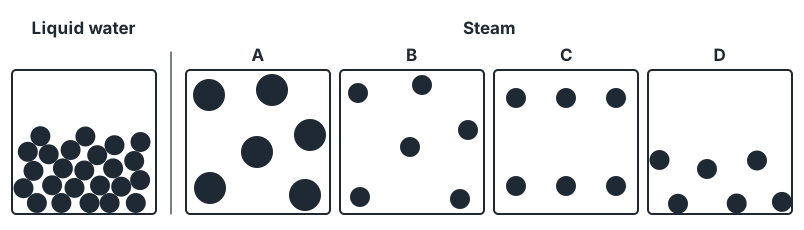
A pupil draws a particle diagram of some liquid water, on the left of the figure. Four other pupils each draw a particle diagram of steam, A to D, in a box of the same size. Which diagram of steam is correct? Then explain why diagram A is incorrect.
Circle one answer.
- Diagram A
- Diagram B
- Diagram C
- Diagram D
Why is diagram A incorrect?
Nudge (only if you are stuck): Compare each steam diagram with the water diagram: the size of the circles, how far apart they are, and where they are in the box. Does a change of state change the particles themselves?
14. explain / describe / identify
A scuba diver carries a steel tank of air on her back. The tank holds 12 litres, but the air squashed into it would fill about 2400 litres if it were let out. (a) Supplement. Explain, in terms of the particles, how so much air fits into the tank. (b) Supplement. Explain why 2400 litres of water could not be squashed into the same tank. (c) During the dive she breathes in half of the air from the tank. Describe how the arrangement, the separation and the motion of the particles of the air left in the tank compare with before, at the same temperature. (d) The inside of her mask mists over with tiny drops of water. Identify this change of state, and explain where the water came from.
(a) So much air in the tank
(b) Why not water
(c) The air left in the tank
(d) The misted mask
Nudge (only if you are stuck): For (a) and (b), think about the space between the particles. For (c), what does a gas always do in its container? For (d), ask from which state, to which state.