Pupil sheet · Elements, compounds and mixtures
What the particles show — questions
Name ______________________ Date ____________
Try every question before you use a nudge. Write in full sentences where you are asked to explain.
1. identify
The diagrams show the particles in four substances, A to D. Each colour stands for a different kind of atom. Match each box to what it shows: an element, a compound or a mixture.
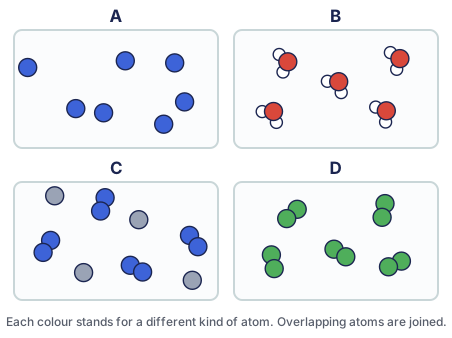
Write the number of the matching option.
- An element
- A compound
- A mixture
- Box A: ______
- Box B: ______
- Box C: ______
- Box D: ______
Boxes B and C both contain two kinds of atom. Explain why B is a compound but C is a mixture.
Nudge (only if you are stuck): For each box, first count the kinds of particle. If there's only one kind, count the kinds of atom in it.
2. identify
Methane is the main gas in natural gas. Each methane molecule is one carbon atom joined to four hydrogen atoms. A gas jar holds methane mixed with oxygen gas. Fill in each gap with a number or with one of the words element, compound or mixture.
1. Each methane molecule contains ___ kinds of atom.
2. Every particle of pure methane is the same, so pure methane is a ___.
3. The gas jar holds ___ kinds of particle.
4. So the contents of the gas jar are a ___, not a pure substance.
Nudge (only if you are stuck): In each sentence, decide first what you are counting: kinds of atom inside one particle, or kinds of particle in the jar.
3. identify / explain
The diagrams show the particles in four samples, P to S. Each colour stands for a different kind of atom. Which box shows a mixture of an element and a compound?
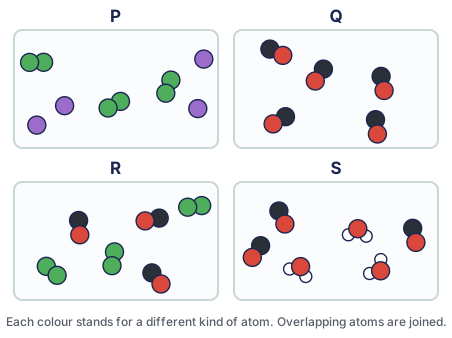
Circle one answer.
- Box P
- Box Q
- Box R
- Box S
Identify what one other box shows, and explain why.
Nudge (only if you are stuck): Find the boxes with more than one kind of particle first. Then check what each kind of particle is.
4. calculate / explain
Ammonia is a compound of nitrogen and hydrogen. Each ammonia molecule is one nitrogen atom joined to three hydrogen atoms. A particle diagram of pure ammonia gas shows 48 atoms in all. Calculate the number of hydrogen atoms in the diagram.
Number of hydrogen atoms in the diagram: ______________ unit ________
A particle diagram of nitrogen gas mixed with hydrogen gas also shows 48 atoms. Explain why the number of hydrogen atoms in it cannot be calculated.
Nudge (only if you are stuck): Start with one ammonia molecule: how many atoms does it have?
5. identify
Chlorine gas, Cl2, is made of pairs of chlorine atoms joined together. Hydrogen chloride gas, HCl, is made of molecules of one hydrogen atom joined to one chlorine atom. Hydrochloric acid is hydrogen chloride gas dissolved in water. Which row is correct?
| Row | Chlorine | Hydrogen chloride | Hydrochloric acid |
|---|---|---|---|
| A | element | compound | mixture |
| B | compound | compound | compound |
| C | element | compound | compound |
| D | element | mixture | mixture |
Circle one answer.
- A
- B
- C
- D
Nudge (only if you are stuck): For each substance, ask: how many kinds of particle, and how many kinds of atom in each particle?
6. state / describe
A glass of pure ethanol and a glass of ethanol mixed with water look exactly the same: clear and colourless. Each ethanol molecule is two carbon atoms, six hydrogen atoms and one oxygen atom joined together. (a) State whether each glass holds an element, a compound or a mixture. (b) Describe how particle diagrams of the two glasses would be different.
(a) Pure ethanol and ethanol mixed with water: element, compound or mixture
(b) How their particle diagrams differ
Nudge (only if you are stuck): Looking doesn't help here. What is inside each glass?
7. state / describe / explain
Brass, used for door handles and trumpets, is made by melting copper and zinc together and letting the liquid set. Different kinds of brass contain different amounts of copper, from about 60% to 90% by mass, and their colour and hardness change with the amount of copper. Iron sulfide is also a solid made of two kinds of atom, and every sample of it has one iron atom for every sulfur atom. (a) State whether brass is an element, a compound or a mixture, and give one piece of evidence from the description. (b) Describe how particle diagrams of two different kinds of brass would differ from each other. Explain why two particle diagrams of iron sulfide would not differ in this way.
(a) Element, compound or mixture, with one piece of evidence
(b) How two brass diagrams differ, and why two iron sulfide diagrams don't
Nudge (only if you are stuck): What does the description tell you about the amount of copper in different kinds of brass? For (b), think about the ratio of the two kinds of atom in each diagram.