Pupil sheet · Elements, compounds and mixtures
Elements, compounds and mixtures — final check
Name ______________________ Date ____________
Work alone, with the lesson closed. Answer every question; there are no hints.
1. predict / explain / determine / deduce
Magnesium is a shiny grey metal, and oxygen is a colourless gas. A pupil holds a strip of magnesium in a Bunsen flame, and a white powder, magnesium oxide, forms. (a) Predict one observation that would show that the change itself gives out energy. (b) Explain why the white powder is evidence that a compound formed, and not a mixture. (c) Two samples of magnesium oxide are analysed. Sample 1 has a mass of 5.0 g and contains 3.0 g of magnesium. Sample 2 has a mass of 8.0 g and contains 4.8 g of magnesium. Determine the mass of oxygen in each sample, and deduce whether the two samples have the same ratio of magnesium to oxygen.
(a) One observation that shows the change gives out energy
(b) Why the white powder is evidence of a compound
(c) The oxygen in each sample, and whether the ratios are the same
2. identify / explain
The diagrams show the particles in three gases, X, Y and Z. Each colour stands for a different kind of atom. (a) Identify each gas as an element, a compound or a mixture, giving a reason from its diagram. (b) A pupil says: "Gas Y contains three kinds of atom, so it must be a mixture." Explain why the pupil is incorrect.
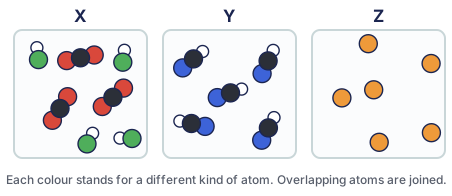
(a) X, Y and Z: element, compound or mixture, each with a reason
(b) Why the pupil is incorrect about gas Y