Pupil sheet · Transpiration
Water vapour leaves the leaves — questions
Name ______________________ Date ____________
Try every question before you use a nudge. Write in full sentences where you are asked to explain.
1. describe
Which of these describes transpiration?
Circle one answer.
- The loss of water vapour from leaves
- The loss of drops of liquid water from leaves
- The uptake of water by the roots
- The movement of water up the stem
Nudge (only if you are stuck): Think about what is lost from the plant, and from where.
2. explain
A clear plastic bag is tied over some leaves of a pot plant and left in a warm, bright place. After an hour, droplets of water cover the inside of the bag. Where did the droplets come from?
Circle one answer.
- Water from the soil crept up the outside of the stem
- Liquid water dripped out of the leaves through the stomata
- The warm air in the bag turned into water
- Water vapour from the leaves condensed on the plastic
Nudge (only if you are stuck): The leaves lost something you cannot see. What happened to it in the bag?
3. identify
The drawing shows a bubble potometer. (a) Give the letter of the part you open to push the bubble back to the start. (b) Give the letter of the air bubble. (c) Which way does the bubble move while you time it, and why?
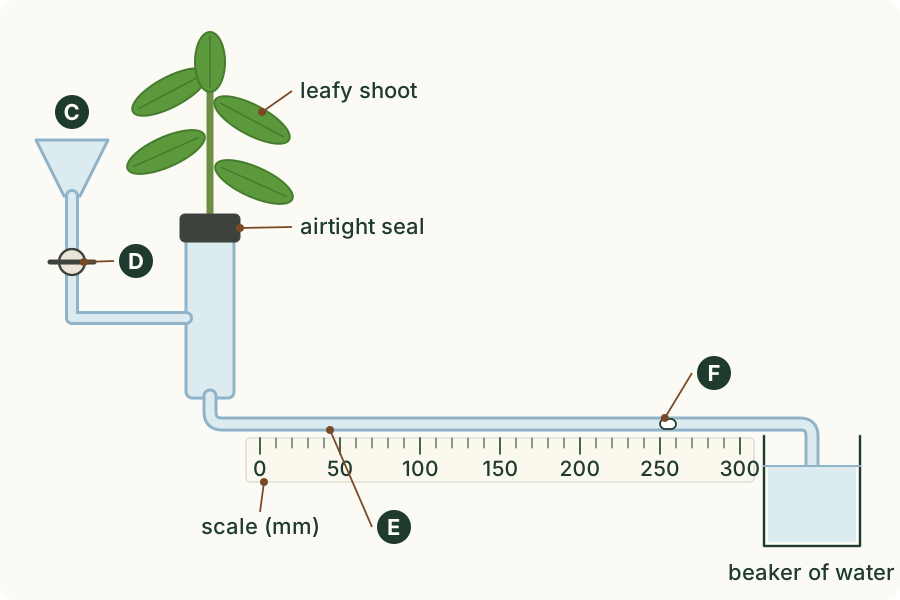
(a) The part you open
(b) The air bubble
(c) Which way, and why
Nudge (only if you are stuck): Water from the funnel pushes the bubble back. While you time, the shoot is taking water up.
4. sequence
Put these steps for timing a potometer run in order.
Write the number of each step in order.
- Time 2 minutes and read the same edge of the bubble
- Let one air bubble into the narrow tube
- Open the reservoir tap to push the bubble back to the start
- Close the tap
- First: ______
- Second: ______
- Third: ______
- Last: ______
Nudge (only if you are stuck): The bubble has to be in the tube, and at the start, before you time it.
5. calculate
In a potometer, the left edge of the bubble (the edge nearer the shoot) was at 250 mm when the clock started and at 232 mm after 2 minutes. Work out (a) the distance the bubble moved and (b) the rate of water uptake.
(a) Distance moved: ______________ unit ________
(b) Rate of water uptake: ______________ unit ________
Nudge (only if you are stuck): Subtract the two readings, then divide by the time.
6. explain
A pupil says: "A potometer measures how much water the shoot loses." Explain why this is not quite right, and why a potometer is still useful for studying transpiration.
Nudge (only if you are stuck): Where is the bubble: on the way in, or on the way out?
7. state
Complete the sentences about how water turns into vapour inside a leaf and leaves it.
Inside the leaf, liquid water turns into water vapour at the surfaces of the … cells.
This change is called … .
The vapour collects in the … between the cells,
then leaves the leaf by …
through pores called … .
Nudge (only if you are stuck): Two gaps name processes: a change of state, and how a gas spreads out. The others are places in the leaf.
8. sequence
Put these stages in the order that water goes through them as it leaves a leaf.
Write the number of each step in order.
- Water vapour diffuses out through the stomata
- Water evaporates from the surfaces of the mesophyll cells into the air spaces
- Water in the xylem of a vein
- Water moves into the mesophyll cells
- First: ______
- Second: ______
- Third: ______
- Last: ______
Nudge (only if you are stuck): Start where the water arrives in the leaf.
9. identify
Choose all the statements that are true about how water leaves a leaf.
Tick every correct statement.
- The guard cells pump water vapour out of the leaf
- Water evaporates from the surfaces of the mesophyll cells into the air spaces
- Water vapour diffuses out of the leaf through the stomata
- Water evaporates straight out of the veins
- Drops of liquid water are pushed out through the stomata
- There is more water vapour in the air spaces than in the air outside the leaf
Nudge (only if you are stuck): Two processes happen: one inside the leaf, one through the pores.
10. explain
Supplement. The drawing shows the lower epidermis of a leaf under a microscope: it has 16 stomata. The same area of the upper epidermis of the same leaf has 5 stomata. (a) Which surface of this leaf loses more water vapour? (b) Explain why.
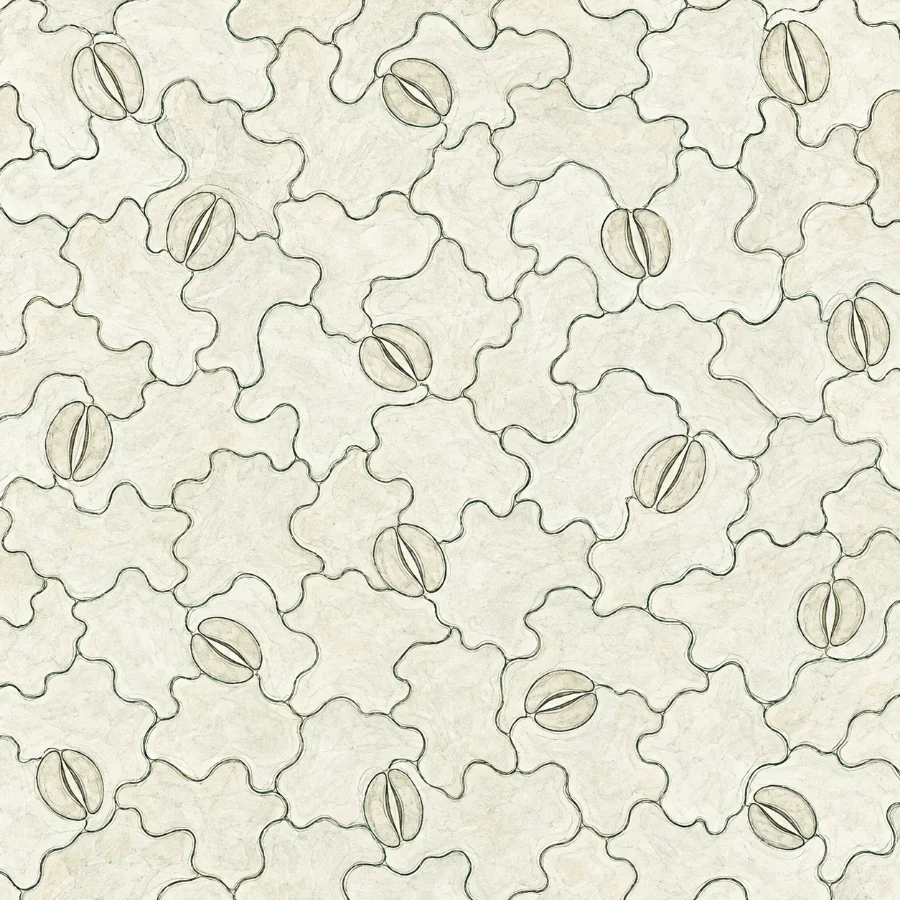
(a) Which surface
(b) Why
Nudge (only if you are stuck): Water vapour leaves through the stomata.
11. explain
Supplement. Explain how the interconnecting air spaces between the mesophyll cells affect the loss of water vapour from a leaf.
Nudge (only if you are stuck): What do the air spaces give the cells that faces the air?
12. calculate / suggest
Two shoots of the same plant are timed in matched potometers in the same room. Shoot P has 12 leaves; its bubble moves 30 mm in 2 minutes. Shoot Q has 4 leaves; its bubble moves 10 mm in 2 minutes. (a) Work out the rate of water uptake of each shoot. (b) Suggest why P takes up water faster.
(a) The two rates
(b) Why P is faster
Nudge (only if you are stuck): Divide each distance by 2. Then think about where the water is lost from.
13. predict / explain
A pupil spreads a thin layer of petroleum jelly, which water vapour cannot pass through, over the lower surface of every leaf of a shoot in a potometer. Most stomata of this plant are on the lower surface. Predict what happens to the rate of water uptake, and explain your prediction.
Nudge (only if you are stuck): Where does water vapour leave the leaf?
14. explain
Supplement. Two bean varieties grow side by side in a hot field. In the same area of leaf, variety X has twice as many stomata as variety Y, and the mesophyll cells of X are more loosely packed, with more air spaces between them. Which variety will need watering more often? Explain your answer using the structure of the leaves.
Nudge (only if you are stuck): Water evaporates into the air spaces, then the vapour diffuses out through the stomata.