Pupil sheet · Respiration
Muscles and the oxygen debt — questions
Name ______________________ Date ____________
Try every question before you use a nudge. Write in full sentences where you are asked to explain.
1. state
Complete the word equation for anaerobic respiration in muscles during vigorous exercise.
glucose → …
Nudge (only if you are stuck): There is only one product, and it is an acid.
2. identify
When do muscle cells respire anaerobically?
Circle one answer.
- During vigorous exercise, and they stop respiring aerobically
- After vigorous exercise, while the oxygen debt is being repaid
- During gentle exercise, whenever they need any extra energy
- During vigorous exercise, when oxygen cannot reach them fast enough
Nudge (only if you are stuck): Think of a sprint. Can the blood bring oxygen fast enough?
3. identify
Choose all the statements that are true about anaerobic respiration in muscles.
Tick every correct statement.
- It makes carbon dioxide
- It makes lactic acid
- It replaces aerobic respiration, which stops
- It makes alcohol
- It releases much less energy per glucose molecule than aerobic respiration
- It does not use oxygen
Nudge (only if you are stuck): Compare it with yeast: which products are missing in muscles?
4. explain
After exercise, the lactic acid made in the muscles is broken down by aerobic respiration, and this releases more energy. Use this fact to explain why anaerobic respiration in muscles releases much less energy per glucose molecule than aerobic respiration.
Nudge (only if you are stuck): If energy can still be released from lactic acid, what does that tell you about the lactic acid?
5. identify
Supplement. What is the oxygen debt?
Circle one answer.
- The extra oxygen needed after vigorous exercise to remove the lactic acid that built up
- The extra oxygen needed after vigorous exercise to refill the lungs, which had emptied
- The extra oxygen needed during vigorous exercise to stop lactic acid from being made
- The extra oxygen needed after vigorous exercise to remove the carbon dioxide that built up
Nudge (only if you are stuck): It is paid back after the exercise. What has to be removed?
6. calculate
Supplement. The table shows the oxygen a speed skater took in at rest, during 5 minutes of hard skating, and in each minute after it. Calculate (a) how much more oxygen per minute she took in during the skating than at rest, (b) the total extra oxygen, above the resting level, that she took in during the 6 minutes after the skating, and (c) this total in cm³. 1 dm³ = 1000 cm³.
| Time | Oxygen taken in (dm³ per minute) |
|---|---|
| at rest, before the skating | 0.4 |
| each minute of the skating | 2.8 |
| 1st minute after | 1.9 |
| 2nd minute after | 1.2 |
| 3rd minute after | 0.8 |
| 4th minute after | 0.6 |
| 5th minute after | 0.5 |
| 6th minute after | 0.4 |
(a) Extra oxygen per minute during the skating: ______________ unit ________
(b) Total extra oxygen after the skating: ______________ unit ________
(c) The total in cm³: ______________ unit ________
Nudge (only if you are stuck): The oxygen debt is only the oxygen above the resting level.
7. explain
Supplement. Use the graph. Explain why the person goes on taking in more oxygen than at rest for several minutes after the exercise has stopped.
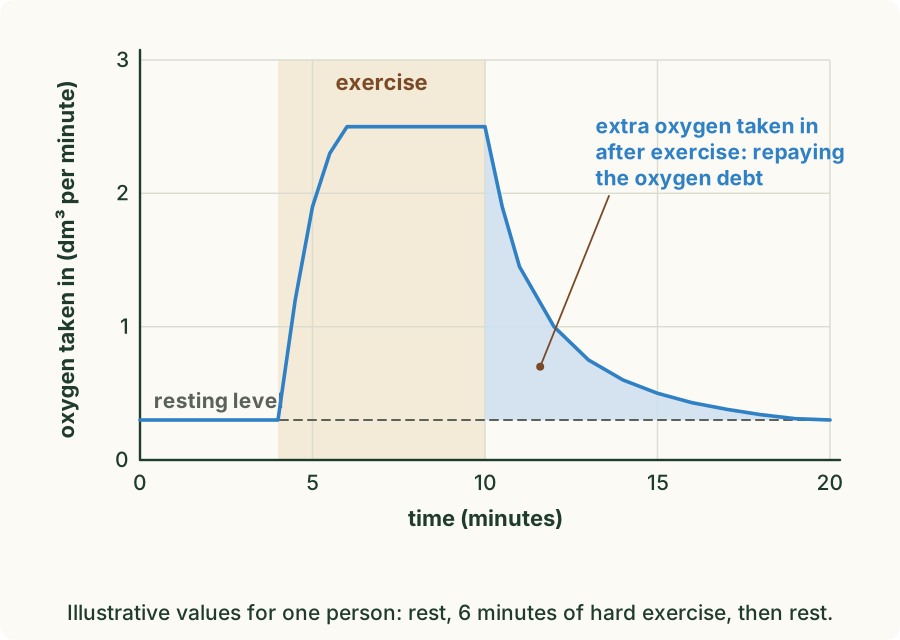
Nudge (only if you are stuck): What built up during the exercise, and what is needed to remove it?
8. sequence
Supplement. After a sprint, put these steps in order to show how the lactic acid is removed.
Write the number of each step in order.
- Lactic acid passes into the blood
- The liver breaks down the lactic acid by aerobic respiration, using oxygen from the deeper, faster breathing
- Lactic acid has built up in the muscles
- The fast heart rate carries the blood to the liver
- First: ______
- Second: ______
- Third: ______
- Last: ______
Nudge (only if you are stuck): Start where the lactic acid was made; finish where it is broken down.
9. determine / describe / suggest
Supplement. A pupil skipped as fast as she could for 3 minutes. The table shows her heart rate and the lactic acid in her blood afterwards. (a) Determine how long after the skipping it took for the lactic acid to fall to half its value at 0 minutes. (b) Describe how her heart rate changed after the skipping. Use numbers from the table. (c) Suggest why her heart rate stays above its resting value for as long as there is extra lactic acid in her blood.
| Time after the skipping (minutes) | Heart rate (beats per minute) | Lactic acid in the blood (mmol per dm³) |
|---|---|---|
| at rest, before | 66 | 1.0 |
| 0 | 152 | 8.0 |
| 4 | 118 | 6.0 |
| 8 | 94 | 4.0 |
| 12 | 78 | 2.0 |
| 16 | 68 | 1.0 |
(a) Time for the lactic acid to halve
(b) The heart rate after the skipping
(c) Why the heart rate stays high
Nudge (only if you are stuck): (a) First work out half of the value at 0 minutes. (c) Where does the blood take lactic acid?
10. identify
Supplement. Match each part of the body to how it helps remove the oxygen debt after exercise.
Write the number of the matching option.
- Breaks down lactic acid by aerobic respiration
- Transports lactic acid in the blood from the muscles to the liver
- Supplies oxygen for the aerobic respiration of lactic acid
- A fast heart rate continues: ______
- Deeper and faster breathing continues: ______
- The liver: ______
Nudge (only if you are stuck): Follow the lactic acid: how does it travel, where does the oxygen come from, and where is it broken down?
11. identify
Supplement. While a pupil dances fast for 10 minutes, her heart rate rises from 72 to 140 beats per minute. Which row explains the rise?
| Row | The working muscle cells… | so the blood must… |
|---|---|---|
| A | respire faster, using more oxygen and glucose and making more carbon dioxide | bring oxygen and glucose, and remove carbon dioxide, faster |
| B | make more oxygen as they contract | carry the extra oxygen to the lungs faster |
| C | stop respiring aerobically and make only lactic acid | carry the lactic acid to the lungs to be breathed out |
| D | respire faster, using more oxygen and glucose and making more carbon dioxide | flow more slowly, to give more time for diffusion in the muscles |
Circle one answer.
- A
- B
- C
- D
Nudge (only if you are stuck): What do working muscle cells use more of, and what do they make more of?
12. suggest
Supplement. After the same 400 m race, a trained athlete's breathing is back to normal in 5 minutes, but an untrained runner's takes 15 minutes. Suggest why.
Nudge (only if you are stuck): Whose muscles respired anaerobically more during the race?
13. compare
Compare anaerobic respiration in yeast and in human muscles. Give (a) one way they are the same and (b) two ways they are different.
(a) The same
(b) Two differences
Nudge (only if you are stuck): Write the two word equations side by side.
14. suggest
Supplement. Suggest why a person whose liver is damaged takes longer to get their breath back after vigorous exercise.
Nudge (only if you are stuck): What job does the liver do after vigorous exercise?