Pupil sheet · Respiration
Energy from food — questions
Name ______________________ Date ____________
Try every question before you use a nudge. Write in full sentences where you are asked to explain.
1. identify
Choose all the things that living organisms use the energy from respiration for.
Tick every correct statement.
- The passage of nerve impulses
- Muscle contraction
- Protein synthesis
- Active transport
- Osmosis of water into a root hair cell
- Diffusion of oxygen into a cell
Nudge (only if you are stuck): Look for processes where a cell has to do work: moving something, making something or carrying something.
2. identify
Match each activity to the use of energy it needs.
Write the number of the matching option.
- Protein synthesis
- Muscle contraction
- Active transport
- Cell division
- A leg muscle shortens during a sprint: ______
- A root hair cell takes in nitrate ions from soil that has fewer of them than the cell: ______
- Skin cells make new cells to heal a cut: ______
- A gland cell makes the enzyme amylase from amino acids: ______
Nudge (only if you are stuck): For each activity, ask: is something moving, being made, being copied or being carried in?
3. identify
Which row describes aerobic respiration?
| Row | Where it happens | What it uses | Nutrient molecules are | Energy is |
|---|---|---|---|---|
| A | in the lungs | oxygen | broken down | released |
| B | in cells | oxygen | broken down | released |
| C | in cells | carbon dioxide | broken down | released |
| D | in cells | oxygen | broken down | made |
Circle one answer.
- A
- B
- C
- D
Nudge (only if you are stuck): Aerobic means "with oxygen". Check each column of each row: where, what is used, and what happens to the energy.
4. state
Complete the word equation for aerobic respiration.
glucose + … →
… + water
Nudge (only if you are stuck): One substance joins glucose at the start. Water is one of the two substances made.
5. explain
A pupil says: "A potato in a dark cupboard is not using any energy. It has no light, no muscles and no nerves." Explain why this is incorrect.
Nudge (only if you are stuck): Is the potato alive? What do living cells do all the time, even in the dark?
6. calculate
Another class repeated the vacuum flask experiment with germinating mung beans and boiled mung beans. Use their results. Calculate (a) the rise in temperature of the germinating beans from day 0 to day 3, and (b) the difference in temperature between the two flasks on day 2.
| Day | Germinating mung beans (°C) | Boiled mung beans (°C) |
|---|---|---|
| 0 | 18.5 | 18.5 |
| 1 | 19.5 | 18.5 |
| 2 | 21.5 | 18.5 |
| 3 | 23.0 | 18.5 |
(a) Rise in temperature of the germinating beans: ______________ unit ________
(b) Difference between the flasks on day 2: ______________ unit ________
Nudge (only if you are stuck): Which two temperatures does each part compare?
7. explain
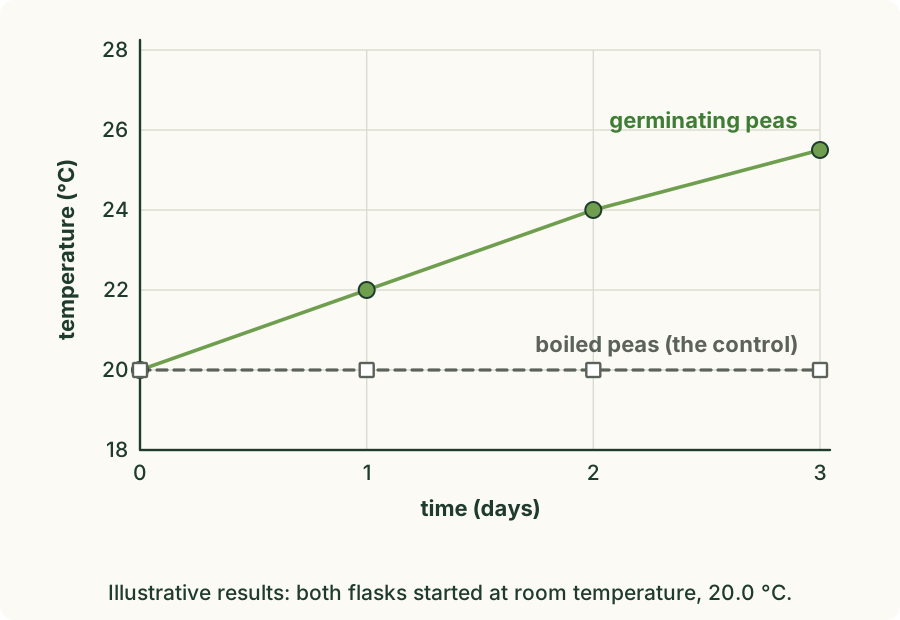
The graph shows results from the pea experiment set up as in the reading. Three other pupils each changed one thing. Explain each result. (a) Pupil 1 did not rinse her boiled peas in disinfectant. After 3 days her boiled peas were 3 °C warmer than at the start. (b) Pupil 2 used two glass beakers instead of vacuum flasks. His germinating peas never became more than 0.5 °C warmer than the boiled peas. (c) Pupil 3 closed each flask with a rubber bung instead of cotton wool. After the first day her germinating peas warmed more and more slowly.
(a) No disinfectant
(b) Glass beakers
(c) A rubber bung
Nudge (only if you are stuck): For each change, ask: what was that part of the method there for?
8. identify
Where, and when, does respiration happen in a person?
Circle one answer.
- Only in muscle cells, during exercise
- Inside every living cell, all the time
- In the blood, while it carries oxygen
- In the lungs, each time you breathe in
Nudge (only if you are stuck): Which cells need energy, and when do they need it?
9. explain / state
A pupil writes the word equation for aerobic respiration as: glucose + carbon dioxide → oxygen + water. (a) Explain what is wrong with it. (b) State the correct word equation.
(a) What is wrong
(b) The correct word equation
Nudge (only if you are stuck): Which gas do respiring cells take in, and which gas do they give off?
10. state
Supplement. Complete the balanced chemical equation for aerobic respiration by filling in the three numbers.
C6H12O6 + …O2 →
…CO2 +
…H2O
Nudge (only if you are stuck): One glucose molecule has 6 carbon atoms and 12 hydrogen atoms. Where do they end up?
11. calculate
Supplement. A root hair cell respires aerobically and gives off 24 molecules of carbon dioxide. Use the balanced chemical equation to calculate (a) the number of glucose molecules it broke down, and (b) the number of oxygen molecules it used.
(a) Glucose molecules broken down: ______________ unit ________
(b) Oxygen molecules used: ______________ unit ________
Nudge (only if you are stuck): The equation is written for one glucose molecule. How many carbon dioxide molecules does one glucose molecule give?
12. suggest
A mouse and a lizard have the same body mass. In a room at 15 °C, the mouse uses many times as much oxygen each hour as the lizard. Suggest why.
Nudge (only if you are stuck): Which use of energy does a mouse have that a lizard does not?
13. suggest
Waterlogged soil has almost no air between its particles. Roots in waterlogged soil take up far fewer mineral ions. Suggest why.
Nudge (only if you are stuck): How do root hair cells take in mineral ions from soil that has fewer of them, and what does that need?
14. predict / explain
Carbon dioxide turns limewater milky. Air with no carbon dioxide in it is pumped slowly through a flask of germinating wheat grains, then bubbled through limewater. A second flask, the same but with boiled wheat grains, is set up beside it. Predict what happens to the limewater after each flask, and explain.
Nudge (only if you are stuck): Which grains respire? What does respiration give off?
15. suggest / explain
Supplement. In a hospital test, a person drinks some glucose whose carbon atoms are of a special kind that a machine can detect. A few minutes later, the machine finds these carbon atoms in the air the person breathes out. Use the balanced chemical equation for aerobic respiration to suggest (a) which substance carries these carbon atoms out of the body, and how it reaches the lungs, and (b) how many molecules of it each glucose molecule gives, and why none of the carbon leaves in the water the person makes.
(a) The substance, and how it reaches the lungs
(b) Molecules from each glucose molecule, and why not water
Nudge (only if you are stuck): Find the 6 carbon atoms of C6H12O6 on the right of the equation. Which product has carbon in it?