Pupil sheet · Respiration
Yeast, bread and temperature — questions
Name ______________________ Date ____________
Try every question before you use a nudge. Write in full sentences where you are asked to explain.
1. identify
Which row describes anaerobic respiration?
| Row | Oxygen | Nutrient molecules such as glucose | Energy released per glucose molecule, compared with aerobic respiration |
|---|---|---|---|
| A | used | broken down | much less |
| B | not used | not used | much less |
| C | not used | broken down | much less |
| D | not used | broken down | more |
Circle one answer.
- A
- B
- C
- D
Nudge (only if you are stuck): "An-" means "without". Check each column of each row, one at a time.
2. state
Complete the word equation for anaerobic respiration in yeast.
glucose → …
+ …
Nudge (only if you are stuck): One product is the gas that makes bread dough rise; the other is in beer and wine.
3. identify
The drawing shows the yeast apparatus with five parts lettered. Match each letter to its job.
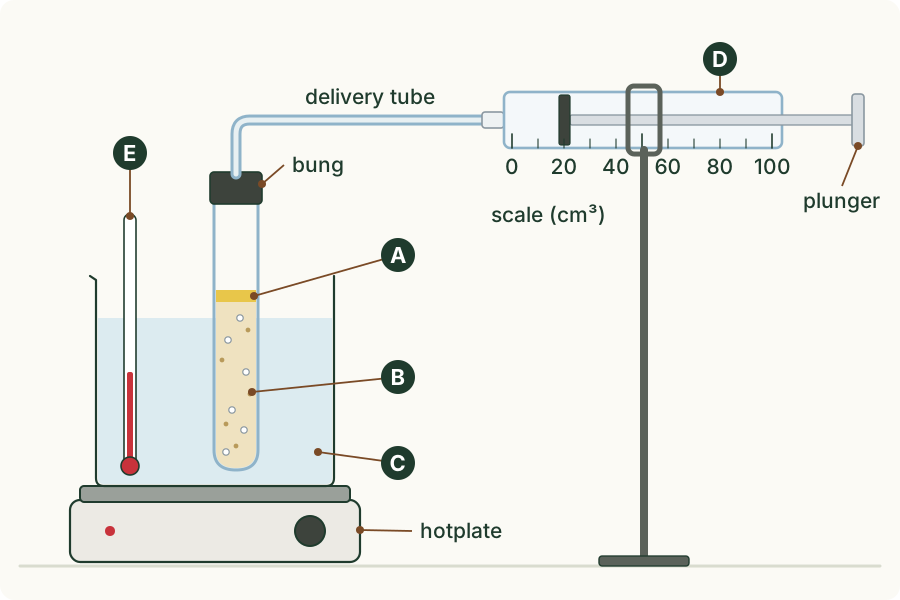
Write the number of the matching option.
- Respires and gives off the gas
- Shows the temperature of the bath
- Stops oxygen from the air dissolving in the solution
- Keeps the tube at the temperature being tested
- Collects the gas and measures its volume
- Part A: ______
- Part B: ______
- Part C: ______
- Part D: ______
- Part E: ______
Nudge (only if you are stuck): Follow the gas: where is it made, where does it go, and what keeps everything at one temperature?
4. calculate
In a yeast run at 35 °C, the gas syringe read 5 cm³ when the clock started and 21 cm³ after 5 minutes. Calculate (a) the volume of gas collected and (b) the rate of gas production.
(a) Volume of gas collected: ______________ unit ________
(b) Rate of gas production: ______________ unit ________
Nudge (only if you are stuck): Where was the plunger when the clock started?
5. sequence
Put these steps for one timed yeast run in order.
Write the number of each step in order.
- Stand the tube in the water bath and connect it to the gas syringe
- After 5 minutes, read the syringe again
- Make up a fresh tube of yeast in boiled and cooled glucose solution, with a layer of oil on top
- Leave it for 10 minutes to reach the temperature of the bath
- Note the syringe reading and start the stop-clock
- First: ______
- Second: ______
- Third: ______
- Fourth: ______
- Last: ______
Nudge (only if you are stuck): The tube has to reach the temperature of the bath before anything is timed.
6. explain
In the yeast method, explain why (a) the glucose solution is boiled and cooled before the yeast is added, (b) a few drops of oil are run onto the solution, and (c) the tube is left in the bath for 10 minutes before the clock starts.
(a) Boiled and cooled
(b) The oil
(c) The 10 minutes
Nudge (only if you are stuck): (a) needs two reasons, one for boiling and one for cooling. (b) is about a gas in the air. (c) is about the first gas that comes out of the tube.
7. calculate
Use the results table from the yeast experiment. Assume that each mean rate stays steady. Calculate (a) the volume of gas the yeast at 40 °C would give off in 12 minutes, and (b) the time the yeast at 50 °C would take to give off 36 cm³ of gas.
| Temperature (°C) | Gas in 5 minutes, run 1 (cm³) | Gas in 5 minutes, run 2 (cm³) | Mean rate (cm³ per minute) |
|---|---|---|---|
| 20 | 5 | 5 | 1.0 |
| 30 | 12 | 13 | 2.5 |
| 40 | 21 | 19 | 4.0 |
| 50 | 9 | 11 | 2.0 |
| 60 | 1 | 0 | 0.1 |
(a) Volume of gas at 40 °C in 12 minutes: ______________ unit ________
(b) Time at 50 °C to give off 36 cm³: ______________ unit ________
Nudge (only if you are stuck): A rate is the volume of gas in one minute. For (a), how many minutes are there? For (b), how many cm³ come each minute?
8. calculate / describe / explain
A class tested a different kind of yeast, two runs at each temperature. Use their results. (a) Calculate the mean rate at 32 °C. (b) Describe how the rate changes from 16 °C to 48 °C. (c) Explain why the rate falls above about 32 °C.
| Temperature (°C) | Gas in 5 minutes, run 1 (cm³) | Gas in 5 minutes, run 2 (cm³) | Mean rate (cm³ per minute) |
|---|---|---|---|
| 16 | 4 | 3 | 0.7 |
| 24 | 9 | 10 | 1.9 |
| 32 | 16 | 17 | ? |
| 40 | 12 | 14 | 2.6 |
| 48 | 4 | 5 | 0.9 |
(a) Mean rate at 32 °C
(b) Describe
(c) Explain the fall above 32 °C
Nudge (only if you are stuck): For (a), use both runs, and give the rate per minute. For (c), what controls the reactions of respiration?
9. identify
In the yeast investigation, match each variable to its role.
Write the number of the matching option.
- The variable you measure (dependent variable)
- Kept the same
- The variable you change (independent variable)
- The temperature of the water bath: ______
- The volume of gas collected in 5 minutes: ______
- The yeast, the glucose solution and the time of each run: ______
Nudge (only if you are stuck): One you choose, one you read off the syringe, and the rest you keep the same.
10. identify
Which of these cells are respiring anaerobically? Choose all that are.
Tick every correct statement.
- Yeast cells in a warm flask with air bubbled through it
- Heart muscle cells of a person sitting and reading a book
- Leg muscle cells of a runner in the last seconds of a 200 m sprint
- Yeast cells deep in bread dough, after the oxygen in it is used up
Nudge (only if you are stuck): For each one, ask: is oxygen reaching the cells fast enough for all the energy they need?
11. state
Supplement. Complete the balanced chemical equation for anaerobic respiration in yeast by filling in the two numbers.
C6H12O6 → …C2H5OH +
…CO2
Nudge (only if you are stuck): Count the hydrogen atoms in C6H12O6 and in one C2H5OH.
12. calculate
Supplement. A yeast cell respires anaerobically and makes 16 molecules of ethanol. Use the balanced chemical equation to calculate (a) the number of glucose molecules it broke down, and (b) the number of carbon dioxide molecules it made.
(a) Glucose molecules broken down: ______________ unit ________
(b) Carbon dioxide molecules made: ______________ unit ________
Nudge (only if you are stuck): The equation is written for one glucose molecule. How many ethanol molecules does one glucose molecule give?
13. state / explain
(a) The delivery tube from the yeast is put into limewater, and the limewater turns milky. State what this shows about the gas. (b) A tube of the same glucose solution with no yeast, set up and timed the same way, gives no gas. Explain what this shows.
(a) The limewater
(b) The tube with no yeast
Nudge (only if you are stuck): Limewater tests for one gas. The second tube differs from the others in one way only.
14. suggest
Another group measured the rate by counting the bubbles that came out of the end of the delivery tube under water in 1 minute. Suggest why the gas syringe gives better results than counting bubbles.
Nudge (only if you are stuck): Are all bubbles the same size? What does the syringe tell you that a count does not?
15. explain
A baker mixes bread dough using water at 70 °C. The dough does not rise. A second batch mixed with water at 35 °C rises well. Explain.
Nudge (only if you are stuck): What makes dough rise, and what does very hot water do to yeast?
16. suggest
A factory grows yeast to sell to bakers: it bubbles air through the warm sugar solution. A brewery that makes beer keeps the air out. Suggest why.
Nudge (only if you are stuck): Which kind of respiration releases more energy for growing? Which kind makes alcohol?
17. suggest / explain
Supplement. In some countries, ethanol made by yeast from sugar cane is mixed into the fuel for cars: it burns in oxygen and releases a lot of energy. Use the balanced chemical equation for anaerobic respiration in yeast to suggest (a) what happens to the 6 carbon atoms of each glucose molecule, and (b) why the yeast gets much less energy from each glucose molecule than it would by aerobic respiration.
(a) The 6 carbon atoms
(b) Why much less energy
Nudge (only if you are stuck): Count where the carbon atoms of C6H12O6 go: how many end up in CO2, and how many in C2H5OH?