Pupil sheet · The gut and physical digestion
Along the gut — questions
Name ______________________ Date ____________
Try every question before you use a nudge. Write in full sentences where you are asked to explain.
1. identify
The drawing shows the digestive system, with eight organs lettered A to H. Identify each lettered organ.
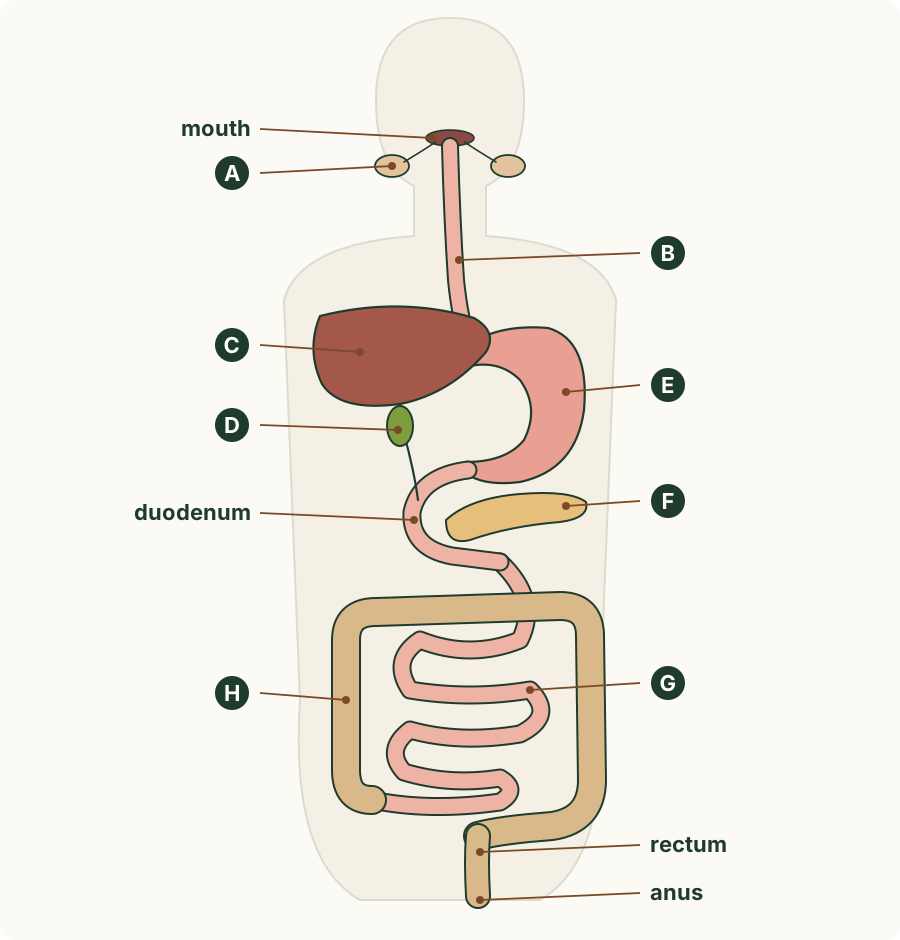
Write the number of the matching option.
- Liver
- Colon
- Oesophagus
- Salivary glands
- Gall bladder
- Ileum
- Pancreas
- Stomach
- A: ______
- B: ______
- C: ______
- D: ______
- E: ______
- F: ______
- G: ______
- H: ______
Nudge (only if you are stuck): Start from the mouth and follow the tube down. The organs beside the tube are the associated organs.
2. define
Match each process to its meaning.
Write the number of the matching option.
- The uptake and use of nutrients by cells
- The removal of undigested food from the body as faeces
- Taking substances, such as food and drink, into the body
- The breakdown of food
- The movement of nutrients from the intestines into the blood
- Ingestion: ______
- Digestion: ______
- Absorption: ______
- Assimilation: ______
- Egestion: ______
Nudge (only if you are stuck): Ingestion and egestion are the two ends; absorption and assimilation both follow digestion.
3. describe
Match each organ to its job.
Write the number of the matching option.
- Stores bile
- Stores faeces
- Carries food from the mouth to the stomach
- Makes bile, and takes up nutrients from the blood and uses or stores them
- Absorbs water from undigested food
- Makes a juice containing enzymes and sends it into the duodenum
- Absorbs digested food into the blood
- Oesophagus: ______
- Pancreas: ______
- Liver: ______
- Gall bladder: ______
- Ileum: ______
- Colon: ______
- Rectum: ______
Nudge (only if you are stuck): Use the table in the reading. Two organs deal with bile.
4. complete
Complete the description of the stomach in physical digestion.
The wall of the stomach contains thick layers of ….
They contract and relax, and … the food:
it is broken into … pieces
and mixed with ….
This increases the … of the food for enzymes.
Nudge (only if you are stuck): What is in the wall of the stomach, and what does it do to the food?
5. sequence
Supplement. Put the steps in order, from where bile is made to what it does.
Write the number of each step in order.
- Bile emulsifies fats into tiny droplets
- The enzyme digests the many tiny droplets faster
- Bile is stored in the gall bladder
- Bile flows along the bile duct into the duodenum
- Bile is made in the liver
- Step 1: ______
- Step 2: ______
- Step 3: ______
- Step 4: ______
- Step 5: ______
Nudge (only if you are stuck): Bile is made in one organ and stored in another before it reaches the fat.
6. sequence
Put the parts of the alimentary canal in the order in which food passes through them.
Write the number of each step in order.
- Stomach
- Rectum
- Ileum
- Anus
- Colon
- Duodenum
- Mouth
- Oesophagus
- Step 1: ______
- Step 2: ______
- Step 3: ______
- Step 4: ______
- Step 5: ______
- Step 6: ______
- Step 7: ______
- Step 8: ______
Nudge (only if you are stuck): The small intestine comes before the large intestine, and each has two parts.
7. classify
Identify the process in each case.
Write the number of the matching option.
- Assimilation
- Egestion
- Ingestion
- Digestion
- Absorption
- A pupil sips water: ______
- The stomach churns a meal: ______
- Vitamins and mineral ions pass from the small intestine into the blood: ______
- A bone cell uses calcium to build new bone: ______
- Fibre left over from a meal leaves the body: ______
Nudge (only if you are stuck): Into the body, broken down, into the blood, used by cells, or out of the body?
8. explain
Food never passes through the pancreas, yet the pancreas is part of the digestive system. Explain why.
Nudge (only if you are stuck): What does the pancreas make, and where does it go?
9. describe
Describe the role of the stomach in physical digestion, and explain how it helps chemical digestion.
Nudge (only if you are stuck): Its wall is muscular. What does that do to the food?
10. explain
Supplement. Explain why the emulsifying of fat by bile is physical digestion, and how it helps the chemical digestion of fat.
Nudge (only if you are stuck): Are the fat molecules changed? What happens to the size of the drops?
11. suggest
After an illness, a patient has a long part of their ileum removed. Suggest which process is affected most, and why the patient may lose weight even though they eat normally.
Nudge (only if you are stuck): What happens to digested food in the ileum?
12. suggest
In some people the muscles of the stomach wall contract only weakly. Suggest how this affects the food that leaves their stomach, and the digestion of that food.
Nudge (only if you are stuck): What do strong stomach muscles do to food?
13. calculate
Supplement. A drop of oil 2 mm across is emulsified into droplets 0.02 mm across, one hundredth as wide. When a drop is broken into droplets one tenth as wide, there are 10 × 10 × 10 = 1000 droplets and their total surface area is 10 times larger. Calculate (a) the number of droplets made here and (b) how many times larger their total surface area is.
(a) Number of droplets (digits without spaces, or as 1 × 10⁶): ______________ unit ________
(b) How many times larger the surface area: ______________ unit ________
Nudge (only if you are stuck): Use 100 in place of 10 in the rule.
14. apply
A patient swallows a capsule the size of a large vitamin pill with a tiny camera inside. It takes pictures as it passes along the gut, and leaves the body a day or two later. (a) List, in order, the parts of the alimentary canal it photographs. (b) Identify two organs of the digestive system it never photographs inside, and explain why. (c) Identify the process by which it leaves the body.
(a) The parts in order
(b) Two organs it never enters, and why
(c) How it leaves
Nudge (only if you are stuck): The camera stays inside the canal. Which organs are beside the canal?