Pupil sheet · The gut and physical digestion
Teeth — questions
Name ______________________ Date ____________
Try every question before you use a nudge. Write in full sentences where you are asked to explain.
1. identify
The drawing shows four human teeth, lettered A to D. Identify the type of each tooth.
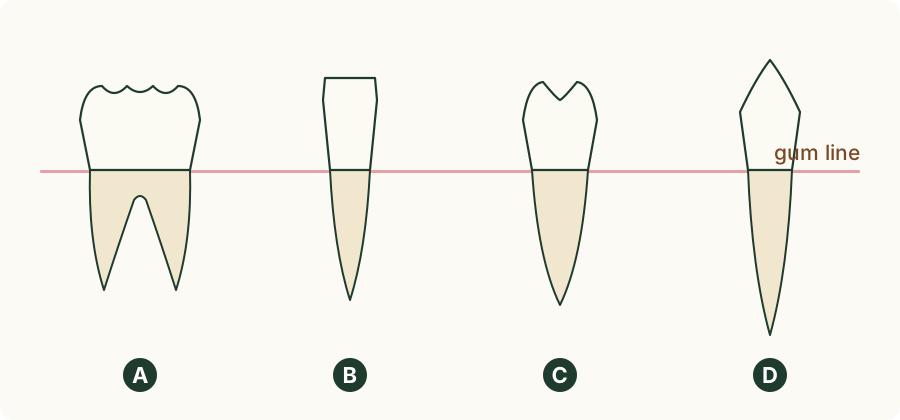
Write the number of the matching option.
- Incisor
- Premolar
- Canine
- Molar
- Tooth A: ______
- Tooth B: ______
- Tooth C: ______
- Tooth D: ______
Nudge (only if you are stuck): Look at the top of each tooth: a straight edge, one point, two cusps or a broad top with several cusps?
2. identify
The drawing shows a molar cut in half, with six parts lettered A to F. Identify each part.
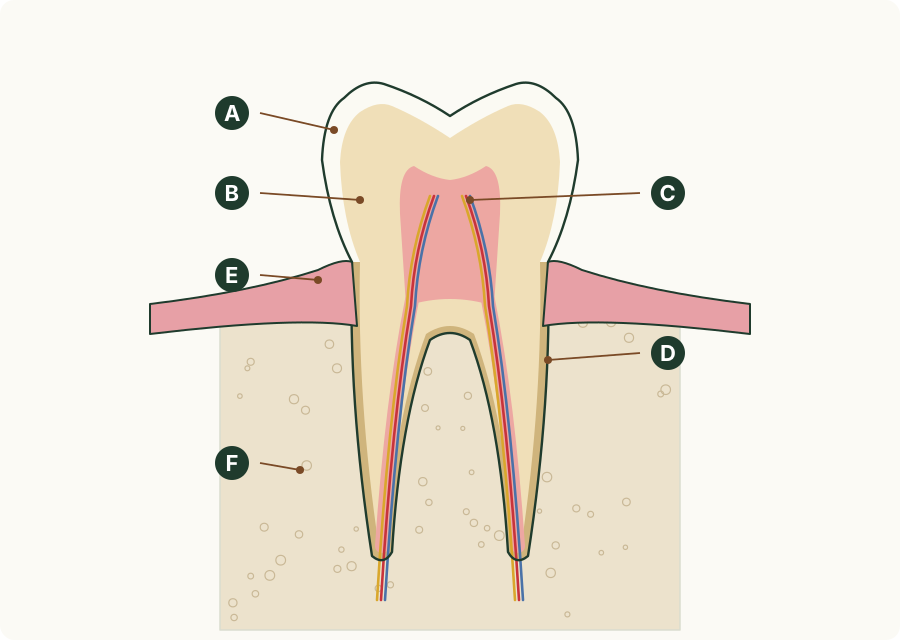
Write the number of the matching option.
- Jaw bone
- Gum
- Dentine
- Enamel
- Cement
- Pulp
- A: ______
- B: ______
- C: ______
- D: ______
- E: ______
- F: ______
Nudge (only if you are stuck): Work from the outside of the crown inwards, then look at what surrounds the root.
3. describe
Match each type of tooth to its job in physical digestion.
Write the number of the matching option.
- Crush and grind food
- Cut and bite off pieces of food
- Grip and tear food
- Incisors: ______
- Canines: ______
- Premolars: ______
- Molars: ______
Nudge (only if you are stuck): In the experiment, which tool cut and which mashed? Two types of tooth do the same job.
4. state
A full set of adult teeth has 32 teeth. Each quarter of the mouth has 2 incisors, 1 canine, 2 premolars and 3 molars. How many teeth of each type are there in the whole mouth?
Incisors: ______________ unit ________
Canines: ______________ unit ________
Premolars: ______________ unit ________
Molars: ______________ unit ________
Nudge (only if you are stuck): There are four quarters: upper left, upper right, lower left and lower right.
5. describe
Describe the structure of a human tooth, from the outside of the crown to the middle, and say how the tooth is held in place.
Nudge (only if you are stuck): Name three layers from outside to inside, what is in the middle layer, and what holds the root.
6. identify
Which statements about the structure of a tooth are correct? Choose all that are correct.
Tick every correct statement.
- The roots sit only in the gum, not in bone
- Cement helps to fix the root in the jaw bone
- Enamel is living, so a chip in it grows back
- Enamel is the hardest substance in the body
- The pulp contains nerves and blood vessels
- Dentine covers the outside of the crown
Nudge (only if you are stuck): Check each against the drawing: which layer is on the outside, and where are the nerves?
7. explain
A man has lost all his molars and premolars, but still has his incisors and canines. Explain why he finds it hard to eat nuts and raw vegetables, and how this affects the digestion of what he eats.
Nudge (only if you are stuck): Which teeth crush and grind? What can incisors do and not do?
8. identify
A tooth at the back of the mouth has a broad top with four cusps. Which type is it, and what is its job?
Circle one answer.
- A canine: it grips and tears food
- A molar: it crushes and grinds food
- An incisor: it cuts and bites off food
- A premolar: it cuts and bites off food
Nudge (only if you are stuck): Where is it, and what shape is its top?
9. explain
(a) Identify the two kinds of structure in the pulp that enter through the small hole at the tip of each root. (b) Explain why the tooth needs each of them.
(a) The two structures
(b) Why each is needed
Nudge (only if you are stuck): One senses; the other carries blood.
10. apply
A child bites into a sandwich and leaves a curved row of tooth marks in the bread. (a) Which type of teeth made most of these marks? (b) Describe what happens to the bitten-off piece next, naming the teeth that work on it.
(a) The teeth that made the marks
(b) What happens next
Nudge (only if you are stuck): Which teeth are at the front, and which deal with food after it has been bitten off?
11. explain
After a hard knock, the blood vessels going into a front tooth are torn. Months later the tooth has turned grey, and it no longer hurts when it is touched or when the patient drinks something cold. (a) Explain why it no longer feels pain or cold. (b) Suggest why the tooth can still be used for biting.
(a) Why no pain or cold
(b) Why it can still bite
Nudge (only if you are stuck): What is in the pulp, and what needs a blood supply? Which parts of the tooth are not living?
12. suggest
When you close your mouth, the cusps of your upper molars fit into the hollows between the cusps of your lower molars. Suggest how this helps the molars do their job.
Nudge (only if you are stuck): What happens to food caught between two bumpy surfaces that fit together?