Pupil sheet · The gut and physical digestion
The gut and physical digestion — final check
Name ______________________ Date ____________
Work alone, with the lesson closed. Answer every question; there are no hints.
1. describe
Grating a carrot in the kitchen breaks it up as chewing does. Describe physical digestion, and give one example of it inside the human body.
2. explain
Explain why food that has been chewed is digested faster by enzymes than food that is swallowed in large lumps.
3. calculate
A cube of cheese with sides of 4 cm is cut into 64 cubes with sides of 1 cm. Calculate (a) the surface area of the big cube and (b) the total surface area of the 64 cubes. Then say whether cutting is physical or chemical digestion, and why.
(a) Big cube: ______________ unit ________
(b) 64 small cubes together: ______________ unit ________
Physical or chemical digestion, and why
4. identify
The drawing shows one quarter of an adult jaw from above, from the middle of the jaw to the back. Each group of teeth is lettered P to S. Identify the type of tooth in each group.
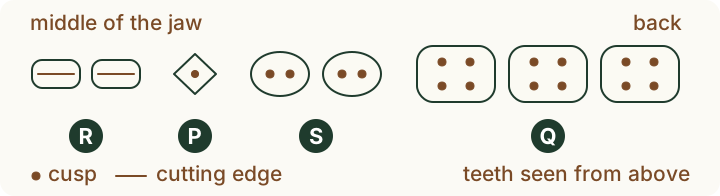
Write the number of the matching option.
- Premolars
- Molars
- Incisors
- Canine
- P: ______
- Q: ______
- R: ______
- S: ______
5. describe
A pupil says: "A tooth is a hard white stone stuck in the gum." Describe the structure of a human tooth to show what the pupil has missed: name the parts from the outside of the crown to the middle, say what the middle contains, and say how the tooth is held in the jaw.
6. describe
Describe how incisors and molars each help in the physical digestion of an apple.
7. identify
The drawing shows the digestive system again, with twelve parts lettered J to V (there is no O) in a new order. Give the letter of (a) the duodenum, (b) the rectum and (c) the anus, and the letter of the organ that (d) stores bile, (e) churns food and (f) absorbs water from undigested food.
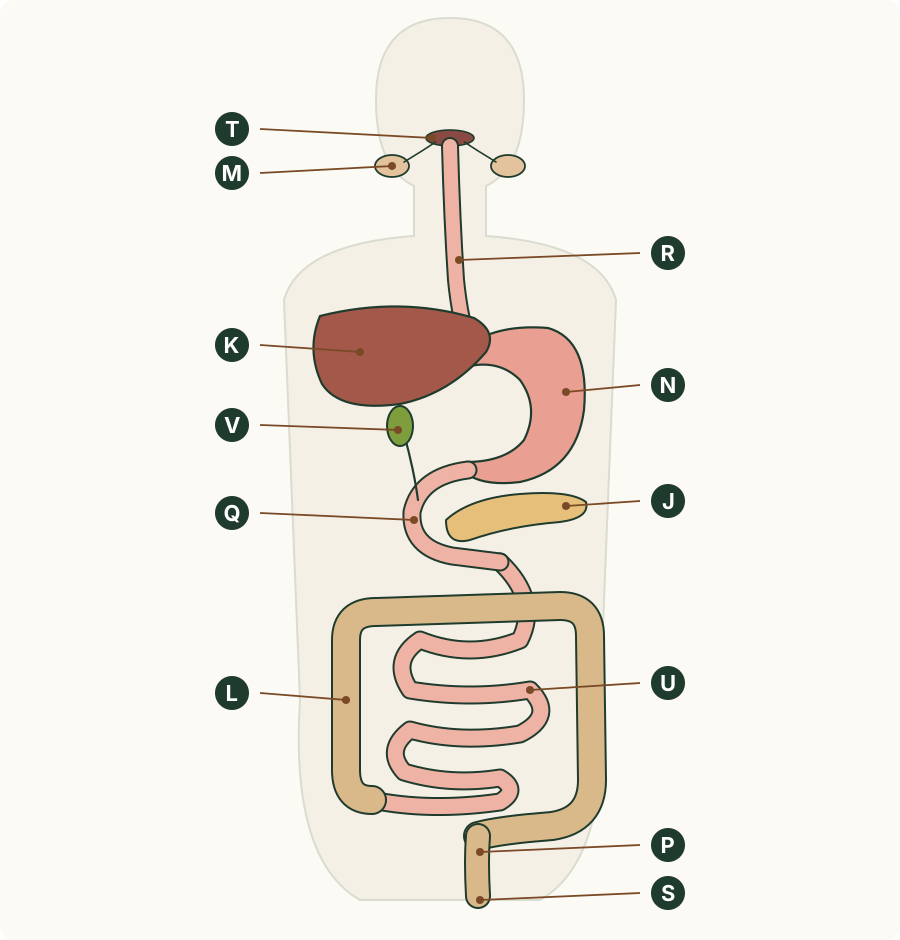
(a) Duodenum
(b) Rectum
(c) Anus
(d) Stores bile
(e) Churns food
(f) Absorbs water
8. state
State the function of (a) the oesophagus, (b) the pancreas and (c) the rectum, and (d) name the process that happens at the anus.
(a) Oesophagus
(b) Pancreas
(c) Rectum
(d) Process at the anus
9. describe
A meal of bread and meat reaches the stomach in lumps about 1 cm across. Two hours later it leaves the stomach as a thick liquid. Describe what the stomach did to the meal in physical digestion, and why this helps chemical digestion.
10. outline
Supplement. A spoonful of olive oil is eaten with a salad. Outline what bile does to the oil in the duodenum, and how this helps the enzyme that digests it.