Pupil sheet · Limits on photosynthesis
How a leaf is built for photosynthesis — questions
Name ______________________ Date ____________
Try every question before you use a nudge. Write in full sentences where you are asked to explain.
1. identify
The drawing shows a cross-section through a leaf. Identify the layers lettered A to E.
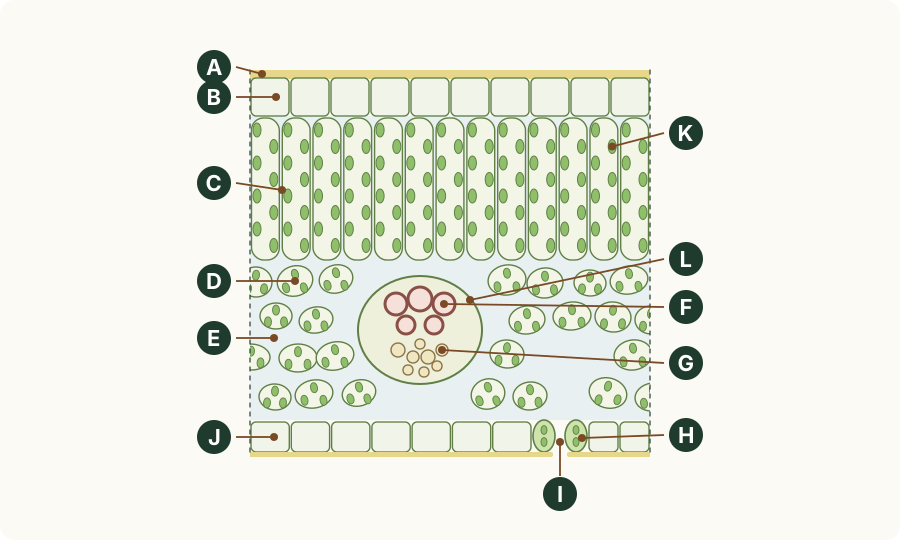
Write the number of the matching option.
- palisade mesophyll
- phloem
- spongy mesophyll
- upper epidermis
- lower epidermis
- air space
- cuticle
- A: ______
- B: ______
- C: ______
- D: ______
- E: ______
Nudge (only if you are stuck): Work down from the top surface. Which lettered parts are rows or groups of cells, and which are not cells at all?
2. identify
Use the same lettered drawing of the leaf. Identify the structures lettered F to L.
Write the number of the matching option.
- guard cell
- xylem
- vascular bundle
- spongy mesophyll
- stoma
- phloem
- lower epidermis
- chloroplast
- cuticle
- F: ______
- G: ______
- H: ______
- I: ______
- J: ______
- K: ______
- L: ______
Nudge (only if you are stuck): Which letters are inside the round bundle, and which are on the lower surface? Which lettered part is a gap, not a cell?
3. calculate / explain
In a simple model of light passing down into a leaf, each layer of cells absorbs about half of the light that reaches it and passes the other half on to the layer below. All of the light, 100%, reaches the first layer. (a) Calculate the percentage of the light that reaches the 3rd layer. (b) Calculate the percentage that reaches the 6th layer. Give (b) to 2 significant figures. Then use your answers to explain why most leaves are thin.
(a) Light reaching the 3rd layer: ______________ unit ________
(b) Light reaching the 6th layer: ______________ unit ________
Use your answers to explain why most leaves are thin.
Nudge (only if you are stuck): Work down one layer at a time: each layer passes on half of the light that reaches it.
4. identify
Match each structure in a leaf to how it helps photosynthesis.
Write the number of the matching option.
- carries sucrose away from the leaf
- brings water to the leaf
- absorbs most of the light
- opens and closes the stomata
- lets carbon dioxide diffuse to the mesophyll cells
- palisade mesophyll: ______
- air spaces: ______
- xylem: ______
- phloem: ______
- guard cells: ______
Nudge (only if you are stuck): Which one is full of chloroplasts near the top? Which ones carry liquids? Which open and close pores?
5. identify
The drawing is a high-power view of a small part of a leaf cross-section, with the upper surface at the top. Four kinds of cell are lettered T, U, V and W. Which row identifies the cells that carry out the most photosynthesis in bright light, and gives evidence for this that you can see in the drawing?
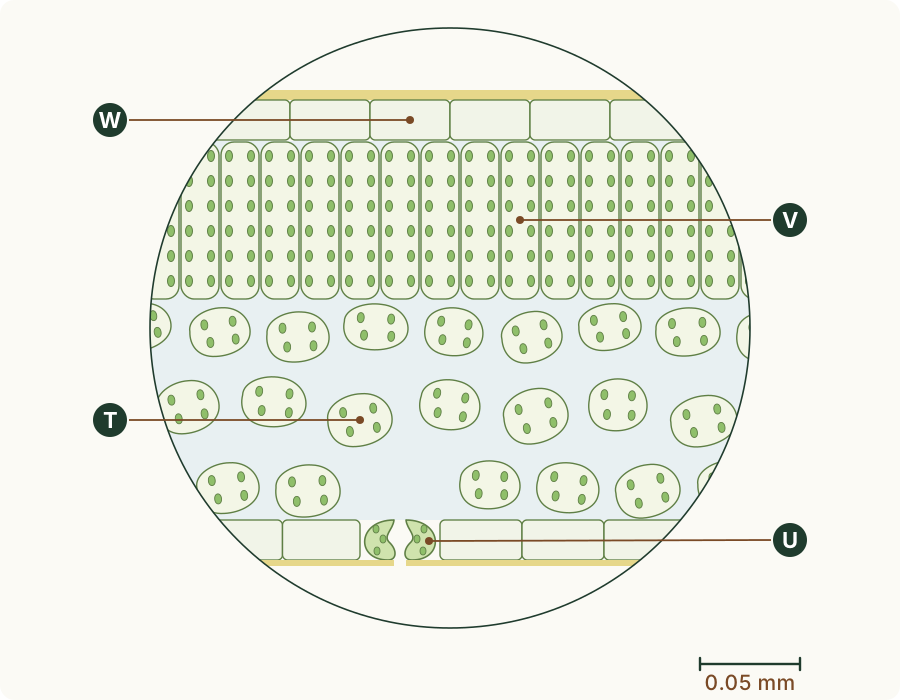
| Row | Lettered cells | Evidence you can see in the drawing |
|---|---|---|
| A | W | 12 chloroplasts in each cell, and the first cells the light reaches |
| B | V | 12 chloroplasts in each cell, just under the clear top row |
| C | T | 12 chloroplasts in each cell, with air spaces around them |
| D | U | 3 chloroplasts in each cell, beside the gap in the bottom row |
Circle one answer.
- A
- B
- C
- D
Nudge (only if you are stuck): Count the chloroplasts in one cell of each lettered kind. Which cells have the most, and how near the light are they?
6. explain
Caterpillars have eaten half the area of every leaf on a young cabbage plant. (a) Explain why the plant now photosynthesises more slowly, even in bright light. (b) A gardener says: "Leaves half the area but twice as thick would do just as well, because they would hold as many cells." Explain why she is wrong.
(a) Half the area eaten
(b) Why thicker is not as good
Nudge (only if you are stuck): What does a leaf catch and take in over its surface? How far would light and carbon dioxide have to go into a thick leaf?
7. identify
Each leaf below has one fault. Choose the main way in which the fault slows photosynthesis in that leaf. One option is not used.
Write the number of the matching option.
- less water reaches the mesophyll cells
- less carbon dioxide gets into the leaf
- carbon dioxide inside the leaf reaches the mesophyll cells more slowly
- the light that reaches the cells is hardly absorbed
- less light reaches the palisade cells
- a leaf of a town tree whose upper surface is coated in black soot: ______
- a pale patch of leaf whose palisade cells have very few chloroplasts: ______
- a leaf on a hot, dry day whose guard cells stay closed: ______
- a leaf whose air spaces have filled with water after a storm: ______
Nudge (only if you are stuck): For each fault, ask: does it change the light or the carbon dioxide? Does it act at the surface of the leaf, or inside it?
8. identify
Guard cells have chloroplasts, so they need light too. Sunlight falls on the upper surface of a leaf. Put in order the parts of the leaf that the light passes through on its way to a guard cell, starting from the outside.
Write the number of each step in order.
- a guard cell in the lower epidermis
- the spongy mesophyll
- the upper epidermis
- the cuticle
- the palisade mesophyll
- First: ______
- Second: ______
- Third: ______
- Fourth: ______
- Last: ______
Nudge (only if you are stuck): Where are most of the guard cells? Which parts of the leaf lie between the sunlit surface and there?
9. explain
Two varieties of kale grow side by side. Variety P has leaves covered in a thick, cloudy white layer of wax over the cuticle. Variety Q has a thin, clear cuticle. In a hot, sunny, dry week, P wilts less than Q. In a dull, cloudy week, Q photosynthesises faster than P. Which statement explains both results?
Circle one answer.
- The thick wax cuts water loss, but it blocks the stomata in the upper epidermis.
- The thick wax absorbs light for photosynthesis, so P needs bright sun to use it.
- The thick wax cuts water loss, but it lets less light through to the palisade.
- The thick wax stops rain soaking in, so P gets less water in dull, wet weather.
Explain why the thick wax helps P in the dry week but not in the dull week.
Nudge (only if you are stuck): What does a waxy layer do for water? What must the outer layers of a leaf let through for photosynthesis?
10. explain
A sharp hailstone cuts through the midrib, the main vein, near the base of a leaf. The leaf stays on the plant. Over the next day, the part of the leaf beyond the cut wilts and photosynthesises more slowly than the rest of the leaf. Which statement explains the slower photosynthesis?
Circle one answer.
- Beyond the cut, the veins can no longer bring carbon dioxide to the cells.
- Beyond the cut, the phloem can no longer carry the oxygen away.
- Beyond the cut, the phloem can no longer bring sucrose to the cells.
- Beyond the cut, the xylem can no longer bring water to the cells.
Nudge (only if you are stuck): Which tissues run along the midrib, and which way does each one carry its load?
11. explain / suggest
A desert cactus opens its stomata only at night and keeps them closed all day. (a) Explain how this helps the cactus to survive in the desert. (b) Explain why closed stomata in the day are a problem for photosynthesis. (c) The cactus still photosynthesises in the day. Suggest how it could get the carbon dioxide it needs.
(a) How it helps the cactus survive
(b) The problem in the day
(c) Getting carbon dioxide
Nudge (only if you are stuck): What escapes through an open stoma, and when is the desert air hottest? When is there light, and when can a gas get in?
12. suggest
A water lily has large, flat leaves that float on the surface of a pond. Unlike most leaves, its stomata are on the upper surface. Suggest why.
Nudge (only if you are stuck): Which gas must a leaf take in for photosynthesis, and where does that gas come from?
13. suggest
Leaves from the shady inside of a beech tree are larger and thinner than leaves from its sunny outside, with fewer layers of palisade cells. Suggest how being larger and thinner suits a leaf in the shade.
Nudge (only if you are stuck): In the shade, which factor is likely to limit photosynthesis? How does a large area help with that?
14. predict / explain
A pupil spreads petroleum jelly, which gases cannot pass through, over the lower surface of one leaf of a plant, then leaves the plant in bright light. Predict and explain the effect on photosynthesis in that leaf.
Nudge (only if you are stuck): Where are most of the stomata? What would stop reaching the mesophyll cells?
15. identify / give
A pupil puts a leaf section on the microscope the wrong way up. She describes what she sees, from the top of her view to the bottom: (1) a row of clear cells, broken in one place by a small gap between two bean-shaped green cells; (2) rounded, loosely packed cells with large air spaces between them; (3) tall cells packed side by side, crowded with chloroplasts; (4) a row of clear cells along the very bottom edge. In the middle is a round bundle, with small cells in its upper half and wide, thick-walled tubes in its lower half. (a) Identify the edge of her view that is the upper surface of the leaf. (b) Identify the tall cells, the bean-shaped cells, the gap between them and the wide tubes. (c) Give two features that show which way up the leaf is.
(a) The upper surface
(b) The four structures
(c) Two features
Nudge (only if you are stuck): In a leaf the right way up, which layer lies just under the upper epidermis? In which surface are most of the stomata?