Pupil sheet · Limits on photosynthesis
Limits on photosynthesis — return questions
Name ______________________ Date ____________
Use one to two weeks after the lessons. Keep the notes and the lesson closed.
1. calculate
Instead of counting bubbles, a pupil collects the gas from a sprig of pondweed in a gas syringe. With the lamp at 15 cm, 2.6 cm³ of gas collects in 4 minutes. (a) Calculate the rate of gas production in cm³ per minute. Give your answer to two decimal places. (b) At the same rate, calculate how long it would take to collect 3.0 cm³ of gas. Give your answer to one decimal place.
(a) Rate of gas production: ______________ unit ________
(b) Time to collect 3.0 cm³: ______________ unit ________
2. explain
A pupil writes three statements about her pondweed results. Explain why each statement is incorrect. (a) "Moving the lamp closer will always make the pondweed photosynthesise faster." (b) "Sodium hydrogencarbonate is plant food, so it makes the pondweed photosynthesise faster." (c) "At 45 °C the rate falls because the heat kills the enzymes."
(a) The lamp
(b) Sodium hydrogencarbonate
(c) The enzymes
3. identify
Supplement. Pondweed is in water at 24 °C, with the lamp at 15 cm and a beaker of water to soak up its heat. A pupil tries two changes, starting each time from these same conditions. Dissolving more sodium hydrogencarbonate in the water raises the rate from 10 to 17 bubbles per minute. Moving the lamp to 8 cm raises it only from 10 to 10.5. Which row identifies the limiting factor at the start, and explains the result of moving the lamp?
| Row | Limiting factor at the start | Why moving the lamp closer hardly changed the rate |
|---|---|---|
| A | light | the plant already had all the light it could use |
| B | carbon dioxide | light was not the factor in shortest supply |
| C | carbon dioxide | the closer lamp warmed the water too much |
| D | temperature | only warming the water could raise the rate |
Circle one answer.
- A
- B
- C
- D
4. predict
Predict the colour of red hydrogencarbonate indicator after each of these.
Write the number of the matching option.
- red, as at the start
- yellow
- purple
- germinating peas in a sealed tube above the indicator, for a day: ______
- air bubbled through the indicator after passing through soda lime, which absorbs carbon dioxide: ______
- outdoor air bubbled through the indicator for 10 minutes: ______
- an empty sealed tube of the indicator, left for a day: ______
5. identify
On its own in a bunged tube of red hydrogencarbonate indicator, a sprig of pondweed turns the indicator purple in 3 hours in bright light, and leaves it close to red in dim light. A water snail on its own turns the indicator orange in 3 hours, in any light. Now a similar sprig and a similar snail go into one bunged tube together, and three such tubes stand for 3 hours: one in bright light, one in the same dim light, one in the dark. Which row identifies the overall change in carbon dioxide and the colour of the indicator in each tube?
| Row | Bright light | Dim light | Dark |
|---|---|---|---|
| A | less carbon dioxide; purple | little change; close to red | more carbon dioxide; yellow |
| B | less carbon dioxide; magenta | more carbon dioxide; orange | more carbon dioxide; yellow |
| C | more carbon dioxide; orange | more carbon dioxide; orange | more carbon dioxide; yellow |
| D | less carbon dioxide; magenta | less carbon dioxide; magenta | more carbon dioxide; yellow |
Circle one answer.
- A
- B
- C
- D
6. explain / state
A pupil puts a sprig of pondweed into 20 cm³ of red indicator in a bunged tube in the light, and a similar sprig into 5 cm³ of red indicator in a bunged tube wrapped in foil. After 2 hours, the tube in the light is only magenta, but the tube in foil is yellow. She concludes that respiration is faster than photosynthesis. (a) Explain two reasons why her conclusion is not valid. (b) State one more variable she should keep the same.
(a) Two reasons why it is not valid
(b) One more variable
7. identify
The drawing shows a cross-section through a leaf of a holly bush growing in full sun, with the upper surface at the top. Which row gives the letters of a stoma, of the xylem and of the cells with the most chloroplasts?
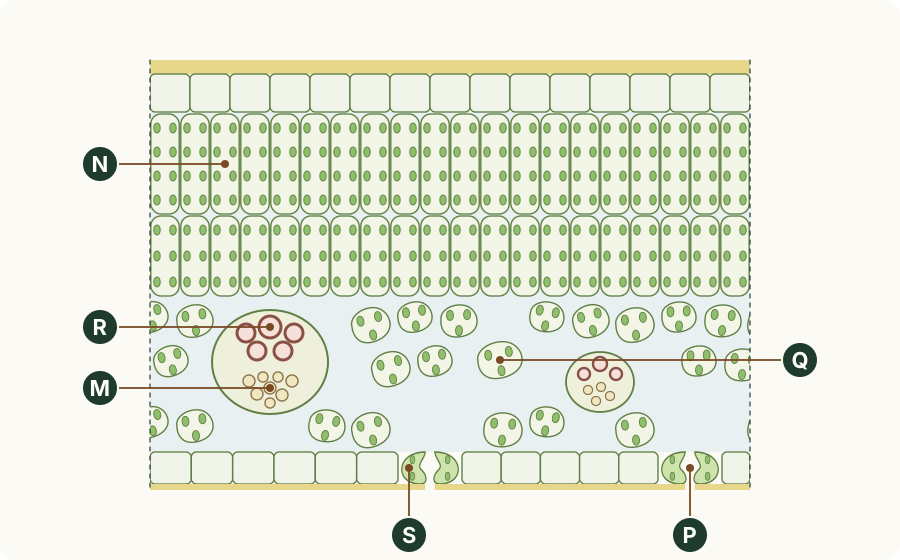
| Row | A stoma | Xylem | Cells with the most chloroplasts |
|---|---|---|---|
| A | S | R | N |
| B | P | R | N |
| C | P | M | N |
| D | P | R | Q |
Circle one answer.
- A
- B
- C
- D
8. state / explain
State two features of the shape of most leaves, and explain how each helps photosynthesis.
Feature 1 and how it helps
Feature 2 and how it helps
9. identify
Which row describes what the xylem, the phloem and the air spaces of a leaf carry, in a way that helps photosynthesis?
| Row | Xylem | Phloem | Air spaces |
|---|---|---|---|
| A | sucrose out of the leaf | water and mineral ions into the leaf | carbon dioxide to the mesophyll cells |
| B | water and mineral ions into the leaf | sucrose out of the leaf | oxygen to the mesophyll cells |
| C | water and mineral ions into the leaf | sucrose out of the leaf | carbon dioxide to the mesophyll cells |
| D | water and mineral ions into the leaf | glucose out of the leaf | carbon dioxide to the mesophyll cells |
Circle one answer.
- A
- B
- C
- D