Pupil sheet · Limits on photosynthesis
Measuring the rate of photosynthesis — questions
Name ______________________ Date ____________
Try every question before you use a nudge. Write in full sentences where you are asked to explain.
1. identify
Pondweed in bright light gives off bubbles of gas. Which statement names the gas that makes up most of the bubbles, and the test that shows it?
Circle one answer.
- Oxygen: a glowing splint relights in it.
- Carbon dioxide: it turns limewater milky.
- Oxygen: a lit splint goes out with a squeaky pop.
- Water vapour: it turns blue cobalt chloride paper pink.
Nudge (only if you are stuck): Which gas does photosynthesis give out, and which test is for that gas?
2. identify
A pupil investigates how the mass of sodium hydrogencarbonate dissolved in the water changes the rate of photosynthesis of pondweed. Match each one to the kind of variable it is in her investigation.
Write the number of the matching option.
- dependent variable
- controlled variable
- independent variable
- mass of sodium hydrogencarbonate dissolved: ______
- number of bubbles per minute: ______
- distance from the lamp to the plant: ______
- temperature of the water: ______
- the sprig of pondweed used: ______
Nudge (only if you are stuck): Which one does she change on purpose? Which one does she measure? The rest are kept the same.
3. identify / calculate
With the lamp at a fixed distance, a pupil counts the bubbles from pondweed for one minute, four times: 13, 14, 22 and 16 bubbles. (a) Identify the anomalous count. (b) Calculate the mean rate without the anomalous count. Give your answer to one decimal place.
(a) Anomalous count: ______________ unit ________
(b) Mean rate without it: ______________ unit ________
Nudge (only if you are stuck): Which count does not fit the pattern of the others? Leave it out before you find the mean.
4. describe
The table shows the mean number of bubbles per minute from pondweed in water at 23 °C, with a beaker of water to soak up the heat of the lamp, and the lamp at five distances. Which statement describes the results?
| Distance from lamp to plant (cm) | Mean bubbles per minute |
|---|---|
| 45 | 3 |
| 36 | 5 |
| 27 | 8.5 |
| 18 | 13 |
| 9 | 14 |
Circle one answer.
- It rises most between 18 cm and 9 cm, from 13 to 14, where the lamp is closest.
- It rises by about 3 each time the lamp comes 9 cm closer, from 3 to 14.
- It falls from 14 to 3 as the lamp comes from 45 cm to 9 cm.
- It rises from 3 to 13 between 45 cm and 18 cm, then only to 14 at 9 cm.
Nudge (only if you are stuck): Compare the change between the far distances with the change between the two closest.
5. describe / explain / suggest
Instead of moving the lamp, a pupil measures the light intensity at the pondweed with a light meter, in lux. The water bath stays at 22 °C, a beaker of water soaks up the heat of the lamp, and nothing is added to the water. The table shows her mean rates. (a) Describe the effect of light intensity on the rate. (b) Explain the rise from 500 to 4000 lux. (c) Suggest why the rate hardly changes from 4000 to 8000 lux.
| Light intensity at the plant (lux) | Mean bubbles per minute |
|---|---|
| 500 | 2 |
| 1000 | 5 |
| 2000 | 11 |
| 4000 | 19 |
| 8000 | 19.5 |
(a) The effect of light intensity
(b) The rise
(c) The levelling off
Nudge (only if you are stuck): Compare the rise from 2000 to 4000 lux with the rise from 4000 to 8000 lux. What does light give the plant?
6. explain / suggest
A pupil forgets the beaker of water between the lamp and the tube. As she moves the lamp from 35 cm to 5 cm, the thermometer in the water bath rises from 21 °C to 27 °C. (a) Explain why her results do not show the effect of light intensity alone. (b) At 5 cm she counts straight after moving the lamp: 9 bubbles in the first minute, then 15 in the second. Suggest why the two counts differ so much.
(a) Why not light alone
(b) Why the counts differ
Nudge (only if you are stuck): A lamp gives out more than light. And does a plant change its rate the moment its conditions change?
7. explain
Sprig X gives off 24 small bubbles per minute. Sprig Y, under the same lamp at the same temperature, gives off 15 larger bubbles per minute. In 10 minutes, Y fills a gas syringe with more gas than X. Which statement explains why the bubble counts put the sprigs in the wrong order?
Circle one answer.
- Some of the oxygen from Y dissolves in the water, so its count is too high.
- The bubbles are not all the same size, so a count does not show the volume.
- Sprig Y stops respiring in the light, so it gives off more of its oxygen.
- The gas given off by sprig X is mostly carbon dioxide, not oxygen.
Nudge (only if you are stuck): Does a count of bubbles tell you how much gas there is?
8. describe
A pupil dissolves different masses of sodium hydrogencarbonate in 100 cm³ of water around the same sprig of pondweed, at 25 °C. She does this twice: once with the lamp at 8 cm, and once with the lamp at 60 cm. The table shows her mean rates. Which statement describes the effect of the carbon dioxide concentration on the rate?
| Sodium hydrogencarbonate in 100 cm³ of water (g) | Mean bubbles per minute, lamp at 8 cm | Mean bubbles per minute, lamp at 60 cm |
|---|---|---|
| 0 | 9 | 2 |
| 0.1 | 16 | 2.5 |
| 0.2 | 21 | 3 |
| 0.3 | 22 | 3 |
Circle one answer.
- At both distances it rises steadily with every extra 0.1 g: from 9 to 22, and from 2 to 3.
- At 8 cm it rises from 9 to 21, then hardly changes; at 60 cm it stays between 2 and 3.
- Carbon dioxide limits the rate at 60 cm, so adding it raises the rate more there than at 8 cm.
- Carbon dioxide has no effect on the rate: at 60 cm it stays between 2 and 3 whatever is added.
Nudge (only if you are stuck): Look at each column on its own. In which column does adding sodium hydrogencarbonate make a big difference?
9. explain
With the lamp at 15 cm and the water bath at 25 °C, pondweed gives off 12 bubbles per minute in tap water. A pupil stirs a little sodium hydrogencarbonate into the water, waits 2 minutes, and counts again: 21 bubbles per minute. Explain the rise.
Nudge (only if you are stuck): What does sodium hydrogencarbonate add to the water, and what does the plant use it for?
10. identify
A pupil plans to investigate the effect of temperature on the rate of photosynthesis of pondweed, by counting bubbles. Which row shows a fair way to change the temperature, and the right things to keep the same?
| Row | How the temperature is changed | Kept the same in every test |
|---|---|---|
| A | move the lamp closer, so that its heat warms the water | the water bath and the sodium hydrogencarbonate |
| B | water baths set at 12, 22, 32 and 42 °C | the lamp distance, the sodium hydrogencarbonate and the bubbles per minute |
| C | water baths set at 12, 22, 32 and 42 °C | the lamp distance and the sodium hydrogencarbonate, with no heat filter |
| D | water baths set at 12, 22, 32 and 42 °C | the lamp distance, the heat filter and the sodium hydrogencarbonate |
Circle one answer.
- A
- B
- C
- D
Nudge (only if you are stuck): Only the temperature may change. What else could a lamp change? And which variable is the one she measures?
11. identify
A pupil sketches two graphs for pondweed. Graph 1 is the rate of photosynthesis against carbon dioxide concentration, in bright light at 25 °C. Graph 2 is the rate against temperature, from 5 °C to 55 °C, in bright light with plenty of carbon dioxide. Which row describes the shape of each graph?
| Row | Graph 1: rate against carbon dioxide | Graph 2: rate against temperature |
|---|---|---|
| A | rises in a straight line, without end | rises to a peak, then falls |
| B | rises, then levels off | rises, then levels off |
| C | rises, then levels off | rises to a peak, then falls |
| D | rises to a peak, then falls | rises in a straight line, without end |
Circle one answer.
- A
- B
- C
- D
Nudge (only if you are stuck): Does extra carbon dioxide go on helping for ever? What happens to enzymes when they get too hot?
12. identify
Supplement. The table shows the rate of photosynthesis of a basil plant, in cm³ of oxygen per hour, at five light intensities, at 12 °C and at 26 °C. The plant has plenty of carbon dioxide in every test. Choose the factor limiting the rate at points X, Y and Z.
| Temperature | Light intensity 1 | Light intensity 2 | Light intensity 4 | Light intensity 6 | Light intensity 8 |
|---|---|---|---|---|---|
| 12 °C | 3 (point X) | 6 | 9 | 9.5 | 9.5 (point Y) |
| 26 °C | 3 | 6 (point Z) | 12 | 17 | 18 |
Write the number of the matching option.
- temperature
- light
- carbon dioxide
- point X: 12 °C, light intensity 1: ______
- point Y: 12 °C, light intensity 8: ______
- point Z: 26 °C, light intensity 2: ______
Nudge (only if you are stuck): For each point, find one change that raises the rate: a brighter light (a column further right), or the warmer row at the same light.
13. identify
Supplement. For a plant in each of these conditions, choose the factor most likely to be limiting its rate of photosynthesis.
Write the number of the matching option.
- carbon dioxide
- temperature
- light
- moss in a sealed glass jar on a sunny, warm windowsill, late in the afternoon: ______
- strawberry plants in a greenhouse under bright lamps with extra carbon dioxide, on a night when the heater fails and the air falls to 5 °C: ______
- the lowest leaves of a tall, dense maize crop at noon on a hot, sunny day: ______
- a fern on an office desk at 22 °C, lit only by the ceiling lights: ______
Nudge (only if you are stuck): In each case, two of light, carbon dioxide and temperature are good. Which one is poor?
14. determine / calculate
Leaf discs cut from a leaf are made to sink by drawing the air out of their air spaces with a syringe. Then 10 discs go into each of two beakers of sodium hydrogencarbonate solution at 25 °C, one beaker with the lamp at 10 cm and one with the lamp at 30 cm. As the discs photosynthesise, oxygen collects in their air spaces and they float up. Use the graph. (a) Determine how many discs were floating 10 minutes after the lamp was switched on, in each beaker. (b) Determine how long it took for 5 discs to float, in each beaker. (c) Calculate how many times faster the discs floated with the lamp at 10 cm than with the lamp at 30 cm.
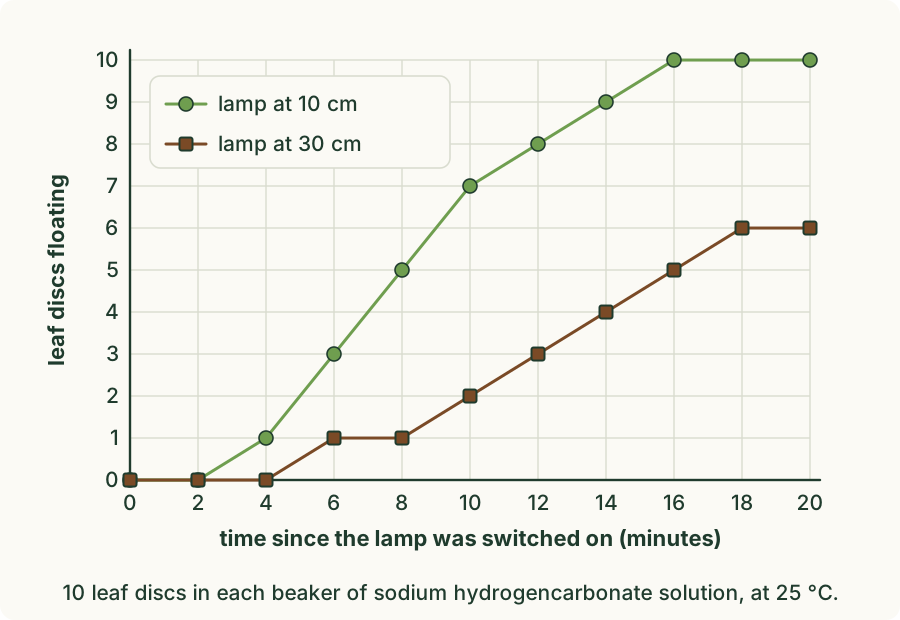
(a) Discs floating at 10 minutes, lamp at 10 cm: ______________ unit ________
(a) Discs floating at 10 minutes, lamp at 30 cm: ______________ unit ________
(b) Time for 5 discs to float, lamp at 10 cm: ______________ unit ________
(b) Time for 5 discs to float, lamp at 30 cm: ______________ unit ________
(c) How many times faster with the lamp at 10 cm: ______________ unit ________
Nudge (only if you are stuck): For (a), start from the time on the x-axis and go up to each line. For (b), start from the number of discs on the y-axis and go across. A shorter time means a faster rate.
15. explain / suggest
Use the same leaf-disc graph. (a) Explain why the discs float up in the light. (b) Explain why the discs with the lamp at 10 cm floated up sooner than the discs with the lamp at 30 cm. (c) When the lamp is switched off, the floating discs slowly sink again. Suggest why.
(a) Why they float
(b) Why sooner at 10 cm
(c) Why they sink in the dark
Nudge (only if you are stuck): What gas does photosynthesis make, and where in the leaf can it collect? What does a closer lamp change? Which process goes on in the dark?
16. explain / suggest
A pupil leaves the same sprig of pondweed in the same tube of water for an hour, with the lamp at a fixed distance and the water bath at a steady temperature. She counts the bubbles for one minute every 15 minutes: 20, 17, 13, then 10 bubbles. Explain why the rate falls, and suggest how she could bring it back up.
Nudge (only if you are stuck): The light and the temperature stayed the same. What else does the plant need from the water around it?
17. suggest
A sprig of pondweed gives off 30 bubbles per minute in water at 28 °C. The water is warmed to 45 °C for 20 minutes, where the rate falls to 11. Then the water is cooled straight back to 28 °C, and the rate is now only 17 bubbles per minute. Suggest why the rate did not go back to 30.
Nudge (only if you are stuck): Which molecules control photosynthesis, and what can heat do to them?
18. suggest / explain
Supplement. At dawn a grower checks a greenhouse of cucumber plants. The vents were shut all night, and the heaters kept the air at 22 °C. The sun is still low. A sensor shows that the air in the greenhouse holds more than twice as much carbon dioxide as the air outside. Which change is most likely to raise the rate of photosynthesis over the next hour? Explain your choice, and explain why there is so much carbon dioxide in the greenhouse.
Circle one answer.
- Open the vents to let fresh air in.
- Switch on the lamps above the cucumber plants.
- Turn the heaters up from 22 °C to 30 °C.
- Release extra carbon dioxide into the greenhouse.
Explain your choice, and why there is so much carbon dioxide in the greenhouse.
Nudge (only if you are stuck): Which process went on all night in the shut greenhouse? So which factor is plentiful now, and which is poor?