Pupil sheet · Nerves and reflexes
Synapses — questions
Name ______________________ Date ____________
Try every question before you use a nudge. Write in full sentences where you are asked to explain.
1. identify
What is a synapse?
Circle one answer.
- A bundle of many neurones.
- A short neurone inside the spinal cord.
- A junction between two neurones.
- The cell body of a neurone.
Nudge (only if you are stuck): Where do two neurones meet?
2. identify
In the knee-jerk reflex, the sensory neurone passes impulses straight to the motor neurone in the spinal cord, with no relay neurone between them. How many synapses between neurones does the impulse cross?
Circle one answer.
- Two.
- Three.
- One.
- None.
Nudge (only if you are stuck): Count the places where one neurone meets the next.
3. identify
Supplement. The diagram shows a synapse. Match each letter to its name.
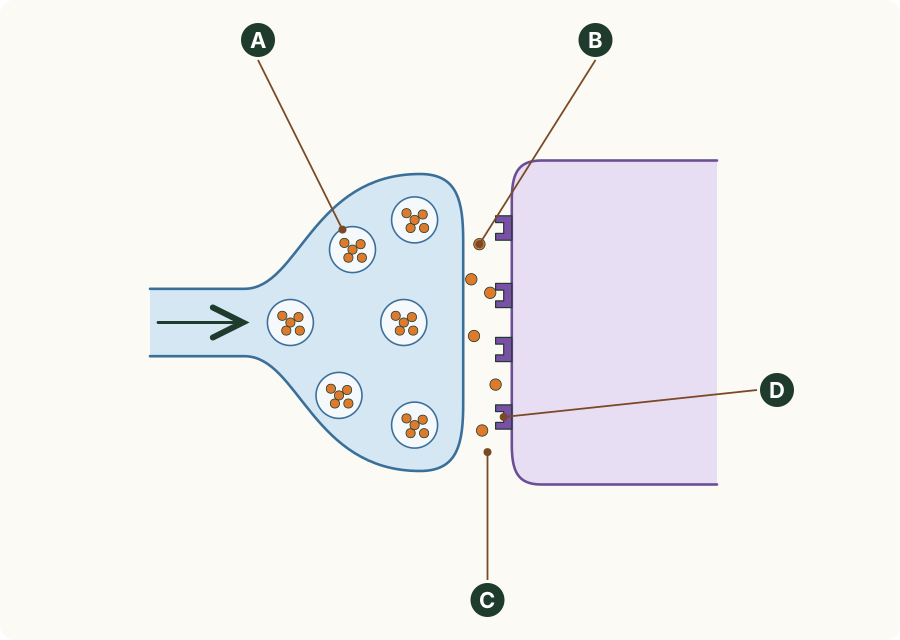
Write the number of the matching option.
- synaptic gap
- vesicle
- receptor proteins
- neurotransmitter molecules
- A: ______
- B: ______
- C: ______
- D: ______
Nudge (only if you are stuck): Which parts are in the first neurone, the gap and the next neurone?
4. describe
Supplement. These sentences describe the events at a synapse in everyday words. Put them in order.
Write the number of each step in order.
- Tiny sacs empty their chemical into the narrow space.
- An impulse reaches the end of the first neurone.
- A new impulse sets off along the next neurone.
- The chemical spreads across the space, from many molecules to few.
- The chemical fits into proteins on the next neurone's membrane.
- First: ______
- Second: ______
- Third: ______
- Fourth: ______
- Last: ______
Nudge (only if you are stuck): It starts with an impulse arriving and ends with an impulse leaving.
5. identify
Supplement. How do neurotransmitter molecules cross the synaptic gap?
Circle one answer.
- Carried by the blood.
- By diffusion.
- By active transport.
- Carried by the impulse.
Nudge (only if you are stuck): From where there are many to where there are few.
6. identify
Supplement. An impulse can cross a synapse from the first neurone to the next, but never back. Which statement explains this?
Circle one answer.
- The impulse loses strength as it crosses, so it cannot cross back again.
- The gap is narrow beside the first neurone and wide beside the next one.
- Only the first neurone has vesicles, and only the next has receptor proteins.
- Only the next neurone has vesicles, and only the first has receptor proteins.
Nudge (only if you are stuck): Which neurone releases neurotransmitter, and which one receives it?
7. explain
Supplement. A pupil says: "An impulse is electrical all the way from the receptor to the effector." Explain why this is not quite right.
Nudge (only if you are stuck): What happens at the synapses?
8. describe
Supplement. Describe the structure of a synapse.
Nudge (only if you are stuck): Three parts: one in each neurone and the space between.
9. describe
Supplement. Describe the events at a synapse when an impulse arrives.
Nudge (only if you are stuck): Four events.
10. identify
Supplement. In a reflex arc, impulses only ever travel from the receptor towards the effector. In experiments, an impulse started part way along a single neurone travels both ways along it. Which part of the arc makes sure that impulses travel in one direction only?
Circle one answer.
- The neurones themselves, which can only carry impulses one way.
- The synapses between the neurones.
- The receptor, which only starts impulses at its own end.
- The effector, which pulls the impulses towards itself.
Nudge (only if you are stuck): If a neurone can carry an impulse either way, where in the arc is the one-way step?
11. explain
A pupil writes: "A synapse is a short neurone in the spinal cord that links a sensory neurone to a motor neurone." Explain why this is incorrect.
Nudge (only if you are stuck): Is a synapse a cell? What is the short neurone called?
12. determine
In one reflex arc there are four neurones in a row: a sensory neurone, two relay neurones and a motor neurone. Determine how many synapses between neurones the impulse crosses.
Synapses: ______________ unit ________
Nudge (only if you are stuck): Count the joins between neighbours.
13. predict / explain
Supplement. A substance stops vesicles from releasing their neurotransmitter. Predict what happens at a synapse when an impulse arrives, and explain.
Nudge (only if you are stuck): What is the first event at the synapse?
14. predict
Supplement. At a synapse that controls a muscle, an enzyme in the synaptic gap normally breaks down neurotransmitter molecules soon after they bind with the receptor proteins. So each impulse that arrives stimulates only one impulse in the next neurone. An insect poison stops this enzyme working. Predict what happens in the next neurone after one impulse arrives.
Circle one answer.
- Impulses keep being stimulated in the next neurone after the arriving impulse has passed.
- Impulses travel back across the synapse into the first neurone.
- The neurotransmitter travels along the next neurone instead of an impulse.
- No impulse is stimulated, because the neurotransmitter cannot bind.
Nudge (only if you are stuck): The neurotransmitter is still released, still diffuses and still binds. What is different afterwards?
15. identify / explain
Supplement. At a synapse, small sacs are found only inside the neurone on the right of the gap, and proteins only on the membrane of the neurone on the left. (a) Identify the sacs and the proteins. (b) State the direction in which impulses cross this synapse, and explain.
(a) Sacs and proteins
(b) Direction
Nudge (only if you are stuck): Which side releases, and which side receives?