Pupil sheet · Nerves and reflexes
Nerves and reflexes — final check
Name ______________________ Date ____________
Work alone, with the lesson closed. Answer every question; there are no hints.
1. identify
A cyclist sees a car door open just ahead and squeezes both brakes at once. Which row is correct?
| Row | How the message travels along the neurones | Where the decision to brake is made | What the nervous system does here |
|---|---|---|---|
| A | as electrical impulses | in the brain, part of the CNS | coordinates: links the eyes with the muscles of both hands so they work together |
| B | as a chemical carried in the blood | in the brain, part of the CNS | coordinates: links the eyes with the muscles of both hands so they work together |
| C | as electrical impulses | in the nerves of the arms, part of the PNS | coordinates: links the eyes with the muscles of both hands so they work together |
| D | as electrical impulses | in the brain, part of the CNS | regulates: keeps a body function, such as body temperature, at the right level |
Circle one answer.
- A
- B
- C
- D
2. identify
Each case shows the nervous system at work. Sort each one into coordination or regulation.
Write the number of the matching option.
- regulation
- coordination
- You read music and play a tune on a keyboard with both hands.: ______
- You watch a rope swing round and jump over it each time it reaches your feet.: ______
- In a cold wind, the blood vessels near your skin become narrower; once you are warm, they widen again.: ______
- When you stand up quickly, your heart beats faster for a moment, so that enough blood still reaches your brain.: ______
3. identify / calculate
A pupil catches a falling metre rule at 12, 14, 40, 15 and 13 cm. Identify the anomalous catch. Then use the table to calculate the mean reaction time of the other four catches.
| Distance fallen (cm) | Time (s) |
|---|---|
| 12 | 0.16 |
| 13 | 0.16 |
| 14 | 0.17 |
| 15 | 0.17 |
| 40 | 0.29 |
Anomalous catch: ______________ unit ________
Mean of the other four: ______________ unit ________
4. identify
The back of your hand brushes a stinging nettle, and your arm pulls away. Three neurones, U, V and W, carry the impulse in this reflex arc. U has its cell body inside the spinal cord, and its long fibre leaves the cord and ends on a muscle in the arm. V is short, and both its ends are inside the spinal cord. W starts at fine endings in the skin on the back of the hand, and its cell body is on a short side branch just outside the spinal cord. Which row identifies U, V and W correctly?
| Row | U | V | W |
|---|---|---|---|
| A | sensory | relay | motor |
| B | motor | relay | sensory |
| C | relay | motor | sensory |
| D | motor | sensory | relay |
Circle one answer.
- A
- B
- C
- D
5. predict / explain
In one person's arm, the motor neurone of the reflex arc that pulls the hand away from heat has been cut. Their fingers touch a hot mug. (a) Predict whether the reflex pulls the hand away, and explain. (b) Predict whether the heat is felt, and explain.
(a) Is the hand pulled away?
(b) Is the heat felt?
6. identify
In which of these reflex actions is the effector a gland?
Circle one answer.
- Tears flow when vapour from a cut onion reaches your eyes.
- You blink when a moth flies close to your eyes.
- The pupils of your eyes get smaller in bright light.
- Your lower leg swings forward when a doctor taps just below your kneecap.
7. identify / give
The diagram shows one neurone, P, between the skin and the spinal cord. (a) Identify this kind of neurone. (b) Give two features in the diagram that show it.
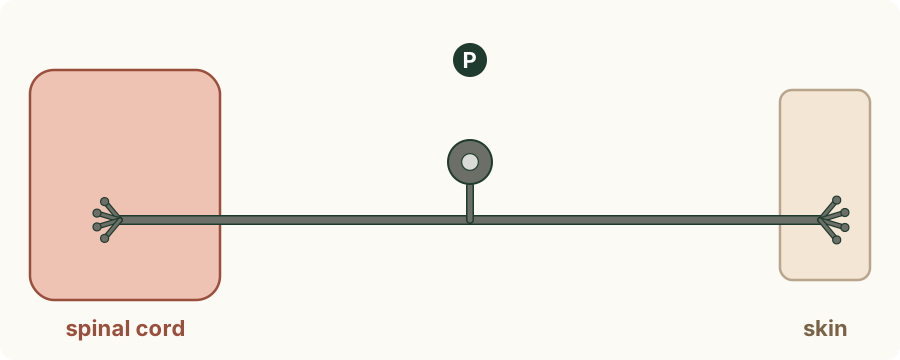
(a) Neurone
(b) Two features
8. explain
A pupil writes: "In a reflex arc, the impulse flows straight from the sensory neurone into the relay neurone, because the two cells are joined together." Explain why this is incorrect.
9. identify
Supplement. Which row describes the structure of a synapse correctly?
| Row | Vesicles containing neurotransmitter | Receptor proteins | Synaptic gap |
|---|---|---|---|
| A | in the end of the next neurone | on the membrane of the neurone the impulse arrives along | a narrow space between the two neurones |
| B | in the end of the neurone the impulse arrives along | inside the vesicles, with the neurotransmitter | a narrow space between the two neurones |
| C | in the end of the neurone the impulse arrives along | on the membrane of the next neurone | a narrow space between the two neurones |
| D | in the end of the neurone the impulse arrives along | on the membrane of the next neurone | a thin tube that joins the two neurones |
Circle one answer.
- A
- B
- C
- D
10. predict / explain
Supplement. A substance is added to a synapse. It breaks down neurotransmitter molecules as soon as they enter the synaptic gap. An impulse then arrives at the end of the first neurone. (a) Predict whether an impulse is stimulated in the next neurone. (b) Explain your prediction, using the events at a synapse.
(a) Prediction
(b) Explanation
11. predict / explain
Supplement. Three neurones form a chain: neurone 1 passes impulses to neurone 2, and neurone 2 passes them to neurone 3. A scientist starts an impulse in the middle of neurone 2, and it travels both ways along it. Predict which of the other neurones gets a new impulse, and explain using the structure of the two synapses.
Circle one answer.
- Neither of them.
- Neurone 1 only.
- Neurone 3 only.
- Neurone 1 and neurone 3.
Explanation, using the two synapses