Pupil sheet · Nerves and reflexes
Reflexes — questions
Name ______________________ Date ____________
Try every question before you use a nudge. Write in full sentences where you are asked to explain.
1. identify
The diagram shows three neurones, X, Y and Z, all drawn in the same colour; the pink band is part of the spinal cord. Match each letter to the kind of neurone.
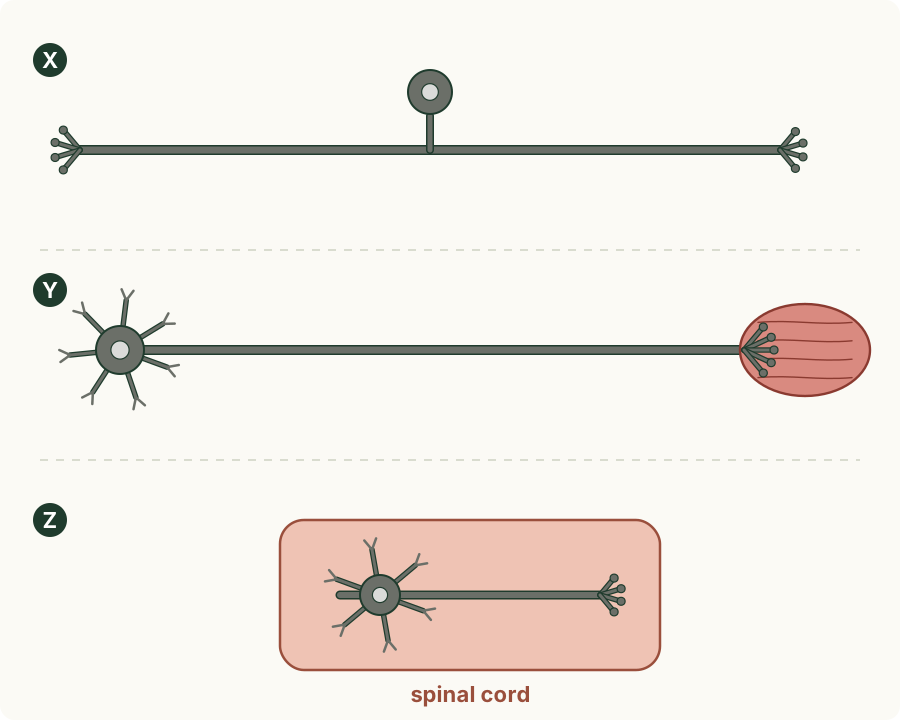
Write the number of the matching option.
- sensory neurone
- motor neurone
- relay neurone
- X: ______
- Y: ______
- Z: ______
Nudge (only if you are stuck): Look at where each cell body is and what each end is joined to.
2. identify
Which kind of neurone carries impulses from a receptor to the central nervous system?
Circle one answer.
- A motor neurone.
- A sensory neurone.
- A relay neurone.
Nudge (only if you are stuck): Think about which way the impulse goes: into the CNS or out of it.
3. identify
Your bare foot touches very hot sand, and a reflex lifts the foot at once. Which row gives the right place for three parts of this reflex arc?
| Row | Receptor | Relay neurone | Effector |
|---|---|---|---|
| A | a muscle in the leg | in the spinal cord | the skin of the sole |
| B | the skin of the sole | in the spinal cord | a muscle in the leg |
| C | the skin of the sole | in the brain | a muscle in the leg |
| D | the skin of the sole | in the leg, between the sole and the spinal cord | a muscle in the leg |
Circle one answer.
- A
- B
- C
- D
Nudge (only if you are stuck): Where is the hot sand detected, where are neurones linked, and what lifts the foot?
4. describe
Put the parts of a reflex arc in the order an impulse passes through them.
Write the number of each step in order.
- Motor neurone
- Effector
- Receptor
- Relay neurone
- Sensory neurone
- First: ______
- Second: ______
- Third: ______
- Fourth: ______
- Last: ______
Nudge (only if you are stuck): Start where the stimulus is detected.
5. identify
Which of these are reflex actions? Choose all that apply.
Tick every correct statement.
- You kick a football towards the goal.
- Your leg kicks forward when the tendon below the knee is tapped.
- You put up your hand when the teacher asks a question.
- You sneeze when dust gets into your nose.
Nudge (only if you are stuck): A reflex is automatic: you do not decide to do it.
6. identify
Which of these can be the effector in a reflex action? Choose all that apply.
Tick every correct statement.
- A bone in the arm.
- A motor neurone.
- A muscle.
- A gland.
Nudge (only if you are stuck): An effector carries out the response.
7. describe
Describe two differences between a sensory neurone and a motor neurone.
Nudge (only if you are stuck): Think about where each cell body is, and which way each carries impulses.
8. explain
Your elbow touches a hot radiator and your arm jerks away before you feel any pain. Explain why the arm moves before you feel the pain.
Nudge (only if you are stuck): Which part of the CNS does the impulse pass through on its way to the arm muscle?
9. describe
Describe what is meant by a reflex action.
Nudge (only if you are stuck): Two words describe how it happens; what does it link?
10. describe
A pupil pricks a finger on a cactus spine and the hand jerks away. Describe the reflex arc that causes this.
Nudge (only if you are stuck): Give the five parts in order, and where each one is.
11. predict / explain
In a reflex arc, the relay neurone stops working. Predict what happens when the skin touches a hot surface, and explain.
Nudge (only if you are stuck): What does the relay neurone link?
12. suggest / explain
When a crumb of food touches the inside of your windpipe, you cough at once, without deciding to. (a) Suggest where the receptors are and what the effectors are. (b) Explain why this reflex is useful.
(a) Receptors and effectors
(b) Why it is useful
Nudge (only if you are stuck): What detects the crumb, and what pushes air out hard?
13. identify / state
A neurone has its cell body inside the spinal cord. Its long fibre leaves the cord and ends on a gland. (a) Identify this kind of neurone. (b) State the role of the gland in this reflex arc. (c) State the response the gland makes.
(a) Neurone
(b) Role of the gland
(c) Response
Nudge (only if you are stuck): Which neurone ends on an effector?