Pupil sheet · Hormones
A reflex and a fright — questions
Name ______________________ Date ____________
Try every question before you use a nudge. Write in full sentences where you are asked to explain.
1. compare
Which row compares nervous control and hormonal control correctly?
| Row | Faster speed of action | Longer duration of effect |
|---|---|---|
| A | nervous control | nervous control |
| B | hormonal control | hormonal control |
| C | nervous control | hormonal control |
| D | hormonal control | nervous control |
Circle one answer.
- A
- B
- C
- D
Nudge (only if you are stuck): Ask two separate questions: which kind of control starts sooner, and which kind keeps going for longer?
2. predict
Adrenaline is removed from the blood little by little after a fright. Suppose a person's body removed adrenaline more slowly than usual. Predict how this would change their heart rate after a fright.
Circle one answer.
- The heart rate would stay above the resting rate for longer.
- The heart rate would not change at all after the fright.
- The heart rate would fall back to the resting rate sooner.
- The heart rate would jump higher in the first second.
Nudge (only if you are stuck): What keeps the heart rate high after the first second, and for how long does it act?
3. identify
A girl is crossing a road when a car horn sounds behind her. Her heart rate rises from 78 to 89 beats per minute within the first second, then climbs to 123 beats per minute over the next two minutes. Which kind of control caused the rise in the first second?
Circle one answer.
- Hormonal control: adrenaline reached her heart.
- Neither: the heart speeds up whenever she walks.
- Both kinds of control, equally and at the same moment.
- Nervous control: impulses reached her heart.
Nudge (only if you are stuck): How long does a hormone take to be released and carried in the blood to the heart?
4. calculate
A balloon bursts just behind a man standing in a queue. His heart rate rises from a resting rate of 76 to a peak of 118 beats per minute, then falls back slowly. Calculate the heart rate halfway back.
Heart rate halfway back (beats per minute): ______________ unit ________
Nudge (only if you are stuck): Halfway back lies between the peak and the resting rate, not between the peak and zero.
5. identify
A student wants to record a blink on a monitor, from the moment a puff of air hits the eye to the end of the blink. Which time window should the monitor show?
Circle one answer.
- 1 minute.
- 10 minutes.
- 0.5 second.
- 0.02 second.
Nudge (only if you are stuck): Is a blink nervous or hormonal? How long does that kind of response last?
6. explain
A swimmer's leg jerks away from a jellyfish sting and relaxes again within a second, but her heart rate stays high for many minutes afterwards. Explain why the two effects last for such different times.
Nudge (only if you are stuck): What makes each effect stop?
7. compare / identify
The table shows two responses of a dog. Compare the two responses by their speed of action and their duration of effect, and identify the response that is mainly under hormonal control.
| Response of a dog | Time to reach its full size | How long it lasts |
|---|---|---|
| X: its ear twitches when a fly lands on it | 0.08 seconds | under 1 second |
| Y: its heart rate rises after a firework | 2 minutes | about 25 minutes |
Speed of action
Duration of effect
Mainly hormonal response
Nudge (only if you are stuck): Use one column of the table for each comparison.
8. determine
The graph shows the heart rate of a cyclist after a near-miss with a car. Determine the time to the peak.
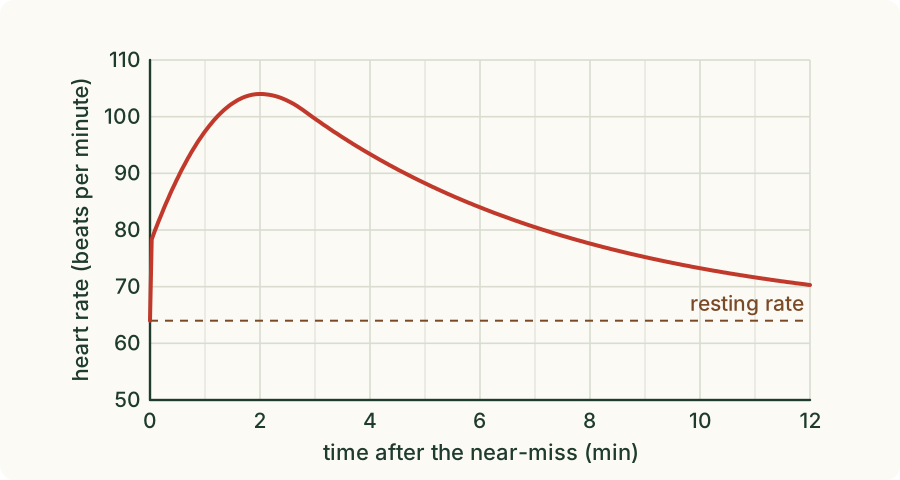
Time to the peak: ______________ unit ________
Nudge (only if you are stuck): Find the highest point of the trace, then go straight down to the time axis.
9. calculate / determine
Use the graph of the cyclist's heart rate. The resting rate is 64 and the peak is 104 beats per minute. (a) Calculate the heart rate halfway back. (b) Determine the time at which the heart rate has fallen halfway back.
(a) Heart rate halfway back (beats per minute): ______________ unit ________
(b) Time halfway back: ______________ unit ________
Nudge (only if you are stuck): For (b), go across from your answer to (a) to the part of the trace after the peak, then down.
10. describe / identify
Use the graph of the cyclist's heart rate. Describe the shape of the trace after the near-miss, and identify the part that shows nervous control and the part that shows hormonal control.
Nudge (only if you are stuck): Look at the very start, then the rise to the peak, then the fall.
11. identify
The table shows four responses in animals and people. Which two are most likely to be controlled by hormones? Choose two.
| Response | Starts after | Lasts for |
|---|---|---|
| P: an octopus changes colour when touched | 0.2 seconds | about 1 second |
| Q: a frog grows legs as a tadpole | several days | the rest of its life |
| R: a dog jumps away from a hot stove | 0.1 seconds | under 1 second |
| S: a person's blood glucose falls back to normal after a sugary drink | about 10 minutes | about 2 hours |
Tick every correct statement.
- R: a dog jumps away from a hot stove.
- P: an octopus changes colour when touched.
- S: blood glucose falls back to normal after a sugary drink.
- Q: a frog grows legs as a tadpole.
Nudge (only if you are stuck): Look at how soon each one starts and how long it lasts.
12. identify
A doctor wants to record how a patient's heart rate changes after an injection of adrenaline, from before the injection until it is back near the resting rate. Which recording time is most suitable?
Circle one answer.
- 1 minute.
- 10 seconds.
- 1 second.
- About 15 minutes.
Nudge (only if you are stuck): How long does the effect of a hormone last?
13. compare
A doctor taps just below a 13-year-old boy's knee, and his lower leg kicks forward at once and drops back. Over the next year, testosterone from his testes makes his voice slowly become deeper, and it stays deep for the rest of his life. Compare the two responses by their speed of action and their duration of effect.
Speed of action
Duration of effect
Nudge (only if you are stuck): Use the times in the story: how soon does each response appear, and how long does it last?