Pupil sheet · Hormones
Hormones — return questions
Name ______________________ Date ____________
Use one to two weeks after the lessons. Keep the notes and the lesson closed.
1. predict
Suppose a medicine stopped adrenaline from acting on the heart, but left the nerves to the heart working. Predict the heart-rate trace of a person who takes it and then has a sudden fright.
Circle one answer.
- A jump in the first second, then a slow rise to a peak, as usual.
- No change in the heart rate at any time after the fright.
- A jump in the first second, but no slower rise to a peak after it.
- No jump in the first second, but a slow rise to a peak after it.
2. determine
After a fright, a boy's heart rate rises from a resting rate of 66 beats per minute to a peak, then falls back. Halfway back, his heart rate is 95 beats per minute. Determine the peak heart rate.
Peak heart rate (beats per minute): ______________ unit ________
3. explain
A student writes: "A hormone is an electrical signal, sent out by a gland, which changes only the organ right next to that gland." Explain the two mistakes in the student's description.
First mistake
Second mistake
4. identify
A person is sitting still. Within a minute, their breathing rate, their heart rate and their pupil diameter all increase. Which of these is the most likely cause?
Circle one answer.
- They have just walked from a bright room into a dark one.
- They have just finished eating a large meal.
- They have just started to fall asleep in the chair.
- They have just been told they must give a speech at once.
5. identify
Supplement: a pianist sits quietly backstage, waiting nervously to go on. Over a few minutes, her blood glucose concentration and her heart rate both increase. Which row shows the hormone that caused these changes and the organ that released the extra glucose into her blood?
| Row | Hormone | Organ that released the glucose |
|---|---|---|
| A | adrenaline | liver |
| B | insulin | liver |
| C | adrenaline | pancreas |
| D | adrenaline | leg muscles |
Circle one answer.
- A
- B
- C
- D
6. identify
Match each hormone to the gland that secretes it. Glucagon is Supplement. Not every organ in the list is used.
Write the number of the matching option.
- liver
- pancreas
- ovaries
- adrenal glands
- uterus
- testes
- testosterone: ______
- oestrogen: ______
- adrenaline: ______
- glucagon (Supplement): ______
7. identify
The diagram shows the abdomen of a person seen from the back, with four label lines, J to M. Identify each labelled organ, and match it to the hormone it secretes from these four: adrenaline, insulin, testosterone and oestrogen. Some organs secrete none of the four.
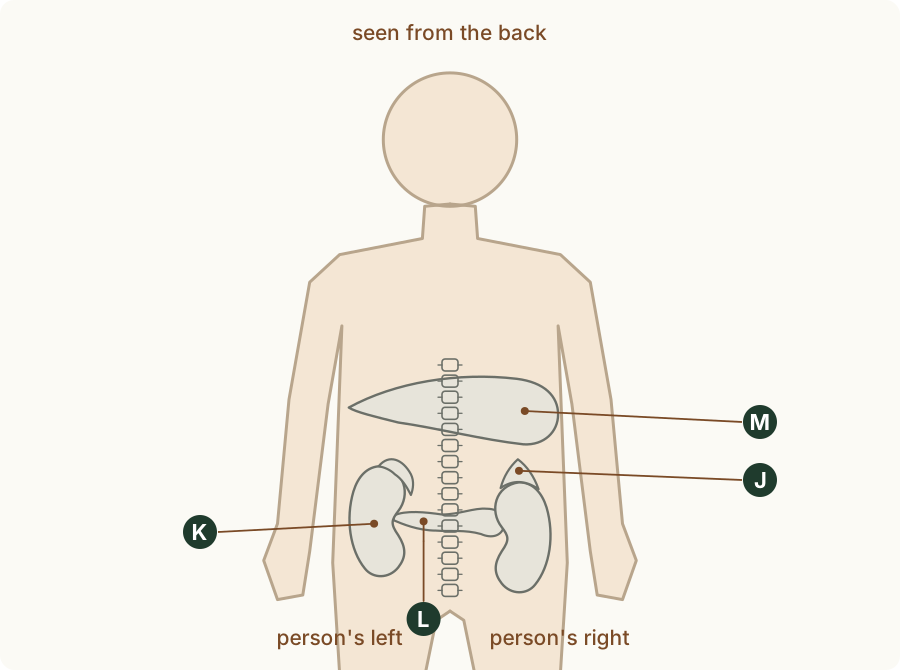
Write the number of the matching option.
- kidney – adrenaline
- adrenal gland – adrenaline
- liver – none of the four
- kidney – none of the four
- liver – insulin
- pancreas – insulin
- J: ______
- K: ______
- L: ______
- M: ______