Pupil sheet · Blood
Clotting — questions
Name ______________________ Date ____________
Try every question before you use a nudge. Write in full sentences where you are asked to explain.
1. state
What are the roles of blood clotting? Choose all that apply.
Tick every correct statement.
- it prevents bacteria multiplying in the blood
- it digests bacteria that enter the cut
- it prevents loss of blood at the cut
- it prevents pathogens entering the body
Nudge (only if you are stuck): Think of what would happen at a cut that did not clot.
2. identify
Which part of blood helps it to clot at a cut?
Circle one answer.
- platelets
- haemoglobin
- lymphocytes
- red blood cells
Nudge (only if you are stuck): Think of the thin pale band of a spun tube: it holds two components.
3. state
Supplement. A man nicks his chin while shaving, and after a few minutes the nick stops bleeding. State the word that completes each sentence about what happened in his blood.
Before the cut, a protein called … was dissolved in his plasma.
It could stay dissolved because it is … .
At the nick, this protein was converted into … , which is insoluble.
Its long threads formed a … that trapped blood cells and sealed the nick.
Nudge (only if you are stuck): Two of the blanks are names of proteins. Which of the two was there before the cut?
4. identify
Supplement. The diagram shows a clot forming where the wall of a small blood vessel has been cut. Match each letter to what it shows. Two answers are not used.
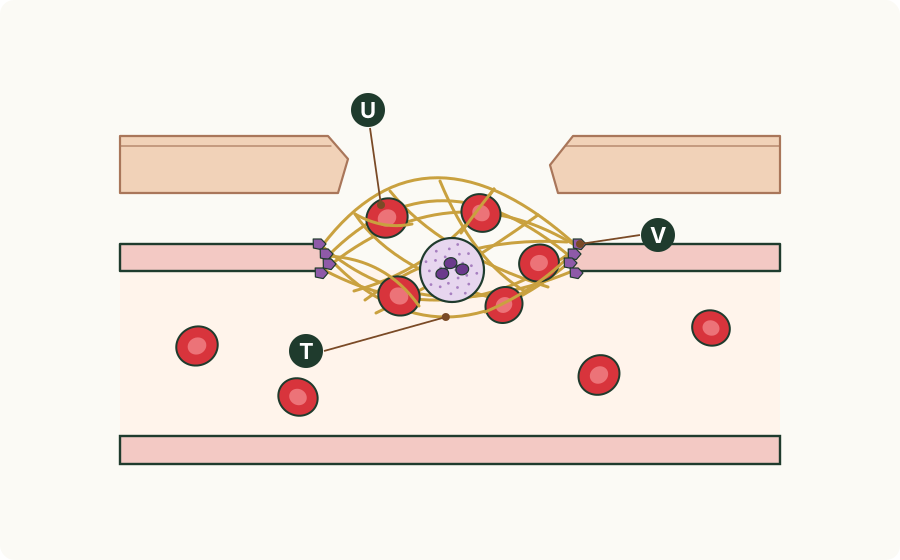
Write the number of the matching option.
- fibrinogen
- a platelet
- a white blood cell
- a red blood cell
- a fibrin thread
- T: ______
- U: ______
- V: ______
Nudge (only if you are stuck): For each answer, ask first whether it could be seen in a drawing at all.
5. explain
Two people get small cuts of the same size on the hand. Cut A stops bleeding after about 4 minutes. Cut B, on a person who takes a medicine that slows clotting, stops bleeding only after about 20 minutes. Explain which cut is more likely to become infected.
Nudge (only if you are stuck): Compare the two cuts ten minutes after they were made: how do they differ?
6. identify
Each event happens at or after a small cut. Match each event to the role of clotting it shows, or to "not a role of clotting". You can use an answer more than once.
Write the number of the matching option.
- not a role of clotting
- prevents blood loss
- prevents pathogens entering
- a nosebleed stops after a few minutes: ______
- once a graze is sealed, bacteria in the soil on it cannot get in: ______
- phagocytes digest bacteria that got into a cut before it was sealed: ______
- lymphocytes make antibodies against bacteria that got into a cut: ______
Nudge (only if you are stuck): A clot is a plug. What can a plug do, and what can it not do?
7. describe
Supplement. Put the stages of clotting at a cut in order.
Write the number of each step in order.
- Fibrin threads form a mesh that traps blood cells.
- Fibrinogen is converted into fibrin.
- The top of the clot dries into a scab.
- Platelets gather at the cut.
- Blood escapes from the cut vessel.
- Step 1: ______
- Step 2: ______
- Step 3: ______
- Step 4: ______
- Step 5: ______
Nudge (only if you are stuck): For each stage, ask what must already be there before it can happen.
8. explain
Supplement. Fibrinogen is carried round the body dissolved in the plasma. Explain why it matters that fibrinogen is soluble, and is converted into fibrin only at a cut.
Nudge (only if you are stuck): What would insoluble threads do inside a blood vessel?
9. suggest / explain
A footballer is kicked hard on the shin. The skin is not broken, but small blood vessels under the skin tear, and blood leaks out of them into the tissue around them: this makes a bruise. The blood round the torn vessels clots. (a) Suggest which role of clotting matters in a bruise, and explain how the clot does it. (b) Explain why the other role of clotting is not needed here.
(a) The role that matters, and how
(b) Why the other role is not needed
Nudge (only if you are stuck): Is there an opening from the outside into the body?
10. explain
Supplement. Blood is collected into two tubes. Tube A contains a chemical that stops clotting; tube B does not. After ten minutes the blood in A is still liquid, but the blood in B has set into a red jelly. Explain, using fibrinogen and fibrin, what happened in tube B.
Nudge (only if you are stuck): What forms the solid part of a clot?
11. suggest
A coronary artery carries blood to the muscle of the heart wall. In some people a clot forms inside a coronary artery, where there is no cut. Clotting at a cut is useful. Suggest why a clot inside a coronary artery is harmful.
Nudge (only if you are stuck): What does the heart muscle beyond the clot need from the blood?