Pupil sheet · Blood
What is in blood? — questions
Name ______________________ Date ____________
Try every question before you use a nudge. Write in full sentences where you are asked to explain.
1. state
Which list gives the four components of blood?
Circle one answer.
- red blood cells, haemoglobin, platelets and plasma
- red blood cells, white blood cells, plasma and fibrin
- red blood cells, white blood cells, platelets and plasma
- red blood cells, white blood cells, oxygen and water
Nudge (only if you are stuck): Think of the spun tube: two layers and a thin band between them hold the four components.
2. identify
The diagram shows a tube of blood after it was spun in a centrifuge. Match each layer to what it contains. One answer is not used.
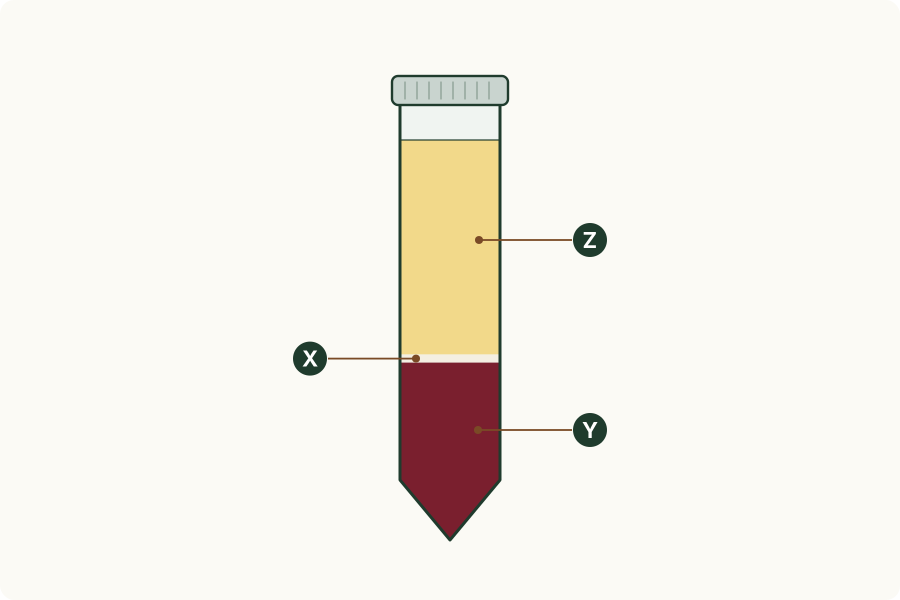
Write the number of the matching option.
- white blood cells and platelets
- red blood cells
- haemoglobin dissolved in water
- plasma
- X: ______
- Y: ______
- Z: ______
Nudge (only if you are stuck): Which part of blood is heaviest, and which is the liquid?
3. identify
A pupil makes a blood smear but forgets to stain it. Which kind of blood cell will be harder to pick out under the microscope, and why?
Circle one answer.
- white cells, because without the stain they lose their nucleus
- red cells, because without the stain they have no colour at all
- red cells, because without the stain their nucleus cannot be seen
- white cells, because without the stain their nucleus is not purple
Nudge (only if you are stuck): Where does each kind of cell get its colour in a stained smear?
4. identify
Supplement. Which feature is the best clue that a white blood cell in a smear is a lymphocyte?
Circle one answer.
- no nucleus and a paler centre
- a nucleus in several joined lobes
- grainy cytoplasm around a small nucleus
- a large round nucleus filling the cell
Nudge (only if you are stuck): Compare the nuclei of the two white cells you found in the experiment.
5. determine
A pupil counts red blood cells in one counting square. 13 red cells lie wholly inside the square. Of the cells that lie across a side, 3 cross the top side, 2 cross the right side, 4 cross the bottom side and 1 crosses the left side. Use the rule for cells on a line to determine the number of red cells the pupil should count in this square.
Red cells counted in the square: ______________ unit ________
Nudge (only if you are stuck): The rule counts the cells on two of the sides and leaves out those on the other two.
6. identify / give
The picture is painted to look like part of a stained blood smear at ×400; it is not a photograph. (a) Identify the letter that shows a red blood cell. (b) Identify the two letters that show white blood cells. (c) Identify the letter that shows a platelet. Give one reason for each answer.
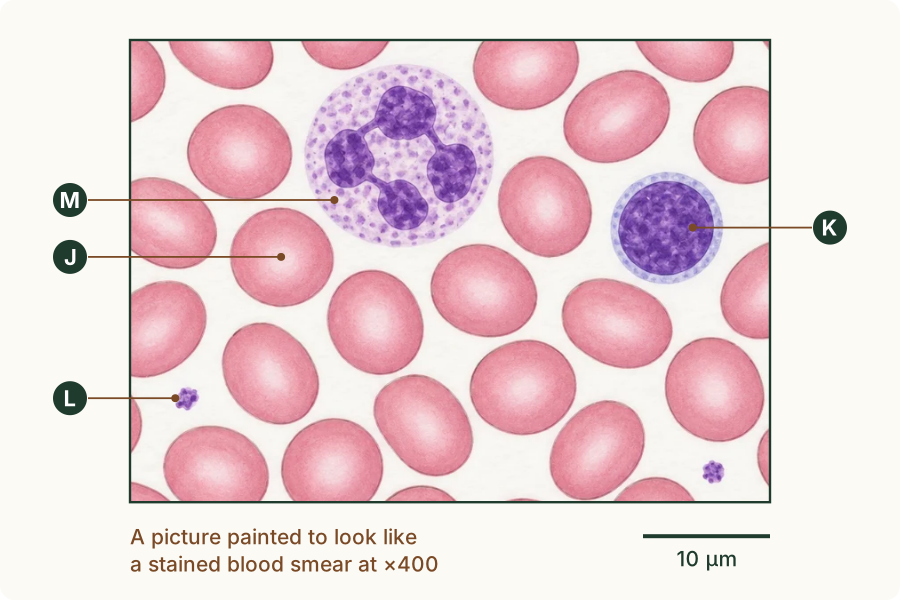
(a) Red blood cell: the letter and a reason
(b) White blood cells: the letters and a reason
(c) Platelet: the letter and a reason
Nudge (only if you are stuck): Look for a nucleus first, then compare the sizes.
7. identify
Supplement. The picture is painted to look like part of a stained blood smear at ×400; it is not a photograph. K and M are white blood cells. Which row identifies K and M and gives the best evidence?
| Row | K | M | Evidence |
|---|---|---|---|
| A | lymphocyte | phagocyte | K's nucleus is round and fills most of the cell; M's nucleus is in lobes |
| B | phagocyte | lymphocyte | K's nucleus is round and fills most of the cell; M's nucleus is in lobes |
| C | lymphocyte | phagocyte | M is the larger white cell; K is only about the size of a red cell |
| D | red blood cell | phagocyte | K is about the size of a red cell; M's nucleus is in lobes |
Circle one answer.
- A
- B
- C
- D
Nudge (only if you are stuck): Decide what kind of cell K is, and what kind M is, before you read the rows.
8. explain / suggest
The picture is painted to look like part of a stained blood smear at ×400; it is not a photograph. (a) A pupil says there is no white blood cell in this picture. Do you agree? Explain, using what you can see. (b) The pupil then writes: "This person's blood has no white blood cells." Suggest why the pupil should look at more fields of the smear before writing this.
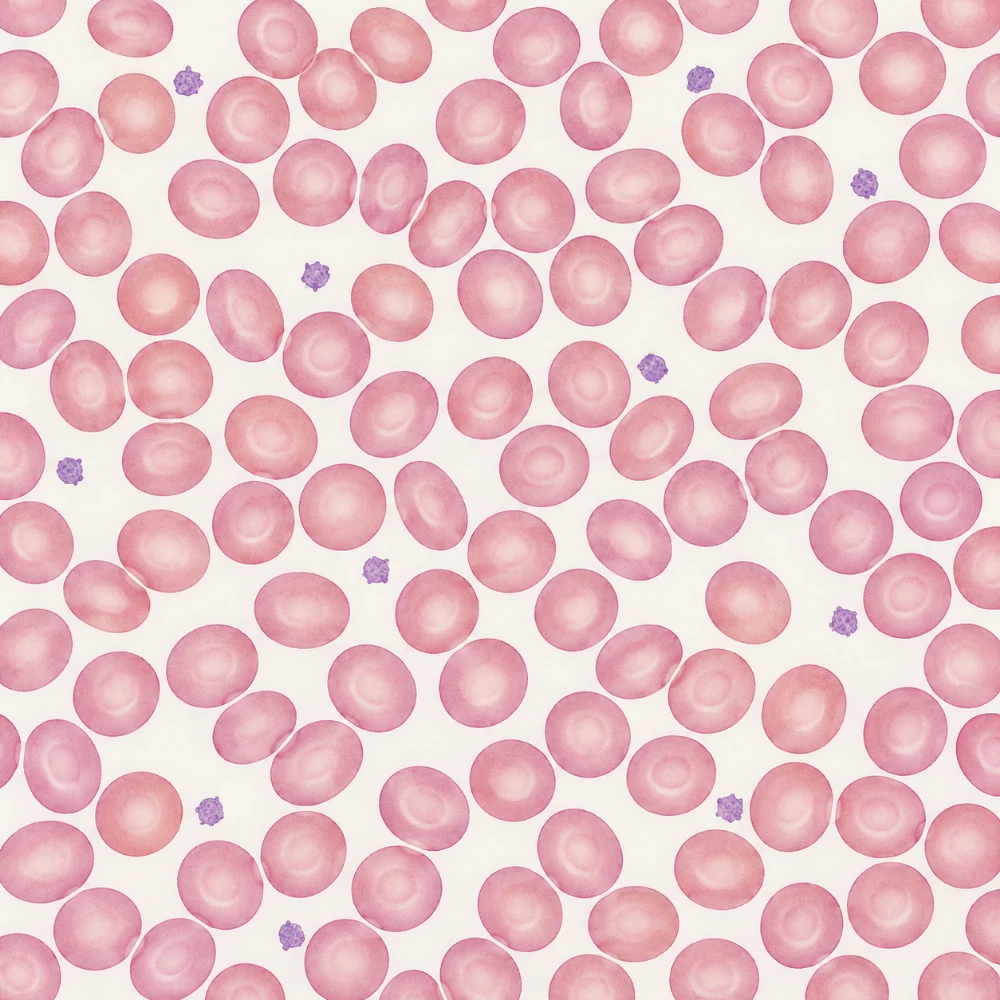
(a) Agree or disagree, and why
(b) Why look at more fields
Nudge (only if you are stuck): (a) What does a white blood cell have that a red cell does not? (b) How common are white cells compared with red cells?
9. calculate
In one field of view of a smear at ×400, a pupil finds 5 white blood cells. The counting square in their eyepiece is a different size from the one in the experiment: it covers one fiftieth of the field's area. In it they count 34 red blood cells. (a) Calculate the number of red cells in the whole field. (b) Calculate the number of red cells for each white cell.
(a) Red cells in the field: ______________ unit ________
(b) Red cells for each white cell: ______________ unit ________
Nudge (only if you are stuck): How many squares of this size would fill the field?
10. calculate / state
A tube of blood is spun in a centrifuge. The blood is 58 mm deep; the dark red layer at the bottom is 24 mm deep and the pale band above it is less than 1 mm. (a) Calculate the percentage of the blood that is red cells. Give your answer to 2 significant figures. (b) State the component that makes up most of the rest.
(a) Red cells: ______________ unit ________
(b) The component that makes up most of the rest
Nudge (only if you are stuck): Percentage = part ÷ whole × 100.
11. identify / give
Supplement. The drawing shows a red blood cell and two white blood cells, G and H, all at one scale. Identify G and H, and give the feature you used for each.
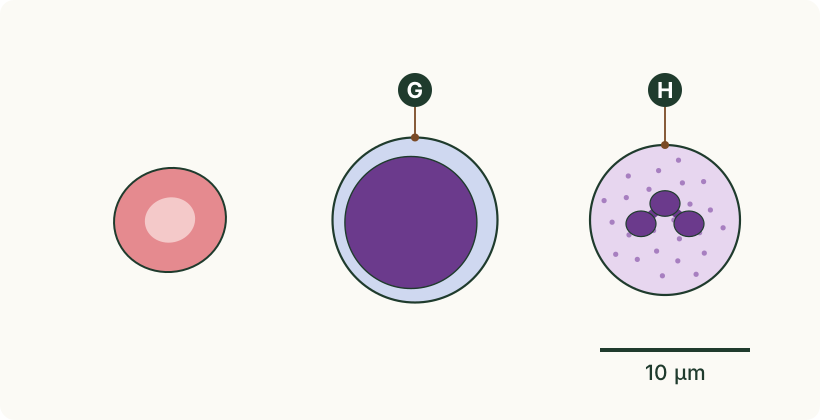
(a) G, and the feature
(b) H, and the feature
Nudge (only if you are stuck): Look at the shape of each nucleus, not only the size of each cell.
12. identify / calculate
A pupil counts the red blood cells in the counting square of five different fields of one smear, using the rule for cells on a line. The counts are 27, 25, 28, 44 and 24. (a) Identify the anomalous count. (b) Calculate the mean number of red cells in a square, leaving out the anomalous count. Give your answers to 2 significant figures.
(a) The anomalous count: ______________ unit ________
(b) Mean red cells in a square: ______________ unit ________
Nudge (only if you are stuck): Look for a count that does not fit with the others.
13. identify
Which features show that a cell in a stained smear is a red blood cell? Choose all that apply.
Tick every correct statement.
- larger than most other cells
- a nucleus stained purple
- stained purple all over
- no nucleus inside the cell
- a centre paler than its edge
Nudge (only if you are stuck): Picture a pink disc in the smear: what does it have, and what does it lack?
14. suggest
A hospital laboratory counts the cells in many fields of a smear of one patient's blood. It finds about 150 red blood cells for each white blood cell. Healthy blood gives several hundred red cells for each white cell. Suggest two different changes in the patient's blood, each of which on its own could give this lower figure.
(a) First change
(b) Second change
Nudge (only if you are stuck): Which two numbers is this figure worked out from?
15. calculate / explain
Two pupils count different fields of one smear. Field A: 0 white cells, and 20 red cells in the square (one hundredth of the field). Field B: 5 white cells, and 19 red cells in the square. (a) Calculate the number of red cells for each white cell, using both fields together. (b) One pupil says field A should be left out, because it found no white cells. Explain why leaving it out would give a wrong answer.
(a) Red cells for each white cell: ______________ unit ________
(b) Why leaving field A out gives a wrong answer
Nudge (only if you are stuck): Treat the two fields as one larger piece of the smear.
16. calculate
Supplement. A laboratory sorts 250 white blood cells from a stained smear by the shape of their nucleus. 175 of them have a nucleus in several joined lobes. The other 75 each have one large round nucleus that fills most of the cell. Calculate the percentage of these white cells that are lymphocytes. Give your answer to 2 significant figures.
Lymphocytes: ______________ unit ________
Nudge (only if you are stuck): Decide which group is the lymphocytes before you calculate.
17. explain
A pupil says: "Blood is red because the red colour is dissolved in the liquid part of blood." Use what happens when blood is spun in a centrifuge to explain why this is incorrect.
Nudge (only if you are stuck): After spinning, which layer is red, and what colour is the liquid?