Pupil sheet · Waves in a ripple tank
Reflection, refraction and diffraction — questions
Name ______________________ Date ____________
Try every question before you use a nudge. Write in full sentences where you are asked to explain.
1. identify
For each situation, choose what is happening to the waves.
Write the number of the matching option.
- Diffraction
- Reflection
- Refraction
- Ripples on a pond reach a straight concrete edge at an angle and leave it at the same angle.: ______
- Over a sandbar, where the water is shallower, the wavefronts are closer together and point a new way.: ______
- Beyond a narrow opening between two rocks, the wavefronts are curved and reach the water on both sides.: ______
- Ripples reach a harbour wall head-on, and soon ripples are seen moving away from it across the harbour.: ______
- Behind the end of a long rock barrier, out of line with the waves arriving, the water bobs up and down.: ______
Nudge (only if you are stuck): For each one, ask what the waves met, and whether the water they travel in has changed.
2. identify
Straight water waves are reflected by a flat barrier. Which of these is different after the reflection?
Circle one answer.
- Their speed
- Their frequency
- Their direction
- Their wavelength
Nudge (only if you are stuck): Are the reflected waves in different water, and has the dipper changed?
3. determine
A dipper in a ripple tank vibrates 6 times each second. In the deep water its waves travel at 0.33 m/s. They then pass over a plastic sheet lying on the bottom of the tank, where the water is shallower and they travel at 0.27 m/s. Determine (a) the frequency of the waves over the sheet, (b) their wavelength in the deep water, in cm, and (c) their wavelength over the sheet, in cm.
(a) Frequency over the sheet: ______________ unit ________
(b) Wavelength in the deep water: ______________ unit ________
(c) Wavelength over the sheet: ______________ unit ________
Nudge (only if you are stuck): For (a), can the number of waves leaving the edge of the sheet each second differ from the number arriving? For (b) and (c), which form of v = fλ gives λ?
4. calculate
A dipper vibrates at 20 Hz. In the deep water of a ripple tank, its waves have a wavelength of 1.1 cm. Over a flat tile laid on the bottom of the tank, their wavelength is 0.70 cm. Calculate (a) the speed of the waves in the deep water and (b) their speed over the tile, both in m/s.
(a) Speed in the deep water: ______________ unit ________
(b) Speed over the tile: ______________ unit ________
Nudge (only if you are stuck): What unit must each wavelength be in for v = fλ to give m/s?
5. identify / explain / calculate
The diagram shows waves in a ripple tank passing from region A into region B. (a) Identify which region is shallower, and give your reason. (b) Explain why the waves change direction as they cross into region B. (c) In region A the waves travel at 0.18 m/s. The arrow on the diagram spans one wavelength in region A. Use it to calculate the frequency of the dipper.
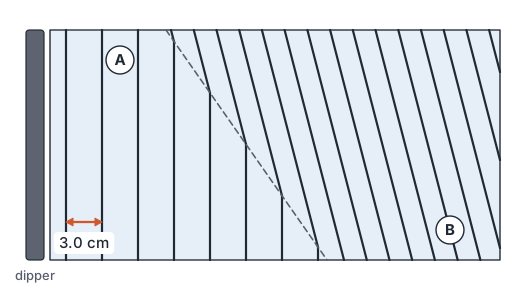
(a) The shallower region
(b) Why the direction changes
(c) The frequency
Nudge (only if you are stuck): Compare how far apart the wavefronts are in A and in B. For (c), what unit must the wavelength be in?
6. identify
Straight waves cross a lake at an angle to the edge of a wide, flat rock lying on the lake bed. Over the rock, the waves change direction. Why?
Circle one answer.
- The rock reflects them, so they turn back the way they came.
- The water is shallower there, so the waves slow down.
- The water is shallower there, so their frequency falls.
- They bend round the edge of the rock, so they spread out.
Nudge (only if you are stuck): What is different about the water over the rock, and what does that change about the waves?
7. identify
Different things are placed in the water of a ripple tank. Match each one to what it shows.
Write the number of the matching option.
- Diffraction by an edge
- Reflection at a plane surface
- Refraction
- Diffraction by a gap
- A brick standing in the water, at an angle to the waves: ______
- A sheet of plastic lying on the bottom of part of the tank: ______
- Two blocks standing in the water with a narrow gap between them: ______
- A ruler standing on its edge, with the waves passing its end: ______
- A long block across the whole tank, facing the waves head-on: ______
Nudge (only if you are stuck): Where do the waves meet each object?
8. describe / state
Describe how to use a ripple tank to show that water waves are refracted. (a) State what you put in the tank, and where. (b) State how you arrange it compared with the wavefronts. (c) Describe what you see on the screen.
(a) What you put in the tank
(b) How you arrange it
(c) What you see
Nudge (only if you are stuck): What must change about the water for the waves to change speed?
9. identify
In a ripple tank, straight wavefronts meet a flat barrier. The angle between the arriving wavefronts and the barrier is 50°. Which row describes the reflected waves?
| Row | Angle between the reflected wavefronts and the barrier | Wavelength of the reflected waves |
|---|---|---|
| A | 40° | the same as before |
| B | 50° | shorter than before |
| C | 50° | the same as before |
| D | 40° | shorter than before |
Circle one answer.
- A
- B
- C
- D
Nudge (only if you are stuck): Is anything about the water or the dipper different for the reflected waves?
10. describe / explain / state
A single straight barrier is placed in a ripple tank so that the waves pass its open end. A table-tennis ball floats in the water just behind the barrier, close to its open end, out of line with the waves arriving. (a) Describe what the waves do as they pass the end of the barrier. (b) Explain whether the ball moves. (c) State one property of the waves behind the barrier that is the same as in the waves arriving.
(a) What the waves do
(b) The ball
(c) What stays the same
Nudge (only if you are stuck): Do waves travel only in straight lines past an edge?
11. identify
Supplement. Waves with a wavelength of 3.0 cm in a ripple tank pass through a gap in a barrier. Which gap makes them spread out the most?
Circle one answer.
- A gap 10 cm wide
- All gaps equally
- A gap 4 cm wide
- A gap 20 cm wide
Nudge (only if you are stuck): Compare each gap with the wavelength.
12. describe / explain / determine / state
Supplement. In a ripple tank, waves with a wavelength of 1.0 cm pass through a gap 5.0 cm wide. (a) Describe how the waves look beyond the gap. (b) The gap is narrowed to 1.0 cm. Describe and explain the change. (c) The gap is set back to 5.0 cm. The frequency of the dipper is lowered to one third of its value, and the waves travel at the same speed. Determine the new wavelength, and state whether the waves now spread out more or less beyond the gap.
(a) Through the 5.0 cm gap
(b) Through the 1.0 cm gap
(c) At one third of the frequency
Nudge (only if you are stuck): Compare the gap with the wavelength each time. For (c), which quantity stays the same?
13. identify
Supplement. In a ripple tank, a dipper makes waves first at 4 Hz and then at 12 Hz. The water depth is the same both times. Both sets of waves pass the end of a straight barrier. Which row is correct?
| Row | Waves with the longer wavelength | Waves that bend further round the end of the barrier |
|---|---|---|
| A | the 12 Hz waves | the 12 Hz waves |
| B | the 4 Hz waves | the 12 Hz waves |
| C | the 12 Hz waves | the 4 Hz waves |
| D | the 4 Hz waves | the 4 Hz waves |
Circle one answer.
- A
- B
- C
- D
Nudge (only if you are stuck): What does the same depth tell you about the speed of the two sets of waves?
14. describe / state / explain
A leisure pool has a wave machine at one end. It makes straight waves 2.4 m long, at a frequency of 0.80 Hz. Halfway along the pool, two walls stand up out of the water with an opening 2.5 m wide between them. Beyond the walls, the floor of the pool slopes up to a shallow “beach”. (a) Describe the shape of the wavefronts just beyond the opening, and state their wavelength there. (b) Describe what happens to the speed and the wavelength of the waves as they travel up the slope, and state what stays the same. (c) Supplement. Swimmers in the water just behind one of the walls, out of line with the opening, are rocked by these waves. A different setting of the machine makes waves only 0.20 m long. Explain why the swimmers behind the wall would hardly be rocked by these.
(a) Beyond the opening
(b) Up the slope
(c) Supplement: the shorter waves
Nudge (only if you are stuck): For (a), what do waves do at a gap? For (b), how does depth affect the speed of water waves? For (c), compare each wavelength with the opening.