Pupil sheet · Waves in a ripple tank
Waves and how they move — questions
Name ______________________ Date ____________
Try every question before you use a nudge. Write in full sentences where you are asked to explain.
1. identify
A leaf floats on a pond. A stone is dropped into the pond, and the ripples spread out and pass the leaf. What does the leaf do as the ripples pass?
Circle one answer.
- It bobs up and down about the same place as the ripples pass.
- It is carried along with the ripples to the edge of the pond.
- It is pushed back towards the place where the stone landed.
- It stays completely still while the ripples pass under it.
Nudge (only if you are stuck): What does a wave carry across the pond?
2. identify
A garden hose lies straight on a lawn. A ladybird sits on the hose halfway along it, and a plastic cup stands against the far end. A gardener flicks the near end of the hose sideways, once. A pulse runs along the hose: the ladybird moves sideways and back and ends where it started, and then the cup tips over. Which row is correct?
| Row | Observation that shows energy reached the far end | Observation that shows the hose was not carried along |
|---|---|---|
| A | the cup tips over | the ladybird ends where it started |
| B | the ladybird ends where it started | the cup tips over |
| C | the ladybird moves sideways | the cup tips over |
| D | the cup tips over | the ladybird moves sideways |
Circle one answer.
- A
- B
- C
- D
Nudge (only if you are stuck): Ask of each observation: does it tell you what reached the far end, or where the hose ends up?
3. determine
A pupil moves one end of a slinky spring steadily from side to side along a smooth floor. A small piece of tape on one coil makes 12 complete vibrations in 8.0 s. The crests on the slinky are 0.50 m apart. Determine (a) the frequency of the wave and (b) the speed of the wave.
(a) Frequency: ______________ unit ________
(b) Wave speed: ______________ unit ________
Nudge (only if you are stuck): How many vibrations does the tape make in one second? For (b), which equation links speed, frequency and wavelength?
4. identify
For each wave, choose whether it is modelled as transverse or longitudinal.
Write the number of the matching option.
- Longitudinal
- Transverse
- Light from the Sun: ______
- Sound from a drum: ______
- A seismic P-wave: ______
- A seismic S-wave: ______
- Waves on the surface of the sea: ______
- A wave made by pushing and pulling the end of a slinky: ______
Nudge (only if you are stuck): For each wave, compare the direction of vibration with the direction in which the wave travels.
5. identify
A referee blows a whistle at one end of a sports field. The sound travels through the air to a player at the other end. How do the air particles between them move as the sound passes?
Circle one answer.
- They vibrate to and fro along the line from the whistle to the player.
- They are carried along the line from the whistle to the player.
- They stay still, because only the energy of the sound moves on.
- They vibrate up and down, at right angles to the line between them.
Nudge (only if you are stuck): Which kind of wave is sound, and what does that tell you about the direction of vibration?
6. identify
An earthquake happens 300 km due north of a seismometer. As wave X passes the seismometer, the ground shakes north and south. As wave Y passes, the ground shakes east and west. Which row is correct?
| Row | Wave X | Wave Y |
|---|---|---|
| A | S-wave, transverse | P-wave, longitudinal |
| B | P-wave, longitudinal | S-wave, transverse |
| C | P-wave, transverse | S-wave, longitudinal |
| D | S-wave, longitudinal | P-wave, transverse |
Circle one answer.
- A
- B
- C
- D
Nudge (only if you are stuck): Which way do the waves travel to reach the seismometer?
7. state / give / describe
A long spring hangs from a hook in the ceiling, with a small weight on its lower end. (a) The weight is pulled down a little and let go, again and again, and a wave travels up the spring. Each coil moves up and down. State whether this wave is transverse or longitudinal, and give the reason. (b) Describe how to send the other kind of wave up the same spring. (c) Describe how a coil halfway up the spring moves as the wave in (b) passes it.
(a) Transverse or longitudinal, and why
(b) The other kind of wave
(c) The coil halfway up
Nudge (only if you are stuck): In which direction does the wave travel along a hanging spring?
8. identify
The graph shows a wave on a rope at one moment. Its displacement is how far each point of the rope is from the rest line. Match each letter to what it shows.
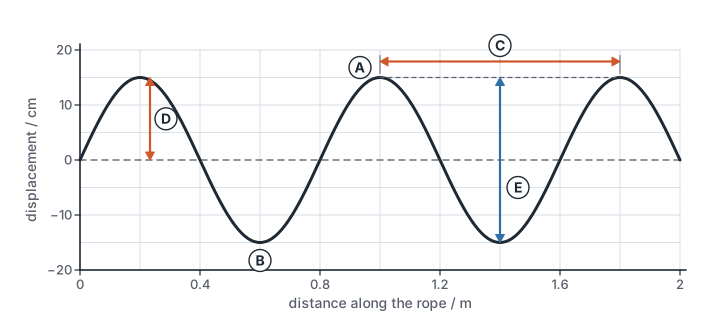
Write the number of the matching option.
- The wavelength
- A crest
- A trough
- Twice the amplitude
- The amplitude
- A: ______
- B: ______
- C: ______
- D: ______
- E: ______
Nudge (only if you are stuck): Check where each arrow starts: on the rest line or on a trough?
9. determine
Use the graph of the wave on the rope (displacement: how far each point of the rope is from the rest line). Determine (a) the wavelength of the wave, in metres, and (b) its amplitude, in centimetres.
(a) Wavelength: ______________ unit ________
(b) Amplitude: ______________ unit ________
Nudge (only if you are stuck): For (a), which distance makes one whole wave? For (b), where is the amplitude measured from?
10. calculate
A dipper in a ripple tank vibrates at 15 Hz. The waves it makes have a wavelength of 1.4 cm. Calculate the speed of the waves in m/s.
Wave speed: ______________ unit ________
Nudge (only if you are stuck): Which equation links speed, frequency and wavelength, and what unit must the wavelength be in?
11. calculate
Waves on a lake have a frequency of 1.2 Hz and travel at 1.3 m/s. Calculate their wavelength. Give your answer to 2 significant figures.
Wavelength: ______________ unit ________
Nudge (only if you are stuck): Which quantity do you need on its own, and what must you do to both sides of v = fλ to get it?
12. calculate
From the end of a pier, a pupil sees ocean waves with crests 9.0 m apart, travelling at 3.6 m/s. Calculate the frequency of the waves.
Frequency: ______________ unit ________
Nudge (only if you are stuck): What is the distance from one crest to the next called?
13. identify
A pupil has a still picture of the straight bright lines made by the waves in a ripple tank, and a ruler. Which method gives the most accurate value of the wavelength?
Circle one answer.
- Measure from the first bright line to the ninth, and divide by 8.
- Measure from one bright line to the next, once, and use that.
- Measure from one bright line to the next dark line, and double it.
- Measure from the first bright line to the ninth, and divide by 9.
Nudge (only if you are stuck): Which method spreads the small error in reading the ruler over the most wavelengths?
14. determine
A dipper in a ripple tank moves up and down 27 times in 3.0 s. From the bottom of a trough to the top of a crest, the water surface rises 0.6 cm. On a still picture taken from above, each wavefront is 0.8 cm from the dark line of the trough next to it. Determine (a) the frequency of the waves, (b) their amplitude, (c) their wavelength and (d) the distance each crest travels in one second.
(a) Frequency: ______________ unit ________
(b) Amplitude: ______________ unit ________
(c) Wavelength: ______________ unit ________
(d) Distance each crest travels in one second: ______________ unit ________
Nudge (only if you are stuck): For (b) and (c), check where each given distance starts and ends: the rest level, a crest or a trough. For (d), which equation gives the distance a wave travels each second?
15. determine / explain
A still picture of a ripple tank shows straight bright lines. A ruler laid along the direction of travel shows six bright lines: the first at 1.0 cm and the sixth at 19.0 cm. (a) Determine the wavelength. (b) The frequency of the dipper is then doubled, and the waves travel at the same speed. Determine the new wavelength. (c) A pupil divides 18.0 cm by 6 to find the wavelength in (a). Explain why this is incorrect.
(a) The wavelength
(b) The new wavelength
(c) Why dividing by 6 is incorrect
Nudge (only if you are stuck): How many gaps are there between six lines? For (b), which quantity stays the same?
16. calculate / explain
An earthquake under the ocean starts a tsunami. A computer map of the deep ocean shows its wavefronts 200 km apart, travelling at 200 m/s. (a) Calculate the frequency of the waves. (b) A ship in the deep ocean rises and falls gently as a tsunami wave passes under it. Explain why the ship is not carried towards the coast. (c) As the wave passes, the ship rises and falls, while the wave itself travels horizontally towards the coast. Explain how this fits the model of water waves as transverse waves.
(a) The frequency
(b) The ship
(c) The transverse model
Nudge (only if you are stuck): For (a), what unit must the wavelength be in? For (b), what does a wave transfer? For (c), compare the two directions.