Pupil sheet · Thermal radiation
Absorbing infrared — questions
Name ______________________ Date ____________
Try every question before you use a nudge. Write in full sentences where you are asked to explain.
1. identify
Infrared from a heater falls on four plates of the same size, each the same distance from the heater. Which plate absorbs the most infrared?
Circle one answer.
- The plate covered in shiny foil
- The white plate
- The plate of polished aluminium
- The matt black plate
Nudge (only if you are stuck): Which surfaces take in most of the radiation that falls on them, and which send most of it back?
2. classify
Sort each surface: does it absorb most of the radiation falling on it, or reflect most of it?
Write the number of the matching option.
- Reflects most
- Absorbs most
- A matt black solar panel: ______
- A white-painted wall: ______
- Shiny foil behind a radiator: ______
- Dark tarmac on a road: ______
- A shiny emergency blanket: ______
Nudge (only if you are stuck): Dull black and dark surfaces are good absorbers. White and shiny surfaces are good reflectors.
3. explain
Firefighters who work close to large fires sometimes wear suits with a shiny silver outer layer. (a) Explain how the shiny layer protects the firefighter from the fire’s radiation. (b) Explain why a matt black outer layer would be a poor choice.
(a) The shiny layer
(b) A matt black layer
Nudge (only if you are stuck): What does a shiny surface do with the radiation that falls on it? What does a dull black one do?
4. state / explain
On a sunny spring day, a patch of snow covered with dark soot melts sooner than the clean white snow around it. (a) State which absorbs more of the Sun’s radiation: the sooty snow or the clean snow. (b) Explain why the sooty snow melts first.
(a) Which absorbs more
(b) Why it melts first
Nudge (only if you are stuck): Compare what dark and white surfaces do with the sunlight falling on them.
5. describe
This experiment compares how well a matt black plate and a shiny plate absorb infrared, using a heater and a coin stuck with wax to the back of each plate. Put the steps in order.
Write the number of each step in order.
- Switch on the heater and start a stopwatch.
- Swap the two plates round and repeat the test.
- Stick a coin to the back of each plate with the same amount of wax, and stand the heater exactly halfway between the plates.
- Note which coin falls first.
- Step 1: ______
- Step 2: ______
- Step 3: ______
- Step 4: ______
Nudge (only if you are stuck): Set everything up fairly before you switch on, then watch, then check the result.
6. state / explain
Two identical cans, P and Q, hold the same volume of water and stand the same distance from a heater. One can is painted matt black and the other is shiny. The graph shows their temperatures. (a) State which can is matt black. (b) Explain how the graph shows this. (c) State two things that must be the same for both cans to make the test fair. (d) Both temperatures stop rising although the heater is still on. Explain why.
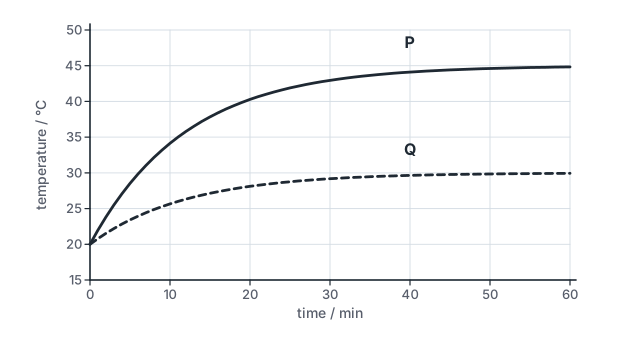
(a) The black can
(b) How the graph shows it
(c) Two things kept the same
(d) Why they stop rising
Nudge (only if you are stuck): The better absorber warms faster. For (d), think about the rate at which each can transfers energy away as it gets hotter.
7. calculate
A pan of soup on a hob receives 900 J of energy from the hob every second, and its temperature stays at 60 °C. At what rate is the soup transferring energy to its surroundings?
Rate of energy transfer to the surroundings: ______________ unit ________
Nudge (only if you are stuck): A constant temperature means the energy goes out as fast as it comes in.
8. state
A can of cold water is put out in the sunshine. For each moment, choose what happens to its temperature.
Write the number of the matching option.
- Its temperature falls
- Its temperature rises
- Its temperature stays constant
- Just after it is put out: it receives energy faster than it transfers energy away: ______
- An hour later: it transfers energy away at the same rate as it receives energy: ______
- A cloud covers the Sun: it now receives energy more slowly than it transfers energy away: ______
Nudge (only if you are stuck): Compare the rate at which energy comes in with the rate at which it goes out each time.
9. explain / describe
In the experiment, the black can under the lamp warmed from 20 °C and levelled off at about 36 °C while the lamp was still on. (a) Explain why its temperature rose quickly at first. (b) Explain why it stopped rising. (c) The lamp was then switched off. Describe and explain what happened to the can’s temperature.
(a) Why it rose quickly
(b) Why it stopped rising
(c) Lamp off
Nudge (only if you are stuck): At first the can is at room temperature. How does the rate at which it transfers energy away change as it warms?
10. identify
Which of these changes would make the Earth’s average temperature rise? Choose all that apply.
Tick every correct statement.
- Less greenhouse gas in the atmosphere, so more infrared escapes into space
- More cloud and ice, so more sunlight is reflected back into space
- More carbon dioxide in the atmosphere, so less infrared from the surface escapes into space
- Less ice and snow, so the Earth reflects less sunlight
Nudge (only if you are stuck): The temperature rises if the Earth absorbs energy faster, or emits energy into space more slowly.
11. explain
A coal fire burns in a fireplace with a chimney. Explain how energy is transferred: (a) to a person sitting in front of the fire; (b) up the chimney; (c) into the metal grate that holds the coal. (d) Explain why fresh air flows into the bottom of the fire.
(a) To the person
(b) Up the chimney
(c) Into the grate
(d) Fresh air
Nudge (only if you are stuck): Which transfer needs no material? Which needs a gas that can flow? Which happens through a solid?
12. explain
The diagram shows a cut-away vacuum flask. Match each labelled part to how it helps to keep a hot drink hot.
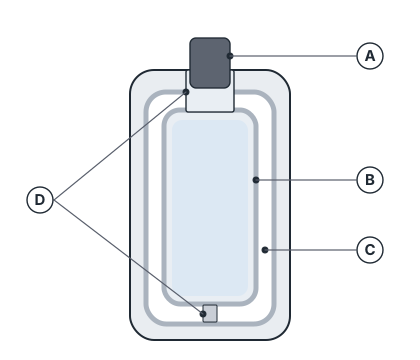
Write the number of the matching option.
- Emits little infrared, and reflects most of what is emitted back
- An insulator that stops warm air leaving the top by convection
- Few, narrow joins, so little energy is conducted to the case
- Almost no particles, so it stops conduction and convection
- A: the stopper: ______
- B: the silvery wall surfaces: ______
- C: the gap with the air pumped out: ______
- D: the narrow neck and the small support: ______
Nudge (only if you are stuck): A vacuum has almost no particles, and a shiny surface is a poor emitter and a good reflector.
13. explain
A car engine is cooled by a liquid coolant that is pumped through a radiator at the front of the car. The radiator is made of thin aluminium tubes joined by many thin metal fins, and a fan blows air through it when the car is not moving. (a) Explain how energy gets from the hot coolant to the outside surfaces of the tubes and fins. (b) Explain why the radiator has many thin fins. (c) The fan is broken. Explain why the engine may overheat when the car stands in a traffic jam, but not when it drives along the road.
(a) From the coolant to the surface
(b) Many thin fins
(c) A traffic jam with a broken fan
Nudge (only if you are stuck): Which transfer happens through a solid? Which needs a gas that flows? What carries the warm air away when the car is not moving?
14. explain
A large volcano erupts and puts a thin cloud of fine ash and droplets high in the atmosphere, all round the Earth. The cloud reflects some of the sunlight back into space. (a) Explain what happens to the rate at which the Earth’s surface absorbs energy from the Sun. (b) Explain what happens to the Earth’s average temperature in the year after the eruption. (c) A few years later the cloud has gone. Explain how the Earth’s temperature changes then.
(a) The rate of absorbing
(b) The year after
(c) When the cloud has gone
Nudge (only if you are stuck): Compare the rate at which the Earth absorbs energy with the rate at which it emits energy. Which is bigger after the eruption?
15. explain / suggest
In a hot city, some people paint the flat roofs of their houses with white “cool roof” paint instead of leaving them dark. (a) Explain why a white roof keeps the rooms below cooler on a sunny day. (b) Supplement. Explain why a dark roof settles at a higher temperature than a white roof in the same sunshine. (c) Supplement. Suggest why painting many roofs in a city white could make the city slightly cooler overall.
(a) A white roof
(b) Supplement: why a dark roof gets hotter
(c) Supplement: a whole city
Nudge (only if you are stuck): White paint reflects most sunlight. For (b), think about the balance of energy in and out.