Pupil sheet · Thermal radiation
Emitting infrared — questions
Name ______________________ Date ____________
Try every question before you use a nudge. Write in full sentences where you are asked to explain.
1. state
Which statement about thermal radiation is correct?
Circle one answer.
- Thermal radiation is infrared radiation, and all objects emit it; hotter objects emit more each second.
- Thermal radiation is infrared radiation, and only black objects emit it.
- Thermal radiation is visible light, so only objects that glow emit it.
- Thermal radiation is infrared radiation, and only objects hotter than their surroundings emit it.
Nudge (only if you are stuck): Think about the ice cube and your hand in the reading, not just the hot tea.
2. identify
For each situation, choose how the thermal energy is mainly transferred.
Write the number of the matching option.
- Convection
- Radiation
- Conduction
- Energy from the Sun reaching the Earth across space: ______
- Energy passing along a metal spoon standing in hot tea: ______
- Warm air rising from a heater to the ceiling: ______
- Warmth on your face from a campfire a few metres away: ______
Nudge (only if you are stuck): Conduction passes energy through a material, convection needs a liquid or gas that flows, and radiation needs no material at all.
3. explain / state
You hold your hand beside a hot mug, a few centimetres from it, not touching it and not above it. (a) Explain why the warmth you feel is not carried to your hand by convection. (b) State how the energy reaches your hand. (c) Your hand is cooler than the mug. State whether your hand emits infrared radiation too.
(a) Why not convection
(b) How the energy arrives
(c) Does your hand emit
Nudge (only if you are stuck): Warm air from the mug rises. For (c), think about which objects emit infrared.
4. explain / state
An astronaut works outside a space station, where there is no air. The side of her suit facing the Sun gets hot. (a) Explain how energy from the Sun reaches the suit. (b) Explain why the energy cannot reach the suit by conduction or convection. (c) She moves into the shadow of the station and her suit cools down. State whether the suit still emits infrared radiation.
(a) How the energy arrives
(b) Why not conduction or convection
(c) In the shadow
Nudge (only if you are stuck): Conduction and convection both need particles. Which kind of transfer does not?
5. identify
Four cans of the same size hold water at the same temperature. Which can emits infrared radiation fastest?
Circle one answer.
- The can painted matt black
- The can painted matt white
- The can of dull, unpainted aluminium
- The can of polished, shiny aluminium
Nudge (only if you are stuck): Which matters more for emitting: dull or shiny, or black or white?
6. complete
Complete the sentences. Dull surfaces are ____ (1) emitters of infrared radiation, and shiny surfaces are ____ (2) emitters. At the same temperature, a matt black surface emits ____ (3) infrared than a matt white one. The difference between dull and shiny is much ____ (4) than the difference between black and white.
Gap 1
Gap 2
Gap 3
Gap 4
Nudge (only if you are stuck): Polished metal gives out very little infrared for its temperature, but matt white paint gives out plenty.
7. explain / suggest
The metal pipes on the back of a fridge carry a warm liquid, and they must give out energy to the room as fast as possible. They are painted dull black. (a) Explain why dull black is a good choice. (b) Suggest what would happen if the pipes were polished until they were shiny, and explain why.
(a) Why dull black
(b) Shiny pipes
Nudge (only if you are stuck): Which surfaces are good emitters of infrared, and which are poor?
8. identify
A pupil uses a Leslie cube filled with hot water and a radiation detector to compare how well the four sides of the cube emit infrared. Which of these must she keep the same for every side? Choose all that apply.
Tick every correct statement.
- The colour of the detector’s stand
- The colour and texture of the side
- The distance from the side to the detector
- The area of the side that the detector faces
- The temperature of the water in the cube
Nudge (only if you are stuck): Only the surface should change. What else could change a reading?
9. identify
The bar chart shows the radiation detector readings for the four sides of a Leslie cube filled with water at 80 °C, with the detector the same distance from each side. The four sides are matt black, matt white, dull aluminium and polished aluminium. Match each side, A to D, to its surface.
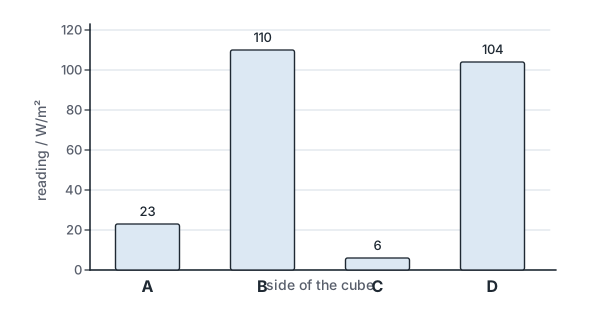
Write the number of the matching option.
- Dull aluminium
- Matt black
- Polished aluminium
- Matt white
- Side A (23 W/m²): ______
- Side B (110 W/m²): ______
- Side C (6 W/m²): ______
- Side D (104 W/m²): ______
Nudge (only if you are stuck): The higher the reading, the better the side emits. Painted matt sides emit far more than metal ones, and shiny metal emits least.
10. state
The Leslie cube is emptied and refilled with water at 90 °C instead of 60 °C. What happens to the radiation detector readings?
Circle one answer.
- Every side gives the same reading as before, because the surfaces have not changed.
- All four readings become equal, because the cube is hotter.
- Only the matt black side gives a higher reading.
- Every side gives a higher reading, and the order of the sides stays the same.
Nudge (only if you are stuck): How does the temperature of a surface affect how fast it emits infrared?
11. calculate
A radiator panel has a surface area of 0.80 m² and radiates 240 W. A second panel has the same paint and is at the same temperature, but its surface area is 1.60 m². The power radiated is proportional to the surface area. Calculate the power that the second panel radiates.
Power radiated by the second panel: ______________ unit ________
Nudge (only if you are stuck): The second panel has twice the surface area. What happens to the power?
12. explain / suggest
A satellite carries electronics that warm up as they work. The energy is carried to a metal panel on the outside of the satellite, on the side facing away from the Sun, which must get rid of it into space. (a) Explain why the panel can lose energy into space only by radiation. (b) Suggest the best finish for the outside of the panel, and explain your choice. (c) Supplement. Suggest two changes that would make the panel lose energy faster.
(a) Why only radiation
(b) The best finish
(c) Supplement: two changes
Nudge (only if you are stuck): Space has almost no particles. For (b), which finish is the best emitter? For (c), what does the rate of emission depend on?