Pupil sheet · Light and the electromagnetic spectrum
The electromagnetic spectrum at work — questions
Name ______________________ Date ____________
Try every question before you use a nudge. Write in full sentences where you are asked to explain.
1. identify
Which of these is the same for all electromagnetic waves travelling through a vacuum?
Circle one answer.
- Their wavelength
- Their colour
- Their speed
- Their frequency
Nudge (only if you are stuck): Radio waves and gamma rays are at opposite ends of the spectrum. What do they still share?
2. compare
An X-ray signal and a radio signal leave a distant star at the same moment and cross empty space to the Earth. Which arrives first?
Circle one answer.
- They arrive together.
- It depends on how strong each signal is.
- The X-rays arrive first.
- The radio signal arrives first.
Nudge (only if you are stuck): Are X-rays and radio waves both electromagnetic waves?
3. explain
A pupil writes: “X-rays pass right through the body, and light does not, so X-rays must travel faster than light.” Explain why the pupil is wrong, and state two ways in which X-rays do differ from visible light.
Why the pupil is wrong
Two ways X-rays differ from visible light
Nudge (only if you are stuck): What decides whether a wave passes through a material: its speed, or how the material absorbs it?
4. calculate
Supplement. A radio message is sent from the Earth to a lander on the Moon, 3.9 × 10⁸ m away. How long does it take to arrive?
Time: ______________ unit ________
Nudge (only if you are stuck): Time = distance ÷ speed. Use the speed of electromagnetic waves in a vacuum.
5. calculate / state
Supplement. A television satellite is 3.6 × 10⁷ m above a dish on the ground. Most of the path is through the vacuum of space, and the last part through air. (a) Calculate how long the signal takes to reach the dish. (b) State how the speed of the signal in air compares with its speed in a vacuum.
(a) Time: ______________ unit ________
(b) The speed in air
Nudge (only if you are stuck): Use 3.0 × 10⁸ m/s for the whole path. Is the air a big change for an electromagnetic wave?
6. state
Supplement. Which value is closest to the speed of light in air?
Circle one answer.
- 340 m/s
- 3.0 × 10⁸ m/s
- 2.0 × 10⁸ m/s, much slower than in a vacuum
- 3.0 × 10⁸ km/s
Nudge (only if you are stuck): In air the speed is approximately the same as in a vacuum.
7. identify
Match each use to the region of the electromagnetic spectrum it uses.
Write the number of the matching option.
- Infrared
- X-rays
- Radio waves
- Gamma rays
- Ultraviolet
- Microwaves
- Reading an RFID tag in a travel card: ______
- A mobile phone call: ______
- Thermal imaging: ______
- Detecting fake bank notes: ______
- An airport security scanner for bags: ______
- Sterilising sealed medical equipment: ______
Nudge (only if you are stuck): Think of what each job needs: reading a tag, a phone call, seeing warm bodies, making ink glow, seeing through bags, killing bacteria in a sealed packet.
8. identify
A TV remote control sends its signal to the television. Which region of the electromagnetic spectrum does it use?
Circle one answer.
- Ultraviolet
- Infrared
- Visible light
- Radio waves
Nudge (only if you are stuck): Point it at a phone camera and press a button: the camera sees a light that your eyes cannot.
9. state / explain
Identify the region of the electromagnetic spectrum used for each job, and give one reason why it suits the job. (a) Sending television programmes from a satellite to a dish on a house. (b) Killing the bacteria in drinking water. (c) Setting off an intruder alarm when a person walks into a dark room. (d) Taking a photograph.
(a) Satellite television
(b) Drinking water
(c) Intruder alarm
(d) Photograph
Nudge (only if you are stuck): Use the table in “Uses, region by region”. For (c), what does a warm body give out?
10. identify / explain
The diagram shows X-rays from an X-ray machine passing towards an arm and a detector behind it. Point P is behind the skin and muscle only, Q is behind the bone, and R is beside the arm. (a) At which point do the fewest X-rays arrive? (b) Explain why, and say how this makes the bone show on the picture.
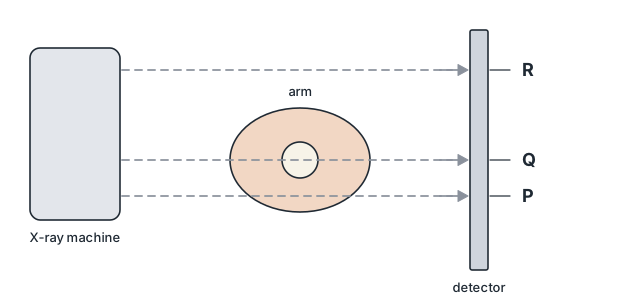
Circle one answer.
- R
- P
- Q
(b) Why, and how the bone shows
Nudge (only if you are stuck): Which part of the arm absorbs X-rays, and which lets them through?
11. identify
Match each region of the electromagnetic spectrum to the harm that too much of it can do to the body.
Write the number of the matching option.
- Damage to surface cells and eyes, leading to skin cancer and eye conditions
- Internal heating of body cells
- Mutation or damage to cells in the body
- Skin burns
- Microwaves: ______
- Infrared: ______
- Ultraviolet: ______
- X-rays and gamma rays: ______
Nudge (only if you are stuck): Two of them work on the outside of the body; two pass right into it.
12. explain
Why does a microwave oven have a metal mesh in its door, and why does it switch off as soon as the door is opened?
Circle one answer.
- To stop the microwaves giving the cook skin cancer
- To stop ultraviolet escaping from the lamp inside
- To keep the microwaves in, because they would heat the cook’s body cells internally
- To keep the heat of the food inside the oven
Nudge (only if you are stuck): What would too many microwaves do to the cook’s body?
13. describe / explain
A gardener works outside in strong sunshine all summer without a hat or sunscreen. (a) Identify the region of the Sun’s radiation that damages the surface cells of the skin. (b) Describe two harmful effects that too much of it can lead to over the years. (c) The gardener says: “The Sun only feels warm, so it cannot hurt me.” Explain why this is wrong. (d) Give two ways the gardener can protect themselves.
(a) The region
(b) Two harmful effects
(c) Why the gardener is wrong
(d) Two ways to protect
Nudge (only if you are stuck): For (c), which region do you feel as warmth, and which do you not feel at all?
14. explain
At a factory, packets of spices are sterilised with gamma rays inside a room with thick concrete walls. (a) Explain why gamma rays can sterilise the spices without the packets being opened. (b) Describe the harm that gamma rays can do to a worker’s body. (c) A worker says: “I would feel it if the gamma rays were leaking.” Explain why this is wrong.
(a) Why the packets stay sealed
(b) The harm to a worker
(c) Why the worker is wrong
Nudge (only if you are stuck): Gamma rays pass right through packaging. Can you feel gamma rays?
15. state / compare / calculate / describe
Jupiter gives out waves much longer than microwaves, and the large dish of a radio telescope on the Earth picks them up. (a) Identify the region of the electromagnetic spectrum the radio telescope picks up from Jupiter, and give one other use of it on the Earth. (b) Jupiter’s waves and the sunlight reflected by Jupiter cross the same stretch of empty space. Compare their speeds. (c) Supplement. Jupiter is 6.3 × 10¹¹ m from the Earth. Calculate how long its waves take to arrive. (d) Astronauts in space have no air above them to absorb the Sun’s ultraviolet and X-rays. Describe the harm that each could do to them.
(c) Supplement: Time for the waves to arrive: ______________ unit ________
(a) The region and another use, (b) the speeds and (d) the harm from ultraviolet and X-rays
Nudge (only if you are stuck): For (c), time = distance ÷ speed.