Pupil sheet · Light and the electromagnetic spectrum
Light split into colours — questions
Name ______________________ Date ____________
Try every question before you use a nudge. Write in full sentences where you are asked to explain.
1. identify
A narrow beam of white light passes through a glass prism. The diagram shows three of the coloured rays that leave it, A, B and C, landing on a screen. One is red, one is green and one is violet. Match each ray to its colour.
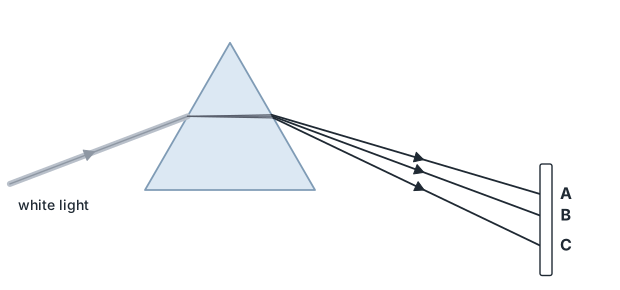
Write the number of the matching option.
- Violet
- Red
- Green
- Ray A: ______
- Ray B: ______
- Ray C: ______
Nudge (only if you are stuck): Which colour does a prism refract the least, and which the most?
2. complete
Complete the sentences. White light is a ____ (1) of colours. A glass prism refracts each colour by a different amount and spreads them apart; this is called ____ (2). The band of colours on the screen is the visible ____ (3). The colour that the prism refracts most is ____ (4).
Gap 1
Gap 2
Gap 3
Gap 4
Nudge (only if you are stuck): Each colour is bent by a different amount. Which colour is at the far end from red?
3. state
Put the seven colours of the visible spectrum in order, starting with the colour a prism refracts least.
Write the number of each step in order.
- Yellow
- Violet
- Orange
- Blue
- Indigo
- Red
- Green
- First: ______
- Second: ______
- Third: ______
- Fourth: ______
- Fifth: ______
- Sixth: ______
- Last: ______
Nudge (only if you are stuck): “Richard Of York Gave Battle In Vain.”
4. identify
Which statement compares red light and blue light correctly?
Circle one answer.
- Red light has the longer wavelength and the higher frequency.
- Red light has the longer wavelength and the lower frequency.
- Both have the same wavelength, but red light is faster in air.
- Red light has the shorter wavelength and the lower frequency.
Nudge (only if you are stuck): Red is at the end of the spectrum that is refracted least. Which way do the wavelength and the frequency change from red to violet?
5. state
Put these four colours in order of wavelength, longest first: blue, orange, violet, red.
Write the number of each step in order.
- Blue
- Violet
- Red
- Orange
- First: ______
- Second: ______
- Third: ______
- Last: ______
Nudge (only if you are stuck): The wavelength gets shorter from red to violet.
6. explain / describe
(a) Explain why a glass prism spreads a narrow beam of white light into a band of colours. (b) A pupil says that the glass of the prism colours the light. Describe what happens when one colour from the spectrum, say green, is sent through a second prism, and explain what this shows.
(a) Why the prism spreads white light
(b) Green light through a second prism
Nudge (only if you are stuck): For (a), think of what white light is made of, and of how much the glass refracts each colour. For (b), Newton tried this.
7. state
Supplement. What is meant by monochromatic light?
Circle one answer.
- Light of a single frequency
- Very bright light that does not spread out
- Light of one colour band, such as all the red light of the spectrum
- White light that has passed through a prism
Nudge (only if you are stuck): “Mono” means one. One what?
8. predict / explain
Supplement. A pupil aims a green laser pointer through a glass prism onto a white card. (a) Predict what the card shows. (b) Explain your prediction, using the word monochromatic. (c) A sodium street lamp gives deep yellow light. State whether a prism can spread it into a spectrum, and why.
(a) What the card shows
(b) Why
(c) The sodium lamp
Nudge (only if you are stuck): A prism can only separate frequencies that are in the light.
9. identify
The diagram shows the electromagnetic spectrum with three regions, P, Q and R, left blank, and an arrow S under it. Match each letter to what it stands for.
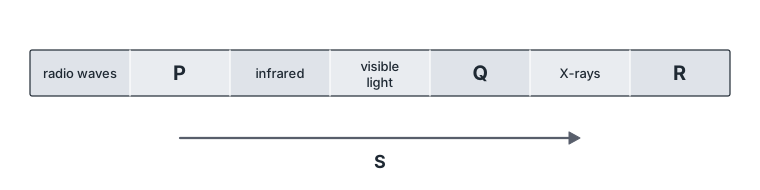
Write the number of the matching option.
- Gamma rays
- Microwaves
- The direction of increasing frequency
- Ultraviolet
- P: ______
- Q: ______
- R: ______
- Arrow S: ______
Nudge (only if you are stuck): Fill in the seven regions in order, starting from radio waves.
10. calculate / explain
A class repeats Herschel’s experiment. Four thermometers with blackened bulbs all start at 18.0 °C. After 8 minutes they read: in the green 18.9 °C, in the red 19.8 °C, just beyond the red, where the card looks dark, 20.6 °C, and in the shade beside the card (the control) 18.2 °C. (a) Find the rise of the thermometer just beyond the red. (b) Take away the rise of the control to find how much the radiation itself warmed that bulb. (c) Explain what the results show about the region just beyond the red.
(a) Rise just beyond the red: ______________ unit ________
(b) Rise caused by the radiation: ______________ unit ________
(c) What the results show
Nudge (only if you are stuck): Rise = final reading − starting reading. The control shows how much the room itself warmed.
11. state
Put the seven main regions of the electromagnetic spectrum in order of wavelength, shortest first.
Write the number of each step in order.
- Microwaves
- Gamma rays
- Visible light
- Radio waves
- Ultraviolet
- X-rays
- Infrared
- First: ______
- Second: ______
- Third: ______
- Fourth: ______
- Fifth: ______
- Sixth: ______
- Last: ______
Nudge (only if you are stuck): The shortest wavelength goes with the highest frequency.
12. explain
In the experiment, a strip of card painted with security-pen ink glowed pale blue just beyond the violet end of the spectrum, where the white card looked dark. (a) Identify the radiation that made it glow. (b) Explain why the white card looked dark there. (c) Compare this radiation with violet light: which has the higher frequency?
(a) The radiation
(b) Why the card looked dark
(c) Which has the higher frequency
Nudge (only if you are stuck): “Ultra” means beyond. Can your eyes detect every kind of electromagnetic wave?
13. identify
Which statement about infrared is correct?
Circle one answer.
- Infrared has a shorter wavelength and a higher frequency than red light.
- Infrared is red light that is too faint to see.
- Infrared lies between visible light and ultraviolet.
- Infrared has a longer wavelength and a lower frequency than red light.
Nudge (only if you are stuck): Where is infrared in the spectrum, compared with red light?
14. state / explain / describe
A lab has a filament lamp, a narrow slit, a glass prism and a white screen. The lamp’s white light makes a spectrum on the screen. Pointed at the screen, the camera of a phone also shows a faint glow just beyond the red end of the spectrum, where the screen looks dark. (a) Identify the process that spreads the white light into colours. (b) State which colour on the screen is nearest the straight-on direction of the beam, and which colour has the highest frequency. (c) Explain what the phone camera detects beyond the red, and name it. (d) Identify the region of the electromagnetic spectrum on the other side of infrared from visible light. (e) Supplement. The lamp is replaced by a sodium lamp. Describe what the screen shows, and explain why, using the word monochromatic.
(a) The process
(b) Nearest colour; highest frequency
(c) What the camera detects
(d) The next region
(e) Supplement: the sodium lamp
Nudge (only if you are stuck): For (b), which colour is refracted least? For (e), how many frequencies does the sodium lamp give?