Pupil sheet · Sound waves
Making sound — questions
Name ______________________ Date ____________
Try every question before you use a nudge. Write in full sentences where you are asked to explain.
1. identify / explain
A plucked guitar string keeps sounding after the finger leaves. Identify the vibrating source and explain how sound starts in the air.
Vibrating source
How it starts sound
Nudge (only if you are stuck): What keeps moving after the finger has left?
2. identify / explain
A loudspeaker lies on the floor facing straight up, so its sound travels up towards the ceiling. How does an air particle just above the cone vibrate while the sound passes? Choose one, then explain why this makes sound a longitudinal wave.
Circle one answer.
- Upwards only, all the way to the ceiling
- Left and right
- Up and down
Why longitudinal?
Nudge (only if you are stuck): First find the direction the sound travels in this room. Then ask: along that line, or across it?
3. identify / explain
Supplement. A sound wave passes through a model of the air. At one instant a pupil counts the particles in four boxes of equal size (table). Match J, K and L to compression or rarefaction. Explain your choice using the spacing of the particles and the pressure.
| Box | Particles counted in the box |
|---|---|
| Undisturbed air (no sound) | 20 |
| J | 12 |
| K | 31 |
| L | 14 |
Write the number of the matching option.
- Rarefaction
- Compression
- J: ______
- K: ______
- L: ______
Spacing and pressure
Nudge (only if you are stuck): Compare each count with the box of undisturbed air. More particles in the same space: are they closer together or farther apart?
4. state
State the approximate human audible range, including the unit at both ends.
Nudge (only if you are stuck): Give a lower limit and an upper limit. Check the upper one: have you written it in hertz, not kilohertz?
5. compare / explain
Three microphone traces U, V and W were recorded at the same microphone position, with the timebase and gain fixed. The table gives what each trace shows. Compare V with U for loudness, then W with U for pitch. Give the trace feature you used each time.
| Trace | Cycles in 10 ms | Height from centre line to peak / divisions |
|---|---|---|
| U | 5 | 2.2 |
| V | 5 | 1.1 |
| W | 3 | 2.2 |
V compared with U: loudness and the feature used
W compared with U: pitch and the feature used
Nudge (only if you are stuck): Which column changes from U to V? Which column changes from U to W?
6. identify
A bird’s call has a frequency of 4 kHz and a frog’s call has a frequency of 800 Hz. Both are strong enough to hear. Which statements are true? Choose all that apply.
Tick every correct statement.
- The 4 kHz call must be louder.
- Both calls lie within the approximate human audible range.
- The 800 Hz call has the higher pitch.
- The 4 kHz call has the higher pitch.
Nudge (only if you are stuck): Write 4 kHz in hertz first. Then compare each frequency with both limits of the audible range.
7. explain
A loudspeaker makes a steady note even though its cone looks still to the unaided eye. Explain how the cone can produce sound.
Nudge (only if you are stuck): Visible to the eye and moving are not the same thing.
8. select / explain
Which description fits sound travelling from a doorbell to you through still air? Choose one and explain.
Circle one answer.
- Local vibration perpendicular to sound travel
- Local vibration parallel to sound travel
- The same particles travel from bell to listener
Explain your choice
Nudge (only if you are stuck): Separate travel of the disturbance from movement of the particles.
9. identify / explain
Supplement. In a new snapshot, region X has fewer particles in the same volume than undisturbed air; region Y has more. Identify both regions, compare their pressure and explain whether X is a vacuum.
Region X
Region Y
Is X a vacuum? Explain.
Nudge (only if you are stuck): Use spacing and pressure, rather than whether a region is drawn high or low.
10. identify / explain
Sources vibrate at 15 Hz, 250 Hz and 22 000 Hz. Identify which frequency lies inside the approximate human audible range and explain what being inside the range does and does not tell you.
Frequency inside the range, with comparisons
What can you conclude about hearing it?
Nudge (only if you are stuck): Compare each value with both limits; also consider sound strength.
11. compare / explain
Use D, E and F at the same microphone position and fixed timebase and gain. (a) Which has lowest pitch? (b) Compare F with D for pitch and loudness, giving reasons.
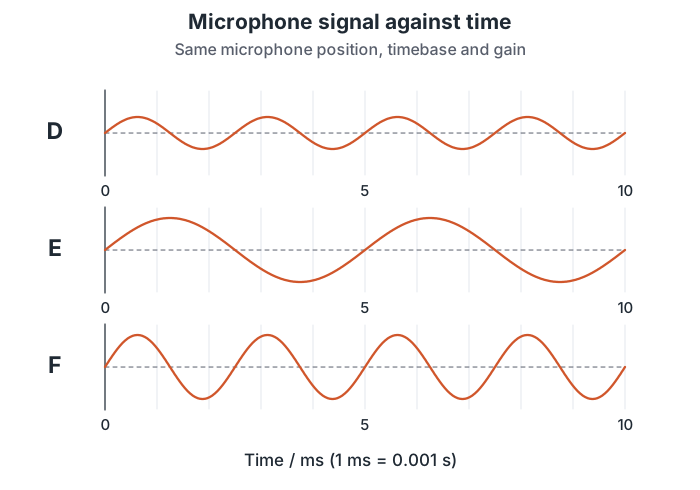
(a) Lowest pitch and reason
(b) F compared with D: pitch, loudness and reasons
Nudge (only if you are stuck): Use the cycle count and the displacement from the centre line separately.
12. explain
A pupil increases only the oscilloscope gain while the loudspeaker setting stays fixed. The trace becomes taller. Explain why this does not show that the sound became louder, and state what the horizontal axis represents.
Why the taller trace is insufficient
Meaning of the horizontal axis
Nudge (only if you are stuck): Is the changed control on the source or the display?
13. explain / describe / identify
An alarm’s thin metal plate vibrates towards and away from a listener. (a) Explain how it starts sound in air. (b) Describe the air vibration relative to wave travel. (c) Supplement: as the plate moves forward it crowds nearby particles; identify that region and compare it with the more spread-out region formed as it retreats.
(a) How the sound starts
(b) Air motion and wave type
(c) Supplement: the two air regions
Nudge (only if you are stuck): Follow source movement → nearby air → travelling disturbance.
14. suggest / explain
A designer wants an alert that is higher in pitch and quieter than a 400 Hz note, while still within the approximate human audible range. Suggest a frequency and an amplitude change, then describe both changes on a microphone trace at fixed position, timebase and gain.
Frequency and audible-range reason
Amplitude change
Two trace changes
Nudge (only if you are stuck): Choose a frequency between the limits; changing pitch does not set loudness.