Pupil sheet · Sound waves
Sound waves — final check
Name ______________________ Date ____________
Work alone, with the lesson closed. Answer every question; there are no hints.
1. identify / explain
A mosquito’s wings beat backwards and forwards about 500 times each second, and you hear a whine. (a) Which row is correct? (b) Supplement: explain why the air pressure at your ear rises and falls about 500 times each second.
| Row | What makes the whine | How an air particle between the mosquito and you moves | Type of wave |
|---|---|---|---|
| A | the wings push and pull the air | up and down, at right angles to the travel | transverse |
| B | air from the wings flows to your ear | along with the sound, all the way to you | longitudinal |
| C | the wings push and pull the air | backwards and forwards along the travel | longitudinal |
| D | the wings push and pull the air | backwards and forwards along the travel | transverse |
Circle one answer.
- A
- B
- C
- D
(b) Supplement: why the pressure at your ear rises and falls
2. compare / determine / state
Use traces L, M and N. The microphone position, timebase and gain are fixed. (a) Compare M with L for pitch and loudness, and N with L for pitch and loudness. Give trace evidence. (b) The traces cover 4 ms. Determine the frequency of the sound shown by M, in hertz. (c) State whether a person could hear the sound of M if it is strong enough, giving both limits of the approximate human audible range.
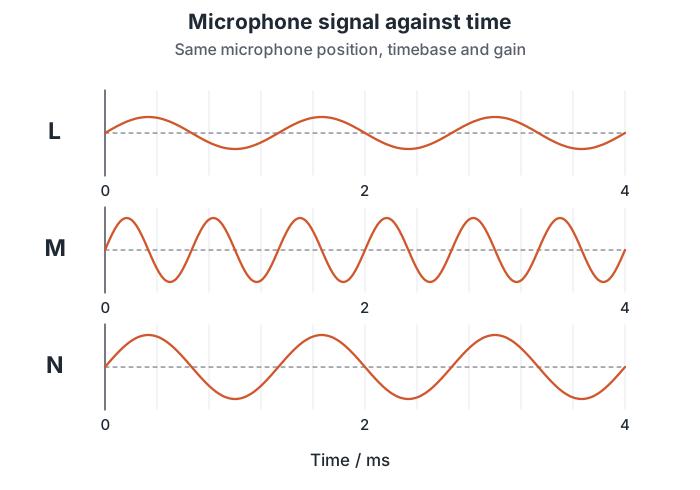
(a) Both comparisons, with evidence
(b) Frequency of M, with working
(c) Audible? Both limits
3. explain / suggest
A motor keeps a plate vibrating inside a sealed jar while air is pumped out. The plate’s stand is fixed to a thick steel base. The signal from a microphone held in the air outside the jar decreases. (a) Explain why a vibrating source is not enough to send sound across an ideal vacuum. (b) A second microphone pressed against the steel base still picks up a clear signal when almost all the air has gone. Suggest how the sound reaches it.
(a) Why vibration alone is not enough
(b) How the sound reaches the second microphone
4. calculate / state / explain
A friend 700 m away across a lake claps two boards together. A video shows the boards meeting 2.05 s before the clap is heard. (a) Calculate the speed of sound from these data. Give your answer to 3 significant figures. (b) State the approximate speed of sound in air and explain whether your value agrees with it.
(a) Speed of sound: ______________ unit ________
(b) Approximate speed in air; does your value agree?
5. state / identify / explain
Supplement. A data book gives the approximate speeds of sound in the table. (a) State the general rule that oxygen, glycerol and granite illustrate. (b) Identify the medium that would carry a sound across the same distance in the least time, and explain. (c) Cork is a solid, but sound is slower in cork than in glycerol. Explain whether this disproves the general rule.
| Medium | State | Approximate speed of sound / m/s |
|---|---|---|
| Glycerol | Liquid | 1900 |
| Cork | Solid | 500 |
| Oxygen | Gas | 330 |
| Granite | Solid | 6000 |
(a) General rule
(b) Least time and reason
(c) Does cork disprove the rule?