Pupil sheet · Reflection in mirrors
Images in a plane mirror — questions
Name ______________________ Date ____________
Try every question before you use a nudge. Write in full sentences where you are asked to explain.
1. deduce
A pupil stands an object pin at three distances in front of a plane mirror. Each time, they move a tall search pin behind the mirror until it and the image of the object pin stay lined up as they move their head from side to side. The table shows their results. Which conclusion do these results support?
| Distance of the object pin in front of the mirror (cm) | Distance of the search pin behind the mirror (cm) |
|---|---|
| 3.5 | 3.6 |
| 6.5 | 6.4 |
| 9.5 | 9.5 |
Circle one answer.
- The image is the same size as the object, at every distance from the mirror.
- The image is always a little nearer the mirror than the object is.
- The image is as far behind the mirror as the object is in front of it.
- The image is virtual, so it cannot be formed on a screen behind the mirror.
Nudge (only if you are stuck): Compare the two distances in each row. Which of the conclusions do these measurements actually test?
2. state / calculate
A vase stands 45 cm in front of a plane mirror. (a) State how far behind the mirror its image is. (b) Calculate the distance from the vase to its image.
(a) Distance of the image behind the mirror: ______________ unit ________
(b) Distance from the vase to its image: ______________ unit ________
Nudge (only if you are stuck): Where was the image of the arrow in the experiment, compared with the arrow itself?
3. explain
Why is the image in a plane mirror called virtual?
Circle one answer.
- It is fainter than the object, because the mirror absorbs some light.
- It lies on the surface of the mirror, so it has no distance behind it.
- Light only seems to come from it; no light reaches the place where it is.
- It looks smaller than the object, because it is further from the eye.
Nudge (only if you are stuck): Where does the light that reaches your eye really travel?
4. determine
Leila stands in front of a plane mirror. At first she is 5.6 m from her image. She walks straight towards the mirror until she is 3.4 m from her image. Determine how far she walked.
Distance Leila walked: ______________ unit ________
Nudge (only if you are stuck): How far from the mirror was she at the start, and at the end?
5. describe / explain
A lamp stands in front of a plane mirror on a wall. (a) Describe what happens to the light from the lamp that hits the mirror. (b) Explain why the lamp seems to be behind the mirror.
(a) The light at the mirror
(b) Why it seems to be behind
Nudge (only if you are stuck): Each ray obeys the law of reflection. What does your eye do with the rays that enter it?
6. predict / explain
A candle stands in front of a plane mirror. A pupil holds a sheet of white paper behind the mirror, exactly where the image of the flame is. What does the paper show? Explain your answer.
Circle one answer.
- Nothing: the paper stays blank in any light.
- A sharp picture of the flame, the same size.
- A dim picture, from light that leaks through.
- A picture of the flame, but only in a dark room.
Explain your answer
Nudge (only if you are stuck): Does any light from the candle reach the place behind the mirror?
7. identify
Supplement. The diagram shows a point object O in front of a plane mirror on squared paper. Which point is the image of O?
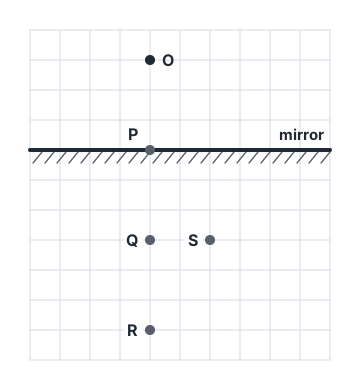
Circle one answer.
- Q
- R
- S
- P
Nudge (only if you are stuck): On which line through O, and how far behind the mirror, is the image?
8. describe
Supplement. Put the steps in order to locate the image of a point object O with two rays.
Write the number of each step in order.
- At each point where a ray meets the mirror, draw the normal.
- Extend the two reflected rays back behind the mirror with dashed lines.
- Draw two rays from O to the mirror.
- Mark the image where the dashed lines cross.
- Draw each reflected ray with its angle of reflection equal to its angle of incidence.
- Step 1: ______
- Step 2: ______
- Step 3: ______
- Step 4: ______
- Step 5: ______
Nudge (only if you are stuck): What must be on the page before you can measure an angle of incidence?
9. identify
A candle 14 cm tall stands 36 cm in front of a plane mirror. Which row describes its image?
| Row | Height of the image | Position of the image | Kind of image |
|---|---|---|---|
| A | less than 14 cm | 36 cm behind the mirror | virtual |
| B | 14 cm | 72 cm behind the mirror | virtual |
| C | 14 cm | 36 cm behind the mirror | virtual |
| D | 14 cm | 36 cm behind the mirror | real |
Circle one answer.
- A
- B
- C
- D
Nudge (only if you are stuck): Check each column on its own: the size, the position, and whether light really reaches the image.
10. calculate
Supplement. Seen from the side, the small red light of a smoke alarm on a shop ceiling is 1.1 m in front of a large plane mirror on a wall. A security camera is 2.4 m in front of the mirror and 0.90 m lower than the light. The camera sees the light in the mirror. Calculate how far below the height of the light the ray from the light to the camera hits the mirror. Give your answer to 2 significant figures.
Distance below the height of the light: ______________ unit ________
Nudge (only if you are stuck): Find the image of the light first. Which point does the ray seem to come from when it enters the camera?
11. calculate / explain
Supplement. In a periscope, the top mirror should be at 45° to the horizontal, but it has slipped to 42°. Light travelling horizontally hits it. (a) Calculate the angle of incidence. (b) Calculate the angle between the incident ray and the reflected ray. (c) Explain whether the reflected light still travels straight down the tube.
(a) Angle of incidence (°): ______________ unit ________
(b) Angle between the rays (°): ______________ unit ________
(c) Does the light still travel straight down the tube?
Nudge (only if you are stuck): The ray is at 42° to the surface of the mirror. For (c), find the angle of the reflected ray to the horizontal.
12. determine
Supplement. With a ruler, a protractor and a sharp pencil, draw a straight line across the page for a plane mirror and mark a point object O 5.5 cm in front of it. Draw two rays from O to the mirror, one hitting it 2.8 cm to the left of the normal through O and one 1.6 cm to the right. At each point, draw the normal, measure the angle of incidence and draw the reflected ray at the same angle on the other side of the normal. Extend both reflected rays back behind the mirror with dashed lines. Then determine, from your drawing, (a) the angle of incidence of the ray that hits the mirror 2.8 cm to the left, to the nearest degree, and (b) how far behind the mirror the dashed lines cross.
(a) Angle of incidence, measured (°): ______________ unit ________
(b) Distance behind the mirror where the lines cross: ______________ unit ________
Nudge (only if you are stuck): Measure every angle from the normal, not from the mirror. Long, thin lines make the crossing point easy to find.
13. calculate / describe
At an optician’s, a patient sits 2.7 m in front of a plane mirror on the wall and reads an eye chart in it. The chart hangs 0.6 m behind the patient’s head, facing the mirror. (a) Calculate the distance from the chart to the mirror. (b) Calculate the distance from the patient to the image of the chart. (c) Supplement. Describe how to draw, on a scale diagram, the ray from one letter on the chart that reaches the patient’s eye.
(a) The chart to the mirror
(b) The image to the patient
(c) Supplement: the ray to the eye
Nudge (only if you are stuck): Find the chart’s distance from the mirror first, then where its image is. For (c), where does the light entering the eye seem to come from?