Pupil sheet · Reflection in mirrors
The law of reflection — questions
Name ______________________ Date ____________
Try every question before you use a nudge. Write in full sentences where you are asked to explain.
1. identify
The diagram shows a ray of light reflecting at a plane mirror. Match each numbered line to what it is.
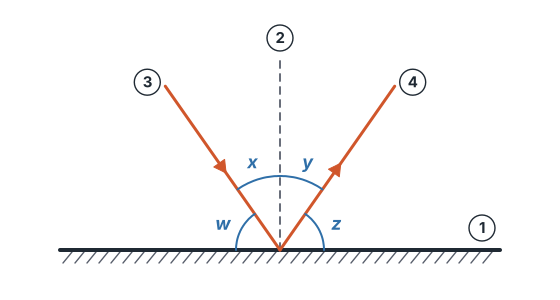
Write the number of the matching option.
- The incident ray
- The reflected ray
- The normal
- The mirror
- Line 1: ______
- Line 2: ______
- Line 3: ______
- Line 4: ______
Nudge (only if you are stuck): Which lines are not paths of light at all?
2. identify
The same diagram marks four angles, w, x, y and z. Which of them is the angle of incidence?
Circle one answer.
- y
- w
- z
- x
Nudge (only if you are stuck): Which two lines is the angle of incidence measured between?
3. define
Which statement defines the normal at a mirror?
Circle one answer.
- The path of the ray towards the mirror, up to the point where it hits it.
- A line along the mirror’s surface, through the point where the ray hits it.
- A line at 45° to the mirror’s surface, at the point where the ray hits it.
- A line at 90° to the mirror’s surface, at the point where the ray hits it.
Nudge (only if you are stuck): The normal is the line that both angles are measured from. How is it set to the mirror?
4. identify
The diagram shows a pupil’s drawing of a ray reflecting at a plane mirror, with a protractor laid on it. The centre of the protractor is on the point where the ray hits the mirror, and its straight edge lies along the mirror. Read the scale where each ray crosses it. Which row gives the angle of incidence and the angle of reflection?
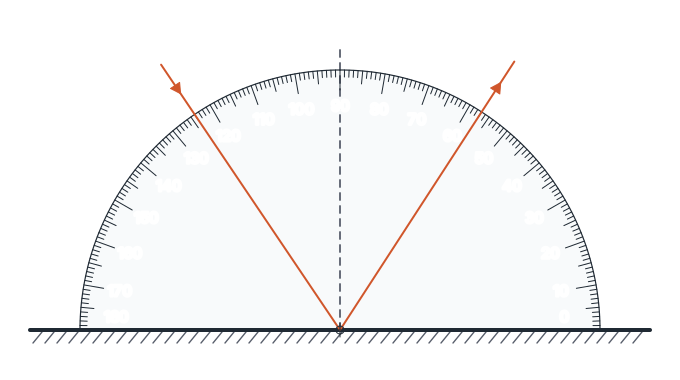
| Row | Angle of incidence | Angle of reflection |
|---|---|---|
| A | 124° | 57° |
| B | 56° | 57° |
| C | 34° | 33° |
| D | 34° | 57° |
Circle one answer.
- A
- B
- C
- D
Nudge (only if you are stuck): Which mark on the scale lies along the normal?
5. state
State the law of reflection by filling each gap. The angle of ____ (1) is ____ (2) to the angle of ____ (3). Both angles are measured from the ____ (4).
Gap 1
Gap 2
Gap 3
Gap 4
Nudge (only if you are stuck): Think of the two columns of the results table in the experiment.
6. state
A ray of sunlight reflects off a flat shop window, which acts as a plane mirror. The reflected ray leaves the glass at 28° to the normal. State the angle of incidence.
Angle of incidence (°): ______________ unit ________
Nudge (only if you are stuck): Which law links the two angles, and which line are both measured from?
7. predict
A ray of light hits a plane mirror at 90° to its surface. Which describes the reflected ray?
Circle one answer.
- It travels along the surface of the mirror.
- It goes back along the normal, the way it came.
- It spreads out in all directions from the mirror.
- It leaves at 45° to the normal, on the far side.
Nudge (only if you are stuck): Which line is at 90° to the surface where the ray hits it? What is the angle of incidence for a ray along that line?
8. identify / state / describe / suggest
A pupil aims a ray at a plane mirror at five angles and measures both angles with a protractor. Their results are in the table. (a) Identify the anomalous result, and state what the pupil should do with it. (b) Describe what the other results show. (c) In three of the other rows the two angles are not exactly equal. Suggest why.
| Angle of incidence (°) | Angle of reflection (°) |
|---|---|
| 12 | 13 |
| 32 | 31 |
| 42 | 48 |
| 52 | 53 |
| 72 | 72 |
(a) The anomalous result and what to do with it
(b) What the other results show
(c) Why not exactly equal
Nudge (only if you are stuck): Compare the two angles in each row. How accurately can a ray be marked and a protractor read?
9. calculate / describe
Supplement. Two plane mirrors meet at 90°, like the inside corner of a box. A ray of light hits the first mirror with an angle of incidence of 33°, reflects, and then hits the second mirror. (a) Calculate the angle of incidence at the second mirror. (b) Describe the direction of the ray that leaves the second mirror, compared with the ray that arrived at the first mirror.
(a) Angle of incidence at the second mirror (°): ______________ unit ________
(b) The direction of the ray that leaves the second mirror
Nudge (only if you are stuck): The second mirror is at 90° to the first. Which line of the first mirror does the second mirror’s normal run along?
10. calculate
Supplement. A ray of light hits a plane mirror with an angle of incidence of 38°. Calculate the angle between the incident ray and the reflected ray.
Angle between the rays (°): ______________ unit ________
Nudge (only if you are stuck): Which two angles, one on each side of the normal, make up the angle between the rays?
11. calculate
Supplement. A ray box is fixed to the bench. Its ray hits a plane mirror with an angle of incidence of 15°. The mirror is then turned slowly in one direction, so that the angle of incidence rises steadily from 15° to 27°. The ray box does not move. Calculate (a) the angle through which the mirror has turned and (b) the angle through which the reflected ray has turned.
(a) Angle through which the mirror turned (°): ______________ unit ________
(b) Angle through which the reflected ray turned (°): ______________ unit ________
Nudge (only if you are stuck): The normal is fixed to the mirror. For (b), how far apart are the incident and reflected rays before the turn, and after it?
12. describe
A pupil has no ray box, so they test the law of reflection for one ray with a plane mirror, paper, four pins, a ruler and a protractor. Put the steps in order.
Write the number of each step in order.
- Looking into the mirror, stick two more pins exactly in line with the images of the first two.
- Draw a line for the mirror and a normal at 90° to it, and stand the mirror on the line.
- Draw a line to the point where the normal meets the mirror, and stick two pins on it, well apart.
- Compare the angle of reflection with the angle of incidence.
- Remove the mirror and draw a line through the last two pins, back to the mirror line.
- Measure the angles of incidence and reflection from the normal with a protractor.
- Step 1: ______
- Step 2: ______
- Step 3: ______
- Step 4: ______
- Step 5: ______
- Step 6: ______
Nudge (only if you are stuck): Which pins mark the ray going towards the mirror, and which mark the ray coming away from it?
13. state / calculate
A dance studio has a large flat mirror on one wall. The wall is vertical. (a) State the direction of the normal to the mirror. (b) A ray of light from a spotlight hits the mirror with an angle of incidence of 47° and reflects into a dancer’s eye. State the angle of reflection. (c) Supplement. A ray from a second spotlight also reflects into the dancer’s eye. Its incident ray and reflected ray are at 136° to each other. Calculate the angle of incidence of this ray at the mirror.
(a) The direction of the normal
(b) The angle of reflection
(c) Supplement: the angle of incidence of the second ray
Nudge (only if you are stuck): A mirror on a wall works like any plane mirror. For (c), which two angles make up the angle between the rays?