Pupil sheet · Pressure
Pressure in liquids — questions
Name ______________________ Date ____________
Try every question before you use a nudge. Write in full sentences where you are asked to explain.
1. identify
The densities of three liquids are: olive oil 920 kg/m³, water 1000 kg/m³ and glycerol 1260 kg/m³. Each row of the table describes two points, P and Q, in liquids at rest. Which row correctly shows where the pressure of the liquid is greater?
| Row | Point P | Point Q | The pressure is greater at |
|---|---|---|---|
| A | 0.50 m below the surface of glycerol | 0.50 m below the surface of water | neither: it is the same |
| B | 0.35 m below the surface of water | 0.35 m below the surface of olive oil, in a much wider tank | Q |
| C | 0.55 m below the surface of olive oil | 0.70 m below the surface of glycerol | Q |
| D | 0.25 m above the bottom of a tank of water 1.2 m deep | 0.25 m above the bottom of a tank of water 0.50 m deep | neither: it is the same |
Circle one answer.
- A
- B
- C
- D
Nudge (only if you are stuck): For each row, compare the depths of P and Q below the surface first, then the densities of their liquids.
2. deduce
Two identical jars are filled to the same level, one with liquid X and one with liquid Y. A pressure sensor on the bottom of the jar of X reads more than the same sensor on the bottom of the jar of Y. Which statement explains this?
Circle one answer.
- The air above jar X presses harder.
- Liquid X is denser than liquid Y.
- Liquid X flows more easily than liquid Y.
- Liquid X is less dense than liquid Y.
Nudge (only if you are stuck): The two liquids are at the same depth. What else can make the pressure at the bottom different?
3. describe
A pressure sensor is held under the water in a large tank. Match each change to what happens to its reading.
Write the number of the matching option.
- The reading stays the same.
- The reading decreases.
- The reading increases.
- Pouring more water into the tank, without moving the sensor: ______
- Raising the sensor nearer to the surface: ______
- Sliding the sensor towards a wall of the tank, at the same depth: ______
- Turning the sensor to face upwards, at the same depth: ______
Nudge (only if you are stuck): Only two things set the pressure at a point in a liquid. For each change, ask whether either of them changed.
4. compare
Put these four points in order of the pressure of the liquid, smallest first. The densities are: ethanol 790 kg/m³, water 1000 kg/m³ and sugar solution 1150 kg/m³.
Write the number of each step in order.
- 0.65 m below the surface of water
- 0.12 m below the surface of ethanol
- 0.65 m below the surface of sugar solution
- 0.12 m below the surface of water
- First: ______
- Second: ______
- Third: ______
- Last: ______
Nudge (only if you are stuck): Compare the points two at a time: the same liquid at two depths, or two liquids at the same depth.
5. explain / state / predict
A glass-bottom boat has a flat window in its floor, 0.70 m below the surface of the sea. It also has a round window in its side, with its centre 0.70 m below the surface. (a) Explain why the water pushes upwards on the window in the floor. (b) State how the pressure of the water at the centre of the side window compares with the pressure on the floor window. (c) The boat sails out of a small harbour into the open sea. The water is the same, and the windows stay at the same depth. Predict what happens to the pressure on the floor window.
(a) Why the water pushes up
(b) Side window and floor window
(c) Out in the open sea
Nudge (only if you are stuck): Think about what sets the pressure at a point in a liquid, and what does not.
6. calculate
The water in a well is 4.5 m deep. The density of the water is 1000 kg/m³. Take g = 9.8 N/kg. Calculate the pressure of the water at the bottom of the well, not counting the pressure of the air.
Pressure of the water: ______________ unit ________
Nudge (only if you are stuck): Use ∆p = ρg∆h, with ∆h measured down from the surface of the water.
7. calculate
A small research submarine dives from 16 m to 43 m below the surface of a freshwater lake. The density of the water is 1000 kg/m³. Take g = 9.8 N/kg. Calculate the increase in the pressure of the water on the submarine. Give your answer to 3 significant figures.
Increase in pressure: ______________ unit ________
Nudge (only if you are stuck): The increase in pressure depends on how far the submarine goes down, not on where it ends up.
8. calculate
A pressure sensor sits on the bottom of a storage tank of diesel oil of density 840 kg/m³. It reads 20 580 Pa more than the pressure of the air. Take g = 9.8 N/kg. Calculate the depth of the diesel in the tank.
Depth: ______________ unit ________
Nudge (only if you are stuck): You know ∆p and ρ, and you want ∆h. Rearrange ∆p = ρg∆h.
9. determine
The graph shows the pressure below the surface of a liquid X, not counting the pressure of the air, at four depths. Take g = 9.8 N/kg. Use the graph to determine the density of liquid X. Give your answer to 2 significant figures.
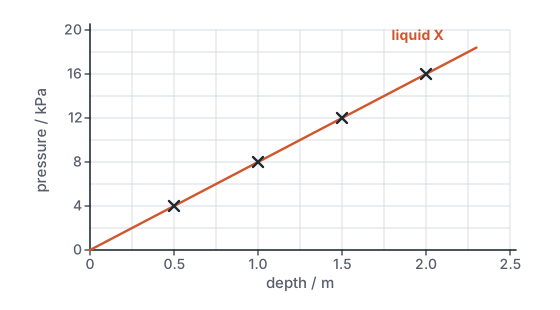
Density of X: ______________ unit ________
Nudge (only if you are stuck): Choose one point on the line. Which unit must the pressure be in before you use ∆p = ρg∆h?
10. identify
A camera hangs on a cable in a lake that is 20 m deep. It is raised from 9.0 m to 4.0 m below the surface. Which value of ∆h should you use in ∆p = ρg∆h to find how much the pressure on the camera falls?
Circle one answer.
- 5.0 m
- 9.0 m
- 11 m
- 13 m
Nudge (only if you are stuck): Mark both depths on a sketch of the lake, each measured down from the surface.
11. determine
Each row of the table gives a point below the surface of a liquid at rest. Determine at which point the pressure of the liquid, not counting the pressure of the air, is greatest.
| Row | Liquid | Density / kg/m³ | Depth below the surface / m |
|---|---|---|---|
| A | petrol | 740 | 2.4 |
| B | honey | 1420 | 1.2 |
| C | water | 1000 | 1.9 |
| D | milk | 1035 | 1.7 |
Circle one answer.
- A
- B
- C
- D
Nudge (only if you are stuck): ∆p = ρg∆h, and g is the same in every row. Which product of two quantities do you need to compare?
12. explain / calculate
A town gets its water from a tank on top of a tall tower. The water surface in the tank is 30 m above a block of flats’ ground floor, and pipes full of water carry it down. No tap is running. The density of water is 1000 kg/m³. (a) Explain why the water pressure at a tap on the ground floor is greater than at a tap on the top floor. (b) Supplement. Take g = 9.8 N/kg. Calculate the pressure of the water, not counting the pressure of the air, at the ground-floor tap, 30 m below the water surface. (c) Supplement. The top-floor tap is 24 m below the water surface. Calculate the difference in pressure between the two taps.
(a) Why greater on the ground floor
(b) Supplement: pressure at the ground-floor tap
(c) Supplement: difference between the taps
Nudge (only if you are stuck): Measure every depth down from the water surface in the tank, not up from the ground.