Pupil sheet · Pressure
Force and area — questions
Name ______________________ Date ____________
Try every question before you use a nudge. Write in full sentences where you are asked to explain.
1. define
Which of these is the definition of pressure?
Circle one answer.
- force per unit volume
- mass per unit area
- force per unit area
- force × area
Nudge (only if you are stuck): A pressure is made by a force pushing on a surface. Which options use both of these?
2. calculate
A force of 50 N pushes evenly on an area of 2.0 m². Calculate the pressure.
Pressure: ______________ unit ________
Nudge (only if you are stuck): Use p = F / A. Which number is the force and which is the area?
3. identify
Match each area in square centimetres to the same area in square metres.
Write the number of the matching option.
- 0.0035 m²
- 2.0 m²
- 7.5 m²
- 0.075 m²
- 0.0002 m²
- 20 000 cm²: ______
- 750 cm²: ______
- 35 cm²: ______
- 2 cm²: ______
Nudge (only if you are stuck): A square metre is 100 cm long and 100 cm wide. How many square centimetres fit inside it?
4. deduce
A filing cabinet stands on four small feet on a carpet. It is filled with papers, which makes its weight twice as large. At the same time, its feet are changed for feet with three times the area. How does the pressure under each foot compare with the pressure before?
Circle one answer.
- six times as large
- two-thirds as large
- 1.5 times as large
- the same as before
Nudge (only if you are stuck): Pressure = force ÷ area. How many times larger is the force now, and how many times larger is the area?
5. calculate
A toolbox of weight 30 N stands on a shelf. Its base is 15 cm long and 8.0 cm wide. Calculate the pressure on the shelf in pascals.
Pressure: ______________ unit ________
Nudge (only if you are stuck): Find the area in cm² first. Change it into m² before you use p = F / A.
6. calculate
An elephant stands still on four feet. Each foot touches the ground over 0.10 m², and the pressure under each foot is 125 000 Pa. Calculate the weight of the elephant.
Weight: ______________ unit ________
Nudge (only if you are stuck): You know the pressure and the area, and you want the force. Rearrange p = F / A.
7. calculate
A sports shop has a pressure mat that measures how hard a foot presses on it. A runner of weight 720 N stands on the mat on one foot. The mat shows an average pressure of 40 000 Pa. Calculate the area of the sole that touches the mat.
Area: ______________ unit ________
Nudge (only if you are stuck): You know the force and the pressure, and you want the area. Rearrange p = F / A.
8. explain
A person walks across a soft vinyl floor, first in flat shoes and then in shoes with narrow, pointed heels. The heels leave small dents, but the flat shoes do not. Which statement explains why?
Circle one answer.
- A harder material touches the floor, so the pressure is larger.
- A larger force acts on the floor, so the pressure is larger.
- The same force acts on a smaller area, so the pressure is larger.
- The same force acts on a smaller area, so the pressure is smaller.
Nudge (only if you are stuck): Is the person heavier in the heels? If not, what is different?
9. identify
Each of these is designed to make a pressure either large or small. Match each one to the statement that explains its design.
Write the number of the matching option.
- A small area makes the pressure large.
- The area does not change the pressure.
- A large area makes the pressure small.
- The skis of a cross-country skier: ______
- The caterpillar tracks of a bulldozer: ______
- The blade of an ice skate: ______
- The tip of a metal tent peg: ______
- A wooden board laid across soft mud: ______
Nudge (only if you are stuck): For each one, ask what it must do: stay on top of a soft surface, or cut or grip into a surface.
10. calculate / state
A pupil holds a pencil between her thumb and her finger and squeezes it. The flat end of the pencil touches her thumb over 32 mm². The sharp point touches her finger over 0.40 mm². The pencil does not move, so it pushes on her thumb and on her finger with the same force. (a) Calculate how many times larger the pressure on her finger is than the pressure on her thumb. (b) She squeezes twice as hard. State how the pressure on her finger changes.
(a) How many times larger
(b) Squeezing twice as hard
Nudge (only if you are stuck): The force is the same at both ends. Which end has the smaller area, and how many times smaller is it?
11. compare
Some vehicles drive onto soft sand. Put them in order of the pressure their tyres put on the sand, smallest first.
Write the number of each step in order.
- A car of weight 10 000 N on the same wide sand tyres, 0.25 m² in all
- A beach buggy of weight 5000 N on wide sand tyres, 0.25 m² in all
- A motorbike of weight 3000 N on its two tyres, 0.015 m² in all
- The same car on its ordinary tyres, 0.080 m² in all
- First: ______
- Second: ______
- Third: ______
- Last: ______
Nudge (only if you are stuck): Work out force ÷ area for each vehicle before you put them in order.
12. determine
The diagram shows a wooden block of weight 45 N. It can stand on any of its faces. Determine the greatest pressure that it can put on a table.
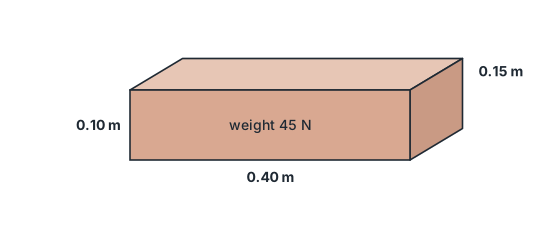
Greatest pressure: ______________ unit ________
Nudge (only if you are stuck): Which face gives the greatest pressure? Work out its area first.
13. calculate / deduce / explain
A person of weight 650 N walks onto a frozen pond. The ice cracks under a pressure of more than 10 000 Pa. (a) Calculate the smallest area that the person’s weight must be spread over so that the ice does not crack. (b) Standing, the soles of their shoes touch the ice over 0.040 m². Use your answer to (a) to deduce whether the ice will hold them. (c) Rescuers tell the person to lie down flat. Explain why lying flat is safer, even though their weight has not changed.
(a) Smallest safe area
(b) Will the ice hold?
(c) Why lying flat is safer
Nudge (only if you are stuck): For (a), you know the force and the largest safe pressure. For (b), compare the area of the soles with your answer to (a).