Pupil sheet · Moments and balance
Centre of gravity — questions
Name ______________________ Date ____________
Try every question before you use a nudge. Write in full sentences where you are asked to explain.
1. state
What is meant by the centre of gravity of an object?
Circle one answer.
- the middle of the object, whatever its shape
- the point through which the whole weight of the object seems to act
- the point where the object is heaviest
- the lowest point of the object
Nudge (only if you are stuck): Look for the words in bold in “One point for the whole weight”.
2. calculate
A uniform metre rule balances on a pivot at its 40 cm mark when a 0.60 N weight hangs at its 10 cm mark. Calculate the weight of the rule.
Weight of the rule: ______________ unit ________
Nudge (only if you are stuck): The rule’s weight acts at its centre of gravity, the 50 cm mark. How far is that from the pivot?
3. describe
Put the steps in order to find the centre of gravity of an irregular plane lamina, a flat piece of card.
Write the number of each step in order.
- Draw a pencil line on the card along the thread
- Make three small holes near the edge of the card, well apart
- Mark where the two lines cross, and check that a line from the third hole passes through it
- Hang a plumb line from the same pin and wait until the card and the thread are still
- Hang the card from the second hole and draw a second line in the same way
- Hang the card from a pin through one hole, so that it can swing freely
- Step 1: ______
- Step 2: ______
- Step 3: ______
- Step 4: ______
- Step 5: ______
- Step 6: ______
Nudge (only if you are stuck): Where does the card’s centre of gravity end up when it hangs still from a pin?
4. identify
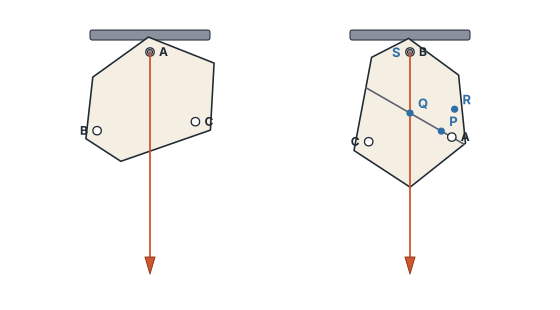
A card was hung from hole A and then from hole B, and a line was drawn along the plumb line each time. Which point is the centre of gravity of the card?
Circle one answer.
- P
- Q
- R
- S
Nudge (only if you are stuck): The centre of gravity is on the first line and on the second line.
5. state
Complete the sentences. The centre of gravity is the point through which the whole ____ (1) of an object seems to act. When an object is tipped, it topples if the vertical line from its centre of gravity passes ____ (2) its base. An object is more stable when its centre of gravity is ____ (3) and its base is ____ (4).
Gap 1
Gap 2
Gap 3
Gap 4
Nudge (only if you are stuck): Reread the last paragraphs of “Stability”.
6. identify / explain
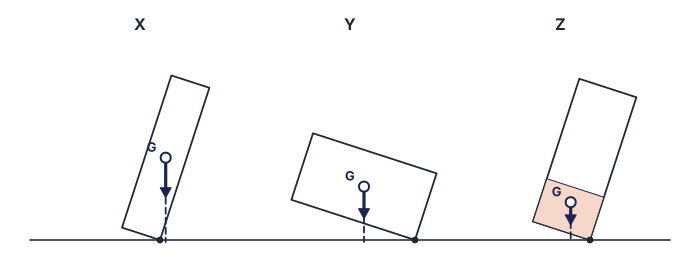
The three objects in the diagram are each tipped by the same small angle and let go. Which one topples?
Circle one answer.
- X
- Y
- Z
Nudge (only if you are stuck): For each object, does the dashed line from G fall inside or outside the edge it is resting on?
7. explain
A card hung from a pin swings for a while and then stops with its centre of gravity straight below the pin. Explain why it always stops in this position.
Nudge (only if you are stuck): If the centre of gravity were to one side of the pin, would the weight have a moment about the pin?
8. explain / describe
In the experiment to find the centre of gravity of a plane lamina: (a) Explain why you wait until the card and the plumb line are completely still before marking the line. (b) Explain why the holes should be far apart. (c) Describe how you check your result.
(a) Why wait
(b) Why holes far apart
(c) Checking the result
Nudge (only if you are stuck): Think about what makes a line land in the wrong place, and what happens when two lines are nearly parallel.
9. explain
A bus tips over more easily on a tilting platform when its top deck is full of passengers than when it is empty. Explain why.
Nudge (only if you are stuck): Where is the centre of gravity of the bus when the top deck is full?
10. identify
A table lamp keeps getting knocked over. Which changes would make it more stable? Choose all that would.
Tick every correct statement.
- make the base heavier
- make the base wider
- make the stem taller
- fit a heavier shade at the top
- put sand in the bottom of the base
- make the base narrower
Nudge (only if you are stuck): Each change: does it lower the centre of gravity, or widen the base?
11. calculate
A uniform metre rule of weight 1.5 N rests on a pivot at its 30 cm mark. (a) Where must a 2.0 N weight hang, on the short side, to balance the rule? Give its distance from the pivot. (b) Calculate the upward force of the pivot on the balanced rule.
(a) Distance of the 2.0 N weight from the pivot: ______________ unit ________
(b) Upward force of the pivot: ______________ unit ________
Nudge (only if you are stuck): The rule’s weight acts at the 50 cm mark. Take moments about the pivot, then add up the downward forces.
12. explain / suggest / describe
A walker carries a heavy rucksack high on her back. (a) Explain why she must lean forward to stay upright. (b) On a moving train, a passenger standing in the aisle stands with her feet wide apart. Explain why this helps her not to fall over. (c) Suggest one way to pack the rucksack so that the walker is more stable. (d) A workshop has cut a flat steel plate of uneven shape, with three small holes far apart near its edge. A crane can lift it by a hook through any of the holes. Describe how the workers can find the plate’s centre of gravity with the crane, a plumb line and chalk, and how they can check it.
(a) Leaning forward
(b) Feet apart
(c) Packing the rucksack
(d) The steel plate
Nudge (only if you are stuck): Her base is the area under and between her feet. Where is the centre of gravity of her body and the rucksack together? For (d), think of the card on the pin.