Pupil sheet · Moments and balance
Turning forces — questions
Name ______________________ Date ____________
Try every question before you use a nudge. Write in full sentences where you are asked to explain.
1. identify
Match each word to its meaning.
Write the number of the matching option.
- the fixed point that an object turns about
- the turning effect of a force
- the shortest distance from the pivot to the line of action of the force
- no resultant force and no resultant moment
- no forces act at all
- Pivot: ______
- Moment: ______
- Perpendicular distance: ______
- Equilibrium: ______
Nudge (only if you are stuck): Look for the words in bold in “The turning effect of a force”, “Moment = force × perpendicular distance” and “Equilibrium”.
2. identify
Which of these everyday actions use the turning effect of a force? Choose all that do.
Tick every correct statement.
- opening a door by pushing on it near the handle
- turning a tap on
- lifting the handles of a wheelbarrow full of soil
- pulling a sledge along flat snow in a straight line
- pushing down on a bicycle pedal
- a book lying still on a table
Nudge (only if you are stuck): In each one, is something turning about a fixed point?
3. identify / explain
Four pushes of the same size act on a door, one at a time. Which push has the biggest moment about the hinge?
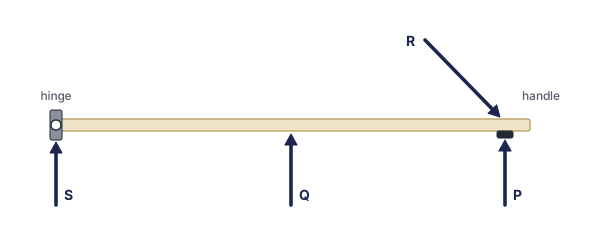
Circle one answer.
- P
- Q
- R
- S
Nudge (only if you are stuck): Which push has the longest perpendicular distance from the hinge to its line of action?
4. calculate
A mechanic pushes with a force of 30 N at right angles to a spanner, 20 cm from the centre of the nut. Calculate the moment of the force about the nut.
Moment: ______________ unit ________
Nudge (only if you are stuck): Change 20 cm to metres first. Then moment = force × perpendicular distance.
5. complete
Complete the sentences. The moment of a force is a measure of its ____ (1) effect. Moment = force × ____ (2) distance from the pivot, and a moment is measured in ____ (3). When a beam balances, the clockwise moment about the pivot equals the ____ (4) moment. An object with no resultant force and no resultant ____ (5) on it is in ____ (6).
Gap 1
Gap 2
Gap 3
Gap 4
Gap 5
Gap 6
Nudge (only if you are stuck): Most of the gaps are words printed in bold in the reading.
6. calculate
The plank in the diagram is balanced. Calculate the weight W.
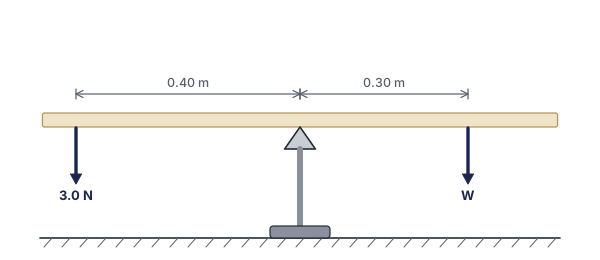
Weight W: ______________ unit ________
Nudge (only if you are stuck): Work out the anticlockwise moment of the 3.0 N weight. W × 0.30 m must equal it.
7. calculate
On a seesaw, a child of weight 450 N sits 1.2 m from the pivot. Her friend weighs 360 N and sits on the other side. How far from the pivot must the friend sit for the seesaw to balance?
Distance from the pivot: ______________ unit ________
Nudge (only if you are stuck): Work out the first child’s moment, then divide it by the friend’s weight.
8. explain
Ayesha says: “A longer spanner undoes a tight nut more easily because the nut feels a bigger force.” Explain what is wrong with her idea and why a longer spanner really helps.
Nudge (only if you are stuck): What changes with a longer handle: the force, or the distance from the nut?
9. identify
A beam rests on a pivot and is in equilibrium. Which statement must be true?
Circle one answer.
- No forces act on the beam.
- The resultant force is zero, but there may be a resultant moment.
- The resultant force is zero and the resultant moment is zero.
- The resultant moment is zero, but there may be a resultant force.
Nudge (only if you are stuck): Equilibrium has two conditions. Which choice has both?
10. state / explain
A driver turns a steering wheel. One hand pushes up on the left of the rim with a force of 20 N, and the other hand pulls down on the right of the rim with a force of 20 N. (a) Is there a resultant force on the wheel? (b) Is there a resultant moment on the wheel? (c) Is the wheel in equilibrium? Explain your answer.
(a) Resultant force
(b) Resultant moment
(c) Equilibrium?
Nudge (only if you are stuck): Draw the two forces on the rim. Do they turn the wheel the same way or opposite ways?
11. calculate
A uniform plank of weight 50 N rests on a pivot at its middle. A child of weight 200 N sits 1.5 m to the left of the pivot, and a child of weight 300 N sits on the right so that the plank balances level. (a) How far from the pivot is the 300 N child? (b) What is the upward force of the pivot on the plank?
(a) Distance of the 300 N child from the pivot: ______________ unit ________
(b) Upward force of the pivot: ______________ unit ________
Nudge (only if you are stuck): For (a), compare the two children’s moments. For (b), add up everything the pivot holds up.
12. calculate
Supplement. The plank in the diagram balances. Calculate the weight F.
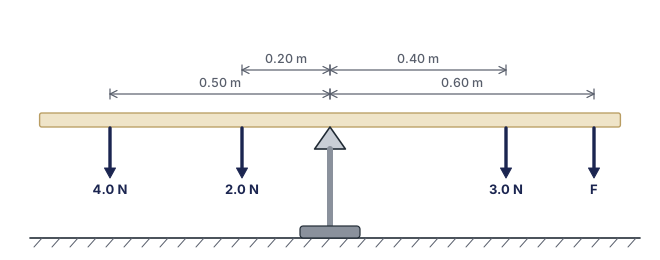
Weight F: ______________ unit ________
Nudge (only if you are stuck): Add the moments on each side; F’s moment is the part the right side is still missing.
13. calculate
Supplement. Two children sit on the left of a seesaw: one of weight 400 N sits 1.2 m from the pivot, and one of weight 300 N sits 0.60 m from the pivot. An adult of weight 600 N sits on the right. How far from the pivot must the adult sit for the seesaw to balance?
Distance of the adult from the pivot: ______________ unit ________
Nudge (only if you are stuck): Work out each child’s moment on its own, then add them.
14. describe
Supplement. A pupil wants to show that a balanced metre rule has no resultant moment on it. Put her steps in the right order.
Write the number of each step in order.
- Measure the distance from the pivot to each thread
- Repeat with other masses and other positions
- Balance the rule on its own on the pivot
- Work out each weight × distance, and add up the clockwise and the anticlockwise moments
- Slide one loop until the rule rests level
- Hang masses from loops of thread on both sides of the pivot
- Step 1: ______
- Step 2: ______
- Step 3: ______
- Step 4: ______
- Step 5: ______
- Step 6: ______
Nudge (only if you are stuck): What must be true of the rule before any masses go on it? When can you measure the distances?
15. explain / state
Supplement. In the experiment with the metre rule: (a) Explain why the rule is balanced on its own on the pivot before any masses are hung on it. (b) Explain why the rule must be level when the distances are measured. (c) State the result that shows there is no resultant moment on the balanced rule.
(a) Balancing the rule first
(b) Why level
(c) The result
Nudge (only if you are stuck): Think about where the rule’s weight acts, and about the angle between the rule and the weights.
16. state / calculate / describe
A market trader weighs a sack of rice with a steelyard: a long steel bar that hangs from a hook. The sack hangs from the bar 0.05 m to the left of the hook. A 20 N weight, the slider, hangs from the bar on the right and can slide along it. The bar is made so that its own weight, 15 N, acts at the hook. With the slider 0.60 m to the right of the hook, the bar hangs level. (a) State which way the sack and the slider each turn the bar about the hook. (b) Calculate the weight of the sack. (c) The bar hangs still. Calculate the upward force of the hook on the bar. (d) Supplement. The trader also hangs a 30 N bag of beans on the bar, 0.10 m to the left of the hook. How far from the hook must the slider be now for the bar to hang level? (e) Supplement. At home you have a 30 cm ruler, a pencil and a pile of identical coins. Describe how you could use them to show that there is no resultant moment on a balanced object.
(a) Which way each weight turns the bar
(b) Weight of the sack
(c) Upward force of the hook
(d) Supplement: where the slider goes now
(e) Supplement: the experiment with coins
Nudge (only if you are stuck): Sketch the bar first: the hook at the top, the sack on the left, the slider on the right. The hook is the pivot. Which moments must balance about it? Then, for (c), which forces must balance?